## Mathematical Equations and Textual Explanation
### Overview
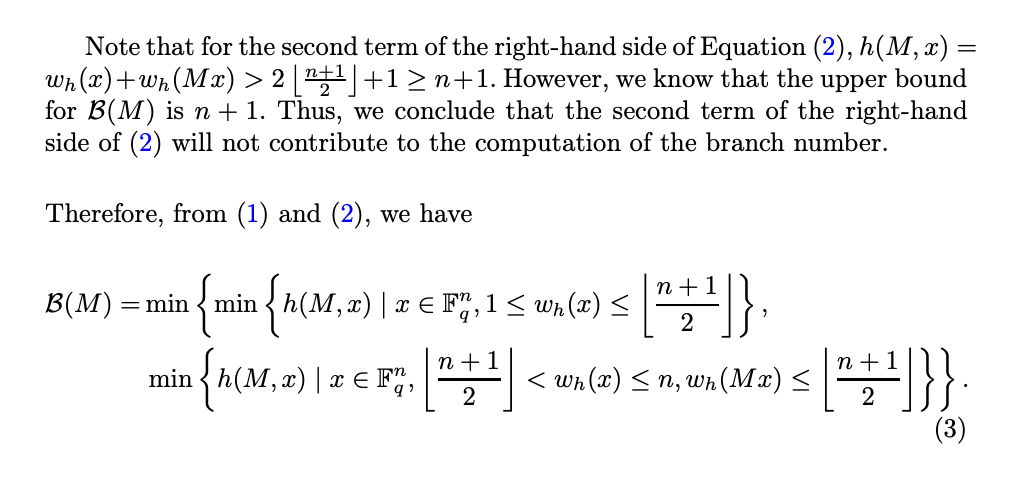
The image presents a block of text containing mathematical equations and explanations related to the computation of a branch number. It includes inequalities, definitions, and a final equation labeled (3) that defines B(M) as a minimum of minimums based on conditions involving h(M, x), w_h(x), and the floor function of (n+1)/2.
### Components/Axes
* **Variables:** B(M), h(M, x), w_h(x), n, x, M, F_q^n
* **Operators:** >, ≥, ≤, min, ∈
* **Equations:**
* h(M, x) = w_h(x) + w_h(Mx) > 2 * floor((n+1)/2) + 1 ≥ n+1
* B(M) = min { min { h(M, x) | x ∈ F_q^n, 1 ≤ w_h(x) ≤ floor((n+1)/2) }, min { h(M, x) | x ∈ F_q^n, floor((n+1)/2) < w_h(x) ≤ n, w_h(Mx) ≤ floor((n+1)/2) } }
### Detailed Analysis or ### Content Details
* **Initial Statement:** "Note that for the second term of the right-hand side of Equation (2), h(M, x) = w_h(x) + w_h(Mx) > 2 * floor((n+1)/2) + 1 ≥ n+1."
* **Upper Bound:** "However, we know that the upper bound for B(M) is n + 1."
* **Conclusion:** "Thus, we conclude that the second term of the right-hand side of (2) will not contribute to the computation of the branch number."
* **Derivation:** "Therefore, from (1) and (2), we have"
* **Equation (3):**
* B(M) = min { min { h(M, x) | x ∈ F_q^n, 1 ≤ w_h(x) ≤ floor((n+1)/2) }, min { h(M, x) | x ∈ F_q^n, floor((n+1)/2) < w_h(x) ≤ n, w_h(Mx) ≤ floor((n+1)/2) } }
### Key Observations
* The text establishes a relationship between h(M, x), w_h(x), and n.
* It argues that a certain term does not contribute to the branch number computation.
* Equation (3) defines B(M) based on two minimization conditions.
* The floor function of (n+1)/2 appears repeatedly as a bound.
### Interpretation
The text presents a mathematical argument and derivation related to the branch number B(M). It suggests that under certain conditions, a term in the equation can be ignored, simplifying the computation. Equation (3) provides a concrete definition of B(M) as the minimum value obtained under two different constraints on w_h(x) and w_h(Mx). The floor function likely represents an integer constraint or a discrete approximation in the problem domain. The overall goal seems to be to efficiently compute or bound the branch number B(M).