## Mathematical Proof Snippet: Branch Number Computation
### Overview
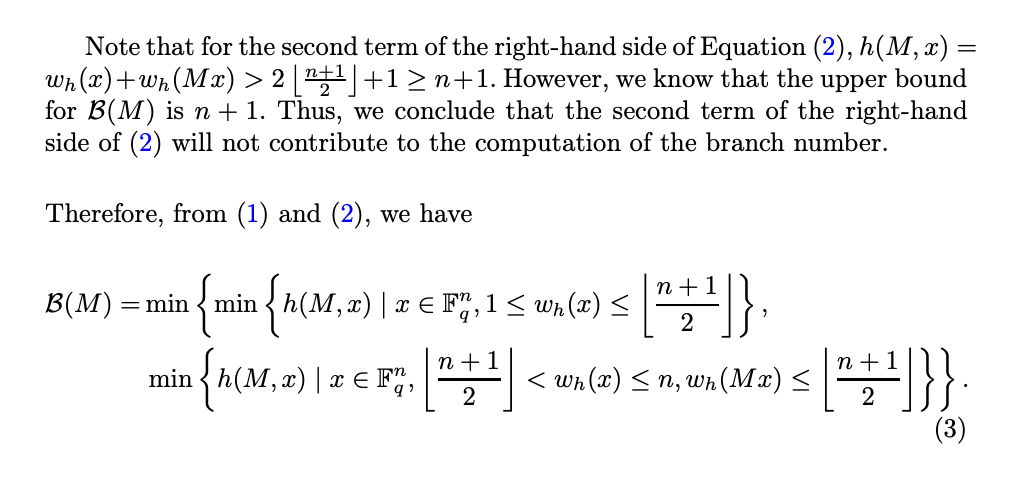
The image contains a mathematical proof discussing the computation of the branch number **B(M)**. It includes explanatory text and equations labeled (1), (2), and (3). The focus is on bounding terms in an equation and concluding which terms contribute to the final result.
### Components/Axes
- **Textual Content**:
- Explanatory paragraph discussing the second term of the right-hand side of Equation (2).
- Equations (1), (2), and (3) defining bounds for **B(M)**.
- **Variables**:
- **B(M)**: Branch number of **M**.
- **h(M,x)**: Function evaluated at **M** and **x**.
- **w_h(x)**: Weight function at **x**.
- **w_h(Mx)**: Weight function at **Mx**.
- **ℕ_q^n**: Finite field of order **q^n**.
### Detailed Analysis
1. **Equation (2) Analysis**:
- The second term of the right-hand side of Equation (2) is analyzed:
\\( h(M,x) = w_h(x) + w_h(Mx) > 2\\left\\lfloor\\frac{n+1}{2}\\right\\rfloor + 1 \\ge n+1 \\).
- The upper bound for **B(M)** is stated as **n+1**, implying the second term does not contribute to the branch number computation.
2. **Equation (3)**:
- Final expression for **B(M)**:
\\[
\\mathcal{B}(M) = \\min \\left\\{ \\min \\left\\{ h(M,x) \\big| x \\in \\mathbb{F}_q^n, 1 \\le w_h(x) \\le \\left\\lfloor\\frac{n+1}{2}\\right\\rfloor \\right\\}, \\right. \\
\\left. \\min \\left\\{ h(M,x) \\big| x \\in \\mathbb{F}_q^n, \\left\\lfloor\\frac{n+1}{2}\\right\\rfloor < w_h(x) \\le n, w_h(Mx) \\le \\left\\lfloor\\frac{n+1}{2}\\right\\rfloor \\right\\} \\right\\}. \\
\\]
### Key Observations
- The second term of Equation (2) is excluded from contributing to **B(M)** due to its upper bound exceeding **n+1**.
- Equation (3) refines the bounds for **h(M,x)** by splitting the domain of **w_h(x)** into two intervals:
1. **1 ≤ w_h(x) ≤ ⌊(n+1)/2⌋**.
2. **⌊(n+1)/2⌋ < w_h(x) ≤ n** with the additional constraint **w_h(Mx) ≤ ⌊(n+1)/2⌋**.
### Interpretation
The proof demonstrates that the branch number **B(M)** is determined by minimizing **h(M,x)** over specific subsets of **ℕ_q^n**, where **h(M,x)** is constrained by the weights **w_h(x)** and **w_h(Mx)**. The exclusion of the second term in Equation (2) simplifies the computation by focusing only on cases where **w_h(x)** and **w_h(Mx)** satisfy tighter bounds. This aligns with the upper bound **n+1** for **B(M)**, ensuring the result remains within the expected range. The use of floor functions and inequalities highlights the discrete nature of the problem, likely tied to coding theory or algebraic geometry.