## Line Graphs: Accuracy vs. Shots Across Datasets
### Overview
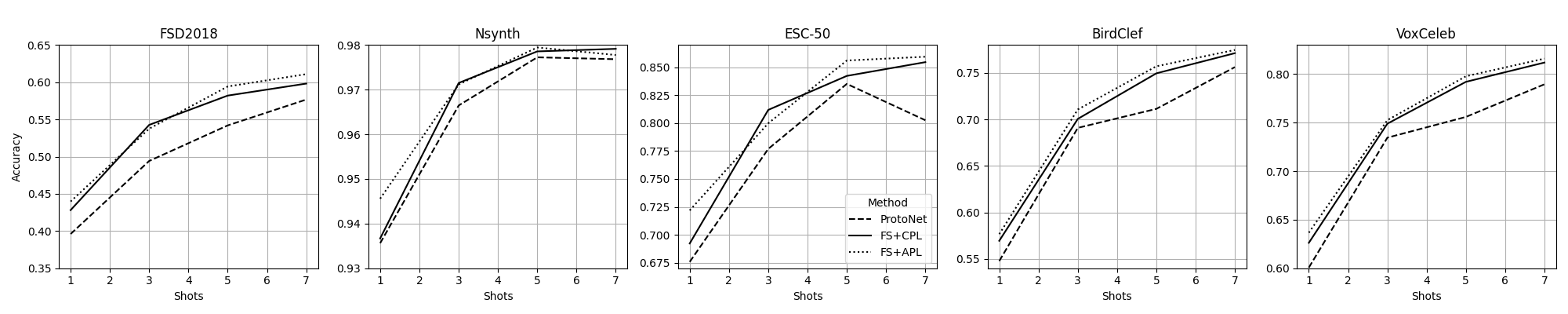
The image contains five line graphs comparing the performance of three machine learning methods (ProtoNet, FS+CPL, FS+APL) across five audio classification datasets (FSD2018, Nsynth, ESC-50, BirdClef, VoxCeleb). Each graph plots accuracy (y-axis) against the number of training shots (x-axis, 1–7). The graphs use distinct line styles to differentiate methods: dashed (ProtoNet), solid (FS+CPL), and dotted (FS+APL).
---
### Components/Axes
- **X-axis**: "Shots" (1–7), representing incremental training data samples.
- **Y-axis**: "Accuracy" (ranging dataset-specifically, e.g., 0.35–0.65 for FSD2018, 0.93–0.98 for Nsynth).
- **Legend**: Located in the bottom-right corner of each graph, with three entries:
- **Dashed line**: ProtoNet
- **Solid line**: FS+CPL
- **Dotted line**: FS+APL
---
### Detailed Analysis
#### FSD2018
- **ProtoNet (dashed)**: Starts at ~0.43 (1 shot), rises sharply to ~0.55 (3 shots), then plateaus at ~0.58 (7 shots).
- **FS+CPL (solid)**: Begins at ~0.40 (1 shot), surpasses ProtoNet by ~0.55 (3 shots), and reaches ~0.60 (7 shots).
- **FS+APL (dotted)**: Starts at ~0.42 (1 shot), follows a similar trajectory to FS+CPL but with minor fluctuations, ending at ~0.59 (7 shots).
#### Nsynth
- **ProtoNet (dashed)**: Begins at ~0.93 (1 shot), climbs steeply to ~0.97 (3 shots), and stabilizes at ~0.98 (7 shots).
- **FS+CPL (solid)**: Starts at ~0.94 (1 shot), matches ProtoNet by ~0.97 (3 shots), and peaks at ~0.98 (7 shots).
- **FS+APL (dotted)**: Initiates at ~0.94 (1 shot), slightly lags behind FS+CPL but converges to ~0.97 (7 shots).
#### ESC-50
- **ProtoNet (dashed)**: Starts at ~0.70 (1 shot), rises to ~0.77 (3 shots), and plateaus at ~0.80 (7 shots).
- **FS+CPL (solid)**: Begins at ~0.72 (1 shot), outperforms ProtoNet by ~0.82 (3 shots), and reaches ~0.85 (7 shots).
- **FS+APL (dotted)**: Starts at ~0.73 (1 shot), follows FS+CPL closely but ends at ~0.83 (7 shots).
#### BirdClef
- **ProtoNet (dashed)**: Begins at ~0.55 (1 shot), climbs to ~0.65 (3 shots), and stabilizes at ~0.70 (7 shots).
- **FS+CPL (solid)**: Starts at ~0.58 (1 shot), surpasses ProtoNet by ~0.72 (3 shots), and peaks at ~0.75 (7 shots).
- **FS+APL (dotted)**: Initiates at ~0.57 (1 shot), matches FS+CPL by ~0.73 (3 shots), and ends at ~0.76 (7 shots).
#### VoxCeleb
- **ProtoNet (dashed)**: Starts at ~0.60 (1 shot), rises to ~0.70 (3 shots), and plateaus at ~0.75 (7 shots).
- **FS+CPL (solid)**: Begins at ~0.62 (1 shot), outperforms ProtoNet by ~0.77 (3 shots), and reaches ~0.80 (7 shots).
- **FS+APL (dotted)**: Starts at ~0.61 (1 shot), follows FS+CPL closely but ends at ~0.78 (7 shots).
---
### Key Observations
1. **FS+CPL consistently outperforms ProtoNet** across all datasets, with the largest gap in Nsynth (~0.05 accuracy difference at 7 shots).
2. **FS+APL matches or slightly underperforms FS+CPL** in most cases, except in BirdClef and VoxCeleb, where it converges to similar accuracy levels.
3. **ProtoNet shows diminishing returns** after 3–4 shots in all datasets, while FS+CPL and FS+APL continue improving.
4. **Nsynth achieves near-perfect accuracy** (~0.98) for all methods by 7 shots, indicating high dataset quality or method suitability.
---
### Interpretation
The data suggests that **FS+CPL is the most effective method** for few-shot learning across diverse audio datasets, likely due to its robust feature learning or regularization. FS+APL performs comparably but may introduce unnecessary complexity in some cases. ProtoNet, while simpler, struggles with generalization beyond 3–4 shots. The convergence in VoxCeleb implies that all methods may plateau at high accuracy with sufficient data, highlighting the importance of dataset-specific method selection. The trends align with expectations for few-shot learning, where incremental data improves performance but with varying efficiency across methods.