## Physics Problem Solution Analysis
### Overview
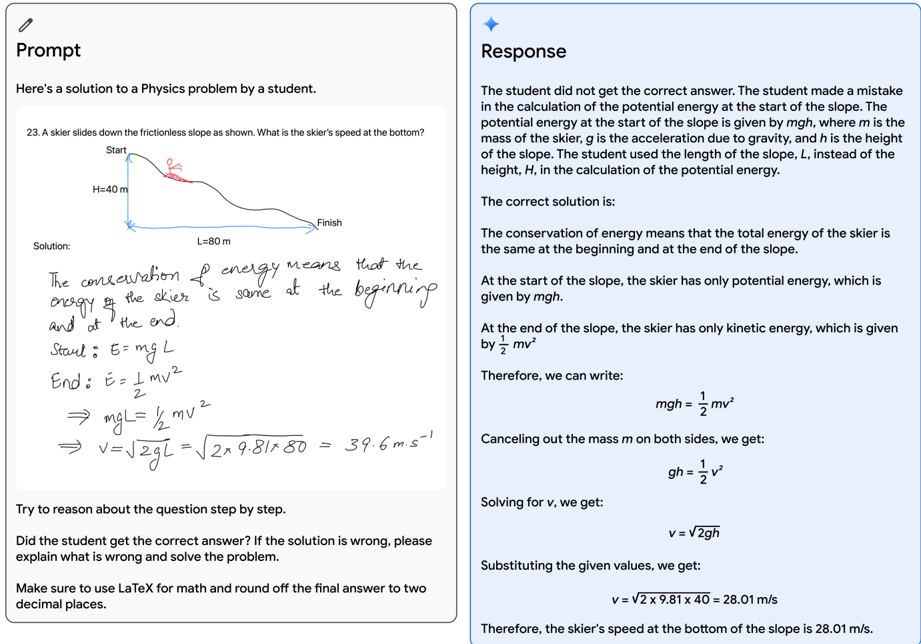
The image presents a physics problem involving a skier sliding down a frictionless slope, along with a student's attempted solution and a corrected solution. The problem asks for the skier's speed at the bottom of the slope. The image is divided into two sections: "Prompt" on the left, which contains the problem statement and the student's solution, and "Response" on the right, which provides an explanation of the student's error and a correct solution.
### Components/Axes
**Prompt Section:**
* **Title:** "Prompt"
* **Problem Statement:** "Here's a solution to a Physics problem by a student."
* **Question:** "23. A skier slides down the frictionless slope as shown. What is the skier's speed at the bottom?"
* **Diagram:** A sketch of a skier on a slope.
* Labels: "Start", "Finish", "H=40 m", "L=80 m"
* **Student's Solution:** A handwritten attempt to solve the problem using the conservation of energy.
* "Solution:"
* "The conscuration of energy means that the energy of the skier is same at the beginning and at the end."
* "Start: E = mgL"
* "End: E = 1/2 mv^2"
* "=> mgL = 1/2 mv^2"
* "=> v = sqrt(2gL) = sqrt(2 x 9.81 x 80) = 39.6 m.s^-1"
* **Instructions:**
* "Try to reason about the question step by step."
* "Did the student get the correct answer? If the solution is wrong, please explain what is wrong and solve the problem."
* "Make sure to use LaTeX for math and round off the final answer to two decimal places."
**Response Section:**
* **Title:** "Response"
* **Explanation of Error:** A textual explanation of why the student's solution is incorrect.
* "The student did not get the correct answer. The student made a mistake in the calculation of the potential energy at the start of the slope. The potential energy at the start of the slope is given by mgh, where m is the mass of the skier, g is the acceleration due to gravity, and h is the height of the slope. The student used the length of the slope, L, instead of the height, H, in the calculation of the potential energy."
* **Correct Solution:** A step-by-step solution to the problem.
* "The correct solution is:"
* "The conservation of energy means that the total energy of the skier is the same at the beginning and at the end of the slope."
* "At the start of the slope, the skier has only potential energy, which is given by mgh."
* "At the end of the slope, the skier has only kinetic energy, which is given by 1/2 mv^2"
* "Therefore, we can write: mgh = 1/2 mv^2"
* "Canceling out the mass m on both sides, we get: gh = 1/2 v^2"
* "Solving for v, we get: v = sqrt(2gh)"
* "Substituting the given values, we get: v = sqrt(2 x 9.81 x 40) = 28.01 m/s"
* "Therefore, the skier's speed at the bottom of the slope is 28.01 m/s."
### Detailed Analysis or ### Content Details
**Student's Solution Analysis:**
* The student incorrectly uses the length of the slope (L = 80 m) instead of the height (H = 40 m) in the potential energy calculation.
* The student's final answer is 39.6 m/s.
**Correct Solution Analysis:**
* The correct solution uses the height (H = 40 m) to calculate the potential energy.
* The correct final answer is 28.01 m/s.
### Key Observations
* The student's error lies in misunderstanding which dimension (height vs. length) is relevant for calculating potential energy in this context.
* The correct solution demonstrates the proper application of the conservation of energy principle.
### Interpretation
The image highlights a common mistake in physics problem-solving: misidentifying the relevant variables. The student's solution demonstrates a misunderstanding of the concept of potential energy and its dependence on height. The corrected solution clarifies the correct approach and emphasizes the importance of using the vertical height difference to calculate the change in potential energy. The problem serves as a good example for reinforcing the concepts of potential and kinetic energy and the principle of conservation of energy.