\n
## Physics Problem Solution: Skier on a Slope
### Overview
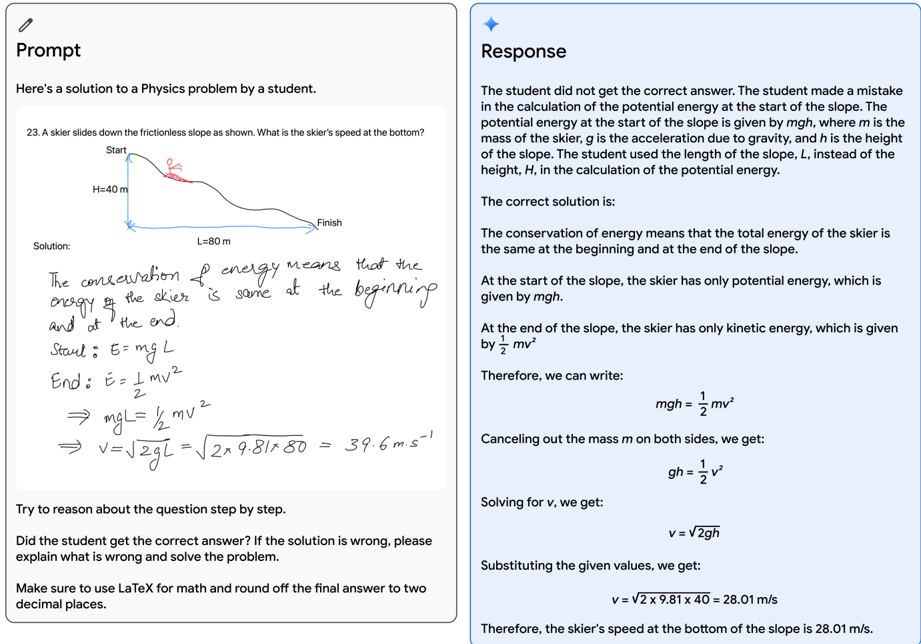
The image presents a handwritten solution to a physics problem involving a skier sliding down a frictionless slope. The problem asks for the skier's speed at the bottom of the slope, given the initial height (H = 40m) and the length of the slope (L = 80m). The student's solution is shown, followed by a corrected solution and explanation.
### Components/Axes
The image is divided into two main sections:
1. **Problem Statement & Student Solution (Left Side):** Contains the problem description, a diagram of the slope, and the student's handwritten calculations.
2. **Corrected Solution & Explanation (Right Side):** Provides the correct solution and a step-by-step explanation.
The diagram on the left side includes:
* **Labels:** "Start", "Finish", "H=40 m", "L=80 m".
* **Visual Representation:** A simple line representing the slope, with a skier depicted on it.
### Detailed Analysis or Content Details
**Left Side - Student Solution:**
The student's solution attempts to use conservation of energy. The steps are as follows:
1. **Initial Statement:** "The conservation of energy means that the energy of the skier is same at the beginning and at the end."
2. **Initial Energy:** `Start: E = mgL`
3. **Final Energy:** `End: E = 1/2 mv^2`
4. **Equating Energies:** `mgL = 1/2 mv^2`
5. **Solving for v:** `v = √(2gL) = √(2 * 9.81 * 80) = 39.6 m/s^-1`
**Right Side - Corrected Solution:**
1. **Statement:** "The student did not get the correct answer. The student made a mistake in the calculation of the potential energy at the start of the slope. The potential energy at the start of the slope is mgh, where m is the mass of the skier, g is the acceleration due to gravity, and h is the height of the slope. The student used the length of the slope, L, instead of the height, H, in the calculation of the potential energy."
2. **Conservation of Energy:** "The conservation of energy means that the total energy of the skier is the same at the beginning and at the end of the slope."
3. **Initial Potential Energy:** "At the start of the slope, the skier has only potential energy, which is given by mgh."
4. **Final Kinetic Energy:** "At the end of the slope, the skier has only kinetic energy, which is given by 1/2 mv^2."
5. **Equating Energies:** `mgh = 1/2 mv^2`
6. **Simplification:** `gh = 1/2 v^2`
7. **Solving for v:** `v = √(2gh)`
8. **Substitution:** `v = √(2 * 9.81 * 40) = 28.01 m/s`
**Additional Text:**
* "Try to work about the question step by step."
* "Did the student get the correct answer? If the solution is wrong, solve the problem."
* "Make sure to use LaTeX for math and round off the final answer to two decimal places."
### Key Observations
* The student incorrectly used the length of the slope (L) instead of the height (H) in the potential energy calculation.
* The student's calculated velocity (39.6 m/s) is significantly higher than the correct velocity (28.01 m/s).
* The corrected solution clearly explains the error and provides a step-by-step derivation of the correct answer.
* The problem utilizes the principle of conservation of energy.
### Interpretation
The image demonstrates a common mistake in applying the principle of conservation of energy – confusing distance with height. The student's initial approach was conceptually correct (equating initial potential energy to final kinetic energy), but the incorrect substitution of 'L' for 'H' led to a significantly inflated velocity. The corrected solution highlights the importance of carefully identifying the relevant variables and understanding the physical meaning of each term in the equation. The inclusion of LaTeX formatting instructions suggests a focus on precise mathematical representation. The problem serves as a good example for students learning about energy conservation and problem-solving techniques in physics. The detailed explanation on the right side is a good pedagogical approach, breaking down the solution into manageable steps and explicitly addressing the student's error.