## Physics Problem Analysis: Skier on a Frictionless Slope
### Overview
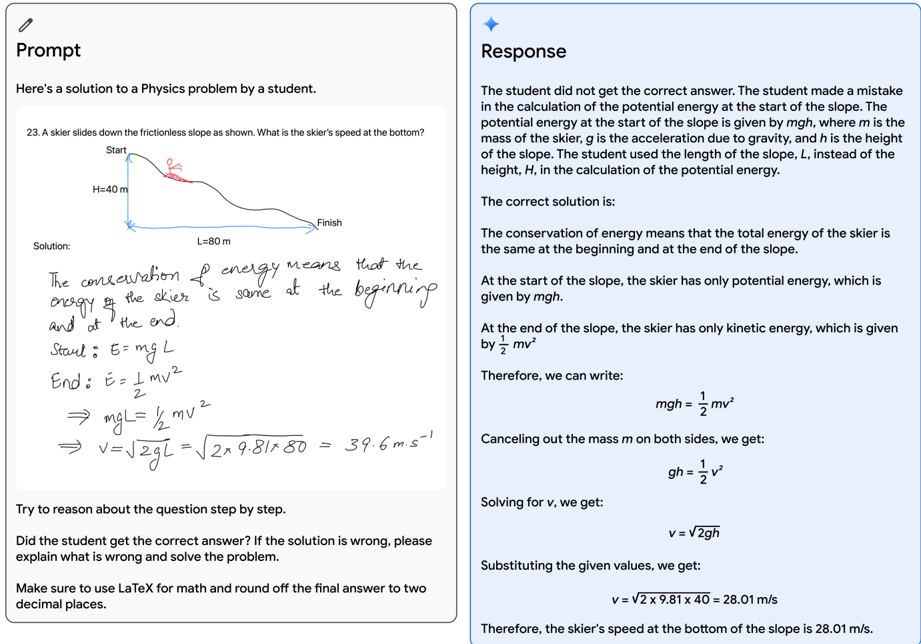
The image is a composite showing a physics problem presented to a student (left panel, labeled "Prompt") and a model's detailed response critiquing and correcting the student's work (right panel, labeled "Response"). The core task is to determine the speed of a skier at the bottom of a frictionless slope given its height and length.
### Components/Axes
**Prompt Panel (Left):**
* **Header:** "Prompt"
* **Problem Statement:** "Here's a solution to a Physics problem by a student." followed by "23. A skier slides down the frictionless slope as shown. What is the skier's speed at the bottom?"
* **Diagram:** A simple line drawing of a slope.
* **Labels:** "Start" (top-left), "Finish" (bottom-right).
* **Dimensions:** A vertical dashed line labeled "H=40 m" (height). A horizontal dashed line labeled "L=80 m" (slope length).
* **Figure:** A stick figure skier is drawn on the slope.
* **Student's Handwritten Solution:**
* **Text:** "The conservation of energy means that the energy of the skier is same at the beginning and at the end."
* **Equations:**
* "Start: E = mgL"
* "End: E = 1/2 mv²"
* "⇒ mgL = 1/2 mv²"
* "⇒ v = √(2gL) = √(2 x 9.81 x 80) = 39.6 m s⁻¹"
* **Instructions:** "Try to reason about the question step by step. Did the student get the correct answer? If the solution is wrong, please explain what is wrong and solve the problem. Make sure to use LaTeX for math and round off the final answer to two decimal places."
**Response Panel (Right):**
* **Header:** "Response"
* **Critique:** "The student did not get the correct answer. The student made a mistake in the calculation of the potential energy at the start of the slope. The potential energy at the start of the slope is given by mgh, where m is the mass of the skier, g is the acceleration due to gravity, and h is the height of the slope. The student used the length of the slope, L, instead of the height, H, in the calculation of the potential energy."
* **Correct Solution Steps:**
1. States the principle of conservation of energy.
2. Defines initial energy (potential): `mgh`.
3. Defines final energy (kinetic): `1/2 mv²`.
4. Sets them equal: `mgh = 1/2 mv²`.
5. Cancels mass `m`: `gh = 1/2 v²`.
6. Solves for `v`: `v = √(2gh)`.
7. Substitutes values: `v = √(2 x 9.81 x 40) = 28.01 m/s`.
* **Conclusion:** "Therefore, the skier's speed at the bottom of the slope is 28.01 m/s."
### Detailed Analysis
**Student's Work Analysis:**
* **Conceptual Error:** The student correctly identified the conservation of energy principle but incorrectly defined the initial potential energy. They used the slope length `L = 80 m` (`E = mgL`) instead of the vertical height `H = 40 m`.
* **Calculation:** Based on their incorrect formula, their arithmetic is correct: `√(2 * 9.81 * 80) ≈ √(1569.6) ≈ 39.62 m/s`, rounded to `39.6 m s⁻¹`.
**Correct Solution Analysis:**
* **Conceptual Correction:** The response correctly identifies that gravitational potential energy depends on vertical height (`h`), not the path length along the slope.
* **Calculation:** Using the correct height `H = 40 m`: `v = √(2 * 9.81 * 40) = √(784.8) ≈ 28.014 m/s`, rounded to `28.01 m/s`.
### Key Observations
1. **Fundamental Misconception:** The student's error highlights a common confusion between the distance traveled along an incline and the vertical displacement relevant for gravitational potential energy.
2. **Diagram Clarity:** The diagram clearly labels both `H` and `L`, making the source of the student's error evident.
3. **Pedagogical Structure:** The response follows a clear, step-by-step pedagogical structure: identify the error, state the correct principle, derive the correct formula, and compute the final answer.
### Interpretation
This image serves as a clear educational example demonstrating the application of the conservation of energy principle in mechanics. It contrasts a common student mistake with the correct methodology.
* **What the Data Suggests:** The problem quantifies how a skier's gravitational potential energy (`mgh`) is entirely converted into kinetic energy (`1/2 mv²`) on a frictionless slope. The final speed depends **only** on the vertical drop (`h`) and gravity (`g`), not on the slope's angle or length (`L`). The student's answer (`39.6 m/s`) is significantly higher than the correct answer (`28.01 m/s`) because they overestimated the initial energy by a factor of `L/H = 2`.
* **Relationship Between Elements:** The "Prompt" sets up the problem and presents a flawed attempt. The "Response" acts as an expert tutor, diagnosing the flaw and providing the canonical solution. The diagram is essential for defining the variables `H` and `L`.
* **Notable Anomaly:** The only anomaly is the student's conceptual error, which is the central focus of the entire image. The rest of the information (problem statement, diagram, correct solution) is standard and consistent with introductory physics.
* **Underlying Principle:** The core lesson is that in conservative force fields (like gravity near Earth's surface), the work done—and thus the change in kinetic energy—depends only on the change in vertical position, not the path taken. This is why the height `H` is the critical parameter, not the slope length `L`.