## Screenshot: Physics Problem Analysis
### Overview
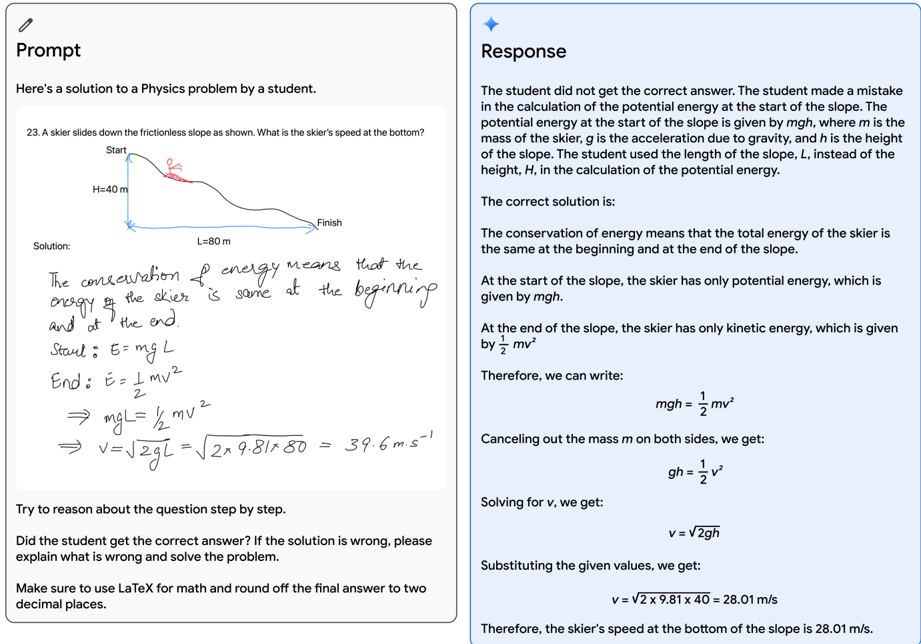
The image contains a physics problem (Question 23) about a skier sliding down a frictionless slope, accompanied by a student's solution and an expert's correction. The problem involves calculating the skier's speed at the bottom of the slope using energy conservation principles.
### Components/Axes
- **Diagram Labels**:
- Vertical axis labeled "H = 40 m" (height of the slope).
- Horizontal axis labeled "L = 80 m" (length of the slope).
- Diagram shows a curved path from "Start" to "Finish" with a skier icon.
- **Student's Solution**:
- Equations written in handwriting:
- Start energy: \( E = mgL \) (incorrectly using slope length \( L \) instead of height \( H \)).
- End energy: \( E = \frac{1}{2}mv^2 \).
- Derived velocity: \( v = \sqrt{2gL} = \sqrt{2 \times 9.81 \times 80} = 39.6 \, \text{m/s} \).
- **Expert's Response**:
- Corrects the student's error: Potential energy should use height \( H \), not \( L \).
- Correct equations:
- Start energy: \( E = mgh \).
- End energy: \( E = \frac{1}{2}mv^2 \).
- Derived velocity: \( v = \sqrt{2gh} = \sqrt{2 \times 9.81 \times 40} = 28.01 \, \text{m/s} \).
### Detailed Analysis
- **Student's Mistake**:
- Used \( L = 80 \, \text{m} \) (slope length) instead of \( H = 40 \, \text{m} \) (vertical height) in the potential energy formula.
- Incorrectly equated \( mgL = \frac{1}{2}mv^2 \), leading to an overestimated speed.
- **Expert's Correction**:
- Emphasized that potential energy depends on vertical height (\( mgh \)), not slope length.
- Applied energy conservation correctly: \( mgh = \frac{1}{2}mv^2 \).
- Solved for \( v \) using \( v = \sqrt{2gh} \), substituting \( g = 9.81 \, \text{m/s}^2 \) and \( h = 40 \, \text{m} \).
### Key Observations
1. **Energy Conservation Principle**:
- Total mechanical energy (potential + kinetic) is conserved in a frictionless system.
- At the start, all energy is potential (\( mgh \)); at the bottom, all energy is kinetic (\( \frac{1}{2}mv^2 \)).
2. **Common Error**:
- Confusing slope length (\( L \)) with vertical height (\( H \)) in energy calculations.
3. **Numerical Values**:
- Student's incorrect speed: \( 39.6 \, \text{m/s} \).
- Correct speed: \( 28.01 \, \text{m/s} \).
### Interpretation
The problem tests the application of energy conservation in a gravitational field. The student's error highlights a critical misunderstanding: potential energy depends on vertical displacement (\( H \)), not the path length (\( L \)). The expert's response clarifies this distinction, demonstrating that the skier's speed is determined solely by the vertical drop. The correct speed (\( 28.01 \, \text{m/s} \)) is significantly lower than the student's result, underscoring the importance of using the correct height in energy equations.
### Spatial Grounding
- **Diagram**:
- Height (\( H = 40 \, \text{m} \)) is marked vertically on the left side of the slope.
- Length (\( L = 80 \, \text{m} \)) is marked horizontally at the base of the slope.
- **Text Placement**:
- Student's solution is written below the diagram, with equations aligned to the left.
- Expert's response is in a separate blue box on the right, with corrections highlighted.
### Trends and Data Points
- **Energy Conversion**:
- Potential energy decreases linearly as the skier descends, converting to kinetic energy.
- No friction implies no energy loss, so total energy remains constant.
- **Velocity Calculation**:
- Correct formula: \( v = \sqrt{2gh} \).
- Incorrect formula (student): \( v = \sqrt{2gL} \).
### Notable Anomalies
- The student's use of \( L \) instead of \( H \) introduces a factor of 2 error in the velocity calculation.
- The expert's response explicitly addresses this by canceling mass (\( m \)) and solving for \( v \) using \( h \).
### Conclusion
The problem emphasizes the importance of correctly identifying variables in physics equations. The skier's speed at the bottom of the slope is **28.01 m/s**, derived from the vertical height (\( H = 40 \, \text{m} \)) and gravitational acceleration (\( g = 9.81 \, \text{m/s}^2 \)). The student's error serves as a reminder to distinguish between path length and vertical displacement in energy conservation problems.