\n
## Diagram: Nemo Microservices Platform Data Flow
### Overview
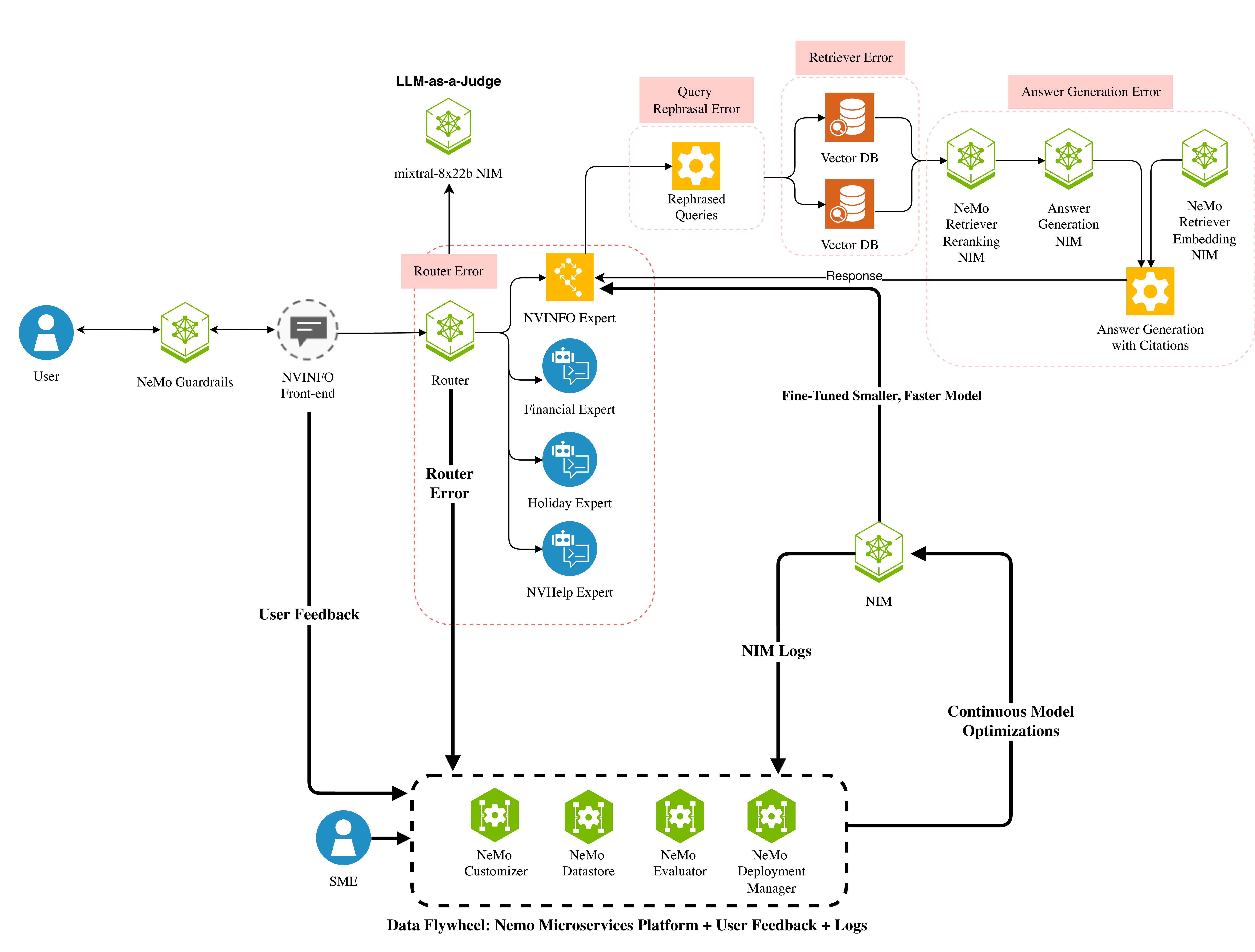
This diagram illustrates the data flow within the Nemo Microservices Platform, incorporating user interaction, expert systems, model fine-tuning, and continuous optimization. The diagram depicts a complex system with multiple components interacting through various pathways, including feedback loops and error handling mechanisms. The overall structure suggests a pipeline for processing user queries, leveraging expert knowledge, and refining the underlying models.
### Components/Axes
The diagram features the following key components:
* **User:** Represented by a blue icon.
* **SME (Subject Matter Expert):** Represented by a blue icon.
* **Nemo Guardrails:** A green hexagonal component.
* **NINFO Front-end:** A green hexagonal component.
* **Router:** A green hexagonal component.
* **NINFO Expert:** A diamond-shaped component containing sub-components: Financial Expert, Holiday Expert, and NVHelp Expert.
* **LLM-as-a-Judge:** A rectangular component.
* **Vector DB:** Two rectangular components labeled "Vector DB".
* **Nemo Retriever Reranking NIM:** A green hexagonal component.
* **Answer Generation NIM:** A green hexagonal component.
* **Nemo Retriever Embedding NIM:** A green hexagonal component.
* **Answer Generation with Citations:** A green hexagonal component.
* **Fine-Tuned Smaller, Faster Model:** A rectangular component.
* **NIM Logs:** A rectangular component.
* **Continuous Model Optimizations:** A rectangular component.
* **Nemo Customizer:** A green hexagonal component.
* **Datastore:** A green hexagonal component.
* **Nemo Evaluator:** A green hexagonal component.
* **Nemo Deployment Manager:** A green hexagonal component.
The diagram also includes labels for error types: "Router Error", "Query Rephrasal Error", "Retriever Error", and "Answer Generation Error". Arrows indicate the direction of data flow.
### Detailed Analysis or Content Details
The data flow can be described as follows:
1. **User Interaction:** A User interacts with the system, initiating a query.
2. **Nemo Guardrails:** The query passes through Nemo Guardrails.
3. **NINFO Front-end:** The query is then processed by the NINFO Front-end.
4. **Routing:** The query is routed, potentially encountering a "Router Error".
5. **NINFO Expert System:** The query is directed to the NINFO Expert system, which branches into Financial, Holiday, and NVHelp Experts.
6. **LLM-as-a-Judge:** The output from the NINFO Expert is evaluated by the LLM-as-a-Judge.
7. **Query Rephrasing:** If necessary, the query is rephrased, potentially leading to a "Query Rephrasal Error".
8. **Vector Database Interaction:** The rephrased query interacts with the Vector DB, potentially encountering a "Retriever Error".
9. **Nemo NIMs:** The Vector DB response is processed by Nemo Retriever Reranking NIM, Answer Generation NIM, and Nemo Retriever Embedding NIM.
10. **Answer Generation:** An answer is generated, potentially with citations, and may encounter an "Answer Generation Error".
11. **Fine-Tuned Model:** The generated answer is processed by the Fine-Tuned Smaller, Faster Model.
12. **NIM Logs & Continuous Optimization:** NIM Logs are generated and used for Continuous Model Optimizations.
13. **User Feedback Loop:** User Feedback is collected and fed back into the system, influencing the Nemo Customizer, Datastore, Nemo Evaluator, and Nemo Deployment Manager.
14. **SME Interaction:** SMEs interact with the Nemo Customizer, Datastore, Nemo Evaluator, and Nemo Deployment Manager.
The diagram uses arrows to indicate the flow of data. The thickness of the arrows varies, suggesting different levels of data flow intensity. The color coding (green, blue, red) likely represents different types of components or data streams.
### Key Observations
* The system incorporates multiple feedback loops, particularly through User Feedback and NIM Logs, indicating a focus on continuous improvement.
* The presence of error labels (Router Error, Query Rephrasal Error, Retriever Error, Answer Generation Error) suggests a robust error handling mechanism.
* The NINFO Expert system is a central component, providing specialized knowledge to the system.
* The LLM-as-a-Judge plays a critical role in evaluating and refining the output.
* The system integrates both real-time processing (through the main data flow) and offline optimization (through NIM Logs and Continuous Model Optimizations).
### Interpretation
This diagram represents a sophisticated AI-powered platform designed for information retrieval and answer generation. The architecture emphasizes modularity, with distinct components responsible for specific tasks. The inclusion of expert systems, LLM-based evaluation, and continuous optimization suggests a commitment to accuracy, relevance, and adaptability. The feedback loops are crucial for learning and improving the system's performance over time. The error handling mechanisms indicate a proactive approach to identifying and addressing potential issues.
The "Data Flywheel" label at the bottom suggests that the system is designed to become more effective with increased usage and feedback, creating a virtuous cycle of data collection, model refinement, and improved user experience. The system appears to be designed for complex queries that require specialized knowledge and nuanced understanding. The separation of concerns into distinct microservices (Nemo components) allows for independent scaling and maintenance. The use of a Vector DB suggests a semantic search capability, enabling the system to understand the meaning of queries rather than simply matching keywords. The overall design reflects a modern approach to AI development, prioritizing flexibility, scalability, and continuous improvement.