## Diagram: Logical Relationships Between Statement Pairs
### Overview
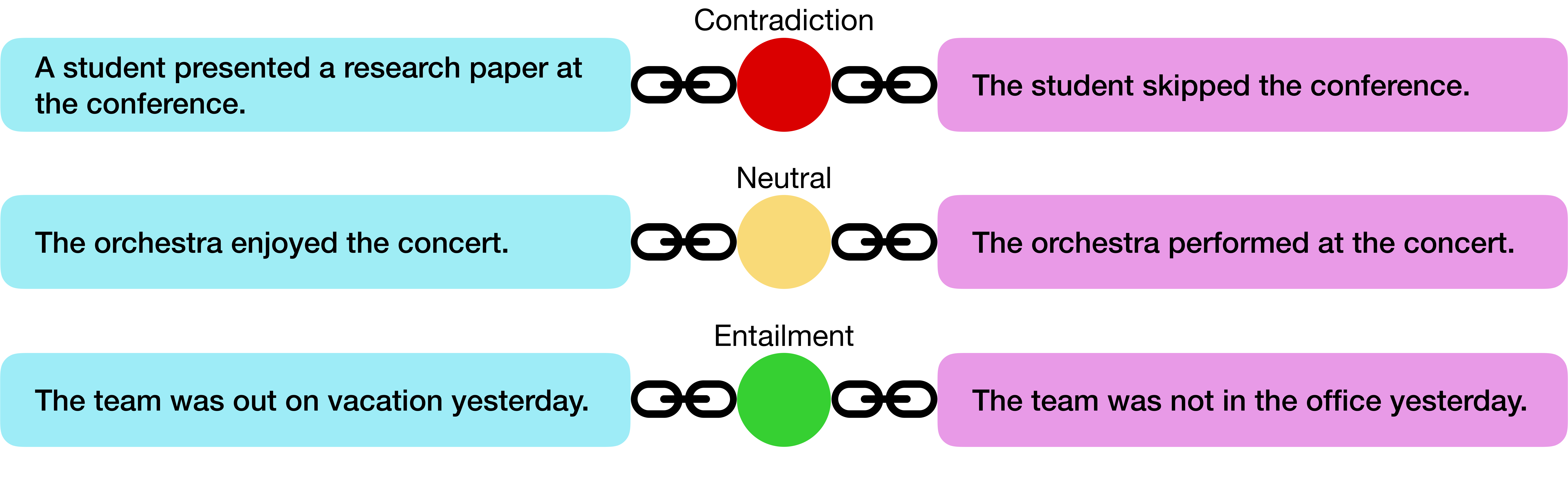
The image is a diagram illustrating three fundamental types of logical relationships between pairs of statements. It presents three horizontal rows, each demonstrating a different relationship: Contradiction, Neutral, and Entailment. Each row consists of two text boxes (left and right) connected by a chain-link icon with a central colored circle, which is labeled with the relationship type.
### Components/Axes
* **Structure:** Three horizontal rows, each representing a distinct logical relationship.
* **Visual Elements per Row:**
* **Left Text Box:** Light blue rounded rectangle containing the first statement.
* **Right Text Box:** Pink rounded rectangle containing the second statement.
* **Connector:** A black chain-link icon (representing a connection or link) on either side of a central colored circle.
* **Central Circle & Label:** A colored circle with a text label above it defining the relationship type.
* **Color Coding for Relationships:**
* **Red Circle:** Contradiction
* **Yellow Circle:** Neutral
* **Green Circle:** Entailment
### Content Details
**Row 1: Contradiction**
* **Label (Top Center):** "Contradiction"
* **Central Circle:** Red
* **Left Statement (Light Blue Box):** "A student presented a research paper at the conference."
* **Right Statement (Pink Box):** "The student skipped the conference."
* **Relationship:** The two statements cannot both be true simultaneously. Presenting at a conference directly contradicts skipping it.
**Row 2: Neutral**
* **Label (Top Center):** "Neutral"
* **Central Circle:** Yellow
* **Left Statement (Light Blue Box):** "The orchestra enjoyed the concert."
* **Right Statement (Pink Box):** "The orchestra performed at the concert."
* **Relationship:** The truth of one statement does not logically imply the truth or falsity of the other. An orchestra can enjoy a concert it performed at, but enjoying is not a necessary condition of performing, nor does performing guarantee enjoyment.
**Row 3: Entailment**
* **Label (Top Center):** "Entailment"
* **Central Circle:** Green
* **Left Statement (Light Blue Box):** "The team was out on vacation yesterday."
* **Right Statement (Pink Box):** "The team was not in the office yesterday."
* **Relationship:** The truth of the first statement logically guarantees the truth of the second. If the team was on vacation, it necessarily follows that they were not in the office.
### Key Observations
1. **Consistent Visual Schema:** The diagram uses a strict, repeating layout (Left Box -> Connector -> Labeled Circle -> Connector -> Right Box) for all three examples, making comparisons straightforward.
2. **Intuitive Color Semantics:** The color choices for the central circles align with common associations: red for conflict/stop (contradiction), yellow for caution/ambiguity (neutral), and green for go/affirmation (entailment).
3. **Clear Examples:** Each relationship is demonstrated with a simple, everyday example that clearly illustrates the logical concept without requiring specialized knowledge.
4. **Symbolic Connector:** The chain-link icon effectively symbolizes the logical "link" or relationship being examined between the two statements.
### Interpretation
This diagram serves as an educational tool for explaining core concepts in logic and natural language inference. It visually decodes abstract relationships into concrete, color-coded examples.
* **Purpose:** To teach the distinction between statements that conflict (Contradiction), are logically independent (Neutral), and where one necessarily follows from the other (Entailment).
* **How Elements Relate:** The spatial layout forces a direct comparison between the left and right statements. The central, labeled circle acts as the "answer" or classification for that pair, with the color providing an immediate visual cue to the relationship's nature.
* **Underlying Concept:** The diagram is a foundational representation of tasks in fields like computational linguistics and AI, where systems must determine the logical relationship between two pieces of text (e.g., for fact-checking, question answering, or textual entailment recognition).
* **Effectiveness:** The design is highly effective for quick comprehension. By isolating each relationship type with a clear example and reinforcing it with color and consistent structure, it allows a viewer to grasp the differences between Contradiction, Neutrality, and Entailment almost instantly. The chosen examples are particularly well-selected for clarity—the "vacation/office" entailment is airtight, while the "enjoyed/performed" neutral pair perfectly captures a common-sense relationship that is not a logical necessity.