## Line Graph: Accuracy vs. Varying Maximum Depth (D_max)
### Overview
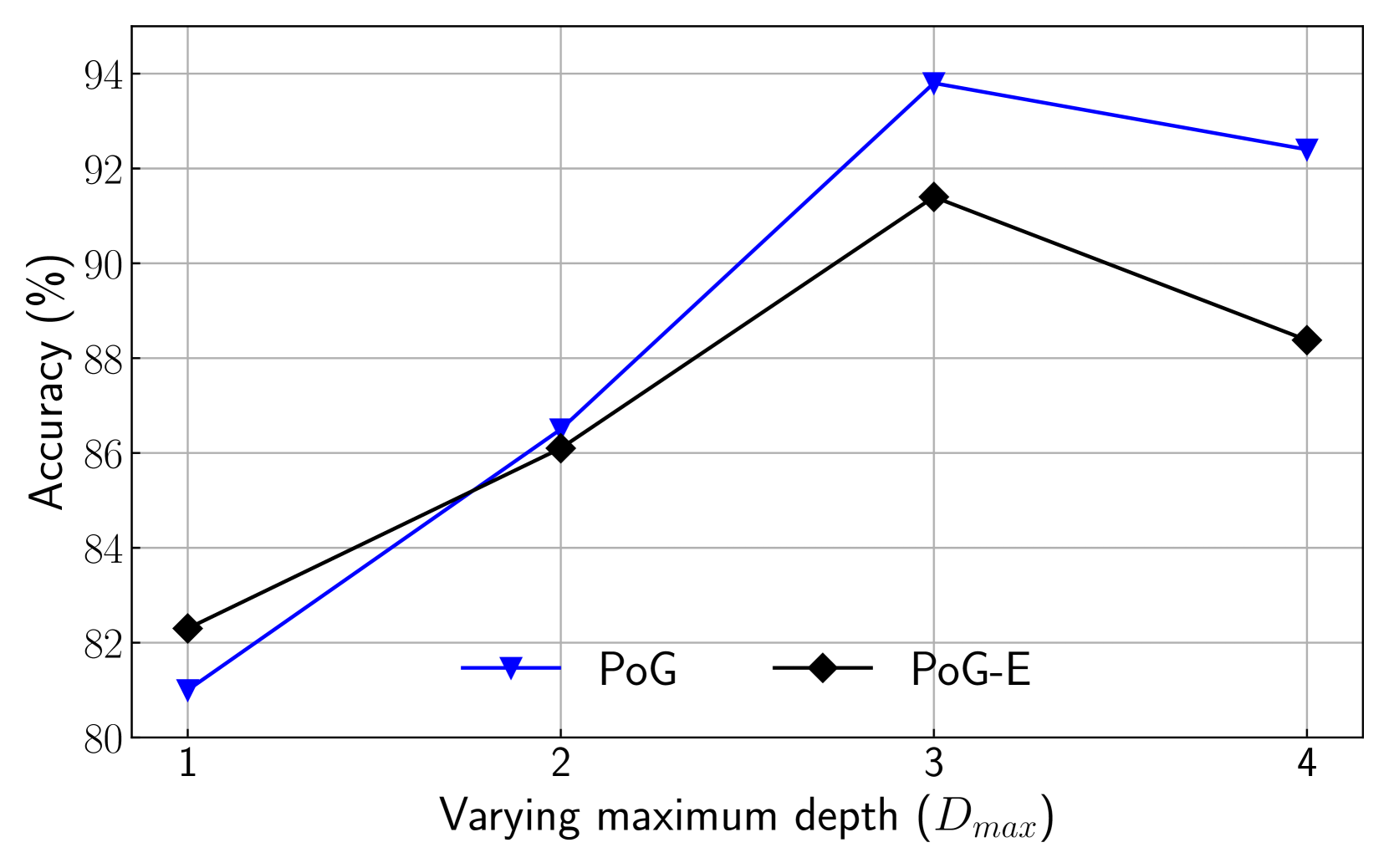
The image depicts a line graph comparing the accuracy of two methods, "PoG" (blue) and "PoG-E" (black), as the maximum depth (D_max) varies from 1 to 4. The y-axis represents accuracy in percentage (%), ranging from 80% to 94%, while the x-axis represents D_max values (1–4). The graph shows distinct trends for both methods, with accuracy increasing initially and then diverging at higher depths.
### Components/Axes
- **X-axis**: "Varying maximum depth (D_max)" with discrete values labeled 1, 2, 3, and 4.
- **Y-axis**: "Accuracy (%)" with a scale from 80% to 94%.
- **Legend**: Located at the bottom-right corner, with:
- **Blue line with triangle markers**: Labeled "PoG".
- **Black line with diamond markers**: Labeled "PoG-E".
### Detailed Analysis
#### PoG (Blue Line)
- **D_max = 1**: Accuracy ≈ 81% (triangle marker).
- **D_max = 2**: Accuracy ≈ 86% (triangle marker).
- **D_max = 3**: Accuracy ≈ 94% (triangle marker, peak).
- **D_max = 4**: Accuracy ≈ 92% (triangle marker, slight decline).
#### PoG-E (Black Line)
- **D_max = 1**: Accuracy ≈ 82% (diamond marker).
- **D_max = 2**: Accuracy ≈ 86% (diamond marker).
- **D_max = 3**: Accuracy ≈ 91% (diamond marker, peak).
- **D_max = 4**: Accuracy ≈ 88% (diamond marker, decline).
### Key Observations
1. **Initial Increase**: Both methods show a consistent upward trend in accuracy as D_max increases from 1 to 2.
2. **Divergence at D_max = 3**:
- PoG achieves the highest accuracy (94%), surpassing PoG-E (91%).
- PoG-E’s accuracy plateaus at D_max = 3, while PoG continues to rise sharply.
3. **Decline at D_max = 4**:
- PoG drops slightly to 92%, while PoG-E declines more noticeably to 88%.
4. **Stability**: PoG-E exhibits more consistent performance across all D_max values compared to PoG.
### Interpretation
The data suggests that increasing D_max improves accuracy up to a critical point (D_max = 3), after which further depth may lead to overfitting or reduced effectiveness. PoG outperforms PoG-E at D_max = 3 but becomes less stable at D_max = 4, indicating potential sensitivity to over-parameterization. PoG-E’s slightly lower but more consistent performance across depths implies it may be more robust to variations in D_max. The divergence at D_max = 4 highlights a trade-off between peak performance and stability, which could inform optimal D_max selection depending on application requirements.