## Chart/Diagram Type: Problematic Solution Example
### Overview
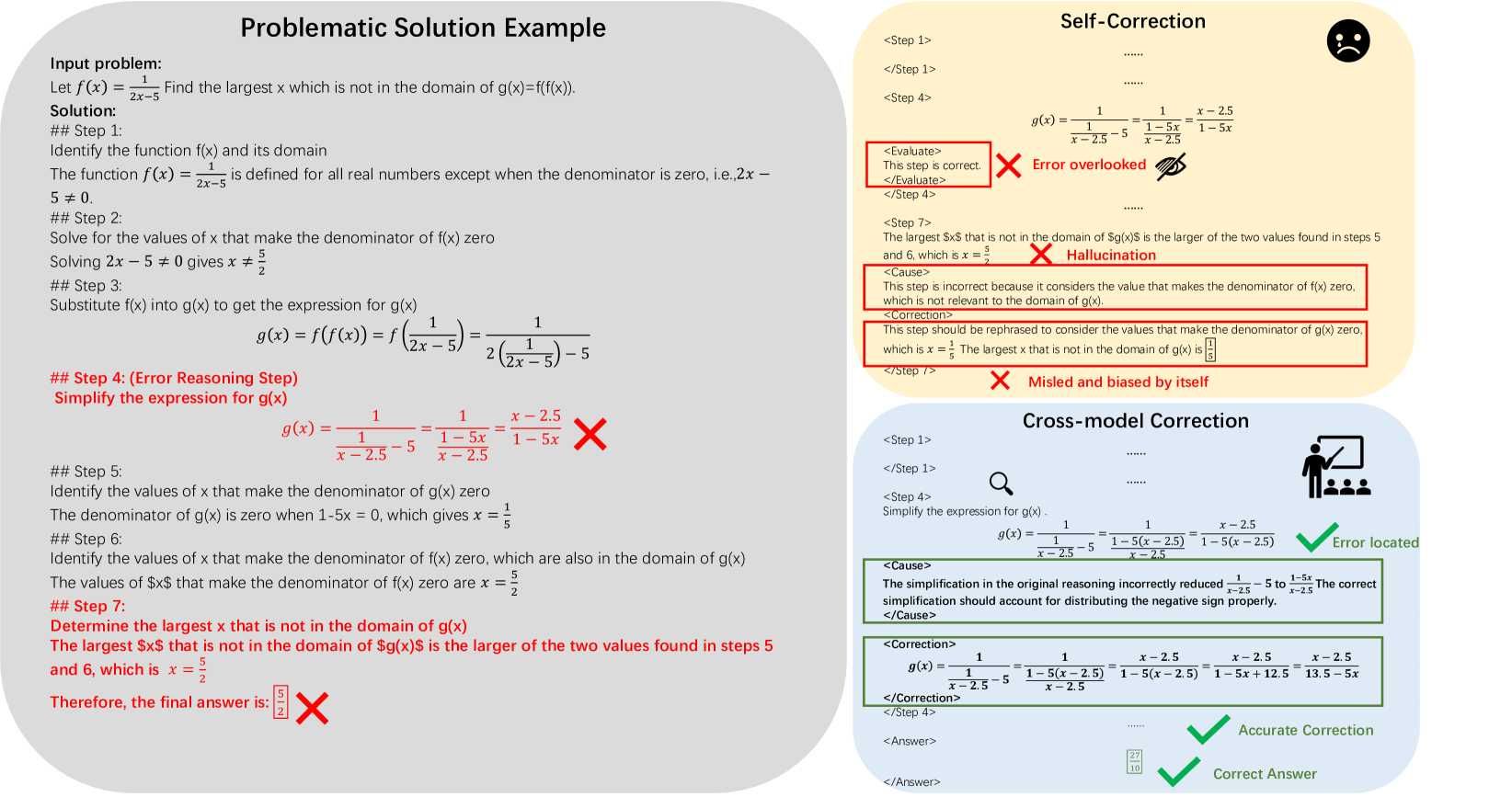
The image presents a problematic solution to a mathematical problem, along with two proposed corrections: a "Self-Correction" and a "Cross-model Correction." The problem involves finding the largest x not in the domain of g(x) = f(f(x)), where f(x) = 1/(2x-5). The image highlights errors in the original solution and demonstrates how the two correction methods address these errors.
### Components/Axes
* **Title:** Problematic Solution Example
* **Input Problem:** Defines the function f(x) and the goal of finding the largest x not in the domain of g(x).
* **Solution:** A step-by-step attempt to solve the problem.
* **Self-Correction:** A method to correct the errors in the original solution.
* **Cross-model Correction:** An alternative method to correct the errors.
* **Steps:** The solution and corrections are broken down into numbered steps (1, 2, 3, 4, 5, 6, 7).
* **Annotations:** Textual annotations highlight errors, causes, corrections, and evaluations.
### Detailed Analysis or ### Content Details
**1. Input Problem and Original Solution:**
* **Input Problem:** Let f(x) = 1/(2x-5). Find the largest x which is not in the domain of g(x) = f(f(x)).
* **Step 1:** Identify the function f(x) and its domain. The function f(x) = 1/(2x-5) is defined for all real numbers except when the denominator is zero, i.e., 2x - 5 ≠ 0.
* **Step 2:** Solve for the values of x that make the denominator of f(x) zero. Solving 2x - 5 ≠ 0 gives x ≠ 5/2.
* **Step 3:** Substitute f(x) into g(x) to get the expression for g(x). g(x) = f(f(x)) = f(1/(2x-5)) = 1/(2(1/(2x-5))-5).
* **Step 4 (Error Reasoning Step):** Simplify the expression for g(x). g(x) = 1/(x/(x-2.5)-5) = 1/((1-5x)/(x-2.5)) = (x-2.5)/(1-5x). This step contains an error, indicated by a red "X".
* **Step 5:** Identify the values of x that make the denominator of g(x) zero. The denominator of g(x) is zero when 1-5x = 0, which gives x = 1/5.
* **Step 6:** Identify the values of x that make the denominator of f(x) zero, which are also in the domain of g(x). The values of x that make the denominator of f(x) zero are x = 5/2.
* **Step 7:** Determine the largest x that is not in the domain of g(x). The largest x that is not in the domain of g(x) is the larger of the two values found in steps 5 and 6, which is x = 5/2. Therefore, the final answer is: 5/2. This step is also marked with a red "X".
**2. Self-Correction:**
* **Step 4:** g(x) = 1/(x/(x-2.5)-5) = 1/((1-5x)/(x-2.5)) = (x-2.5)/(1-5x).
* **Evaluate:** "This step is correct." However, an "Error overlooked" annotation with an eye icon indicates that while the simplification is algebraically correct, it doesn't address the underlying issue.
* **Step 7:** The largest x that is not in the domain of g(x) is the larger of the two values found in steps 5 and 6, which is x = 5/2.
* **Cause:** "This step is incorrect because it considers the value that makes the denominator of f(x) zero, which is not relevant to the domain of g(x)." "Hallucination" is written next to the cause.
* **Correction:** "This step should be rephrased to consider the values that make the denominator of g(x) zero, which is x = 1/5. The largest x that is not in the domain of g(x) is 1/5."
* "Misled and biased by itself" is written below the correction.
**3. Cross-model Correction:**
* **Step 4:** Simplify the expression for g(x). g(x) = 1/(x/(x-2.5)-5) = 1/(1/(x-2.5)-5(x-2.5)/(x-2.5)) = (x-2.5)/(1-5(x-2.5)). "Error located" is written next to the equation.
* **Cause:** "The simplification in the original reasoning incorrectly reduced 1/(x-2.5) - 5 to (1-5x)/(x-2.5). The correct simplification should account for distributing the negative sign properly."
* **Correction:** g(x) = 1/(x/(x-2.5)-5) = (x-2.5)/(1-5(x-2.5)) = (x-2.5)/(1-5x+12.5) = (x-2.5)/(13.5-5x).
* **Answer:** The answer is not explicitly stated, but the implication is that the correct approach leads to a different, presumably correct, answer.
* "Accurate Correction" is written next to a green check mark.
* "Correct Answer" is written next to a green check mark.
### Key Observations
* The original solution makes an error in simplifying the expression for g(x) in Step 4.
* The "Self-Correction" identifies the error in Step 7 but initially overlooks the error in Step 4. It then corrects the logic in Step 7 but fails to address the initial simplification error.
* The "Cross-model Correction" correctly identifies the simplification error in Step 4 and provides the correct simplification.
### Interpretation
The image illustrates the process of identifying and correcting errors in a mathematical solution. It highlights the importance of careful simplification and logical reasoning. The "Self-Correction" demonstrates a common pitfall where the overall logic is adjusted without addressing a fundamental algebraic error. The "Cross-model Correction" provides a more thorough approach by pinpointing the exact location of the error and correcting it. The example suggests that a combination of self-checking and external validation (cross-model) can lead to more robust and accurate solutions. The "Hallucination" and "Misled and biased by itself" annotations suggest that the self-correction method can sometimes lead to incorrect conclusions due to flawed reasoning or biases.