\n
## Problematic Solution Example & Self-Correction Diagram
### Overview
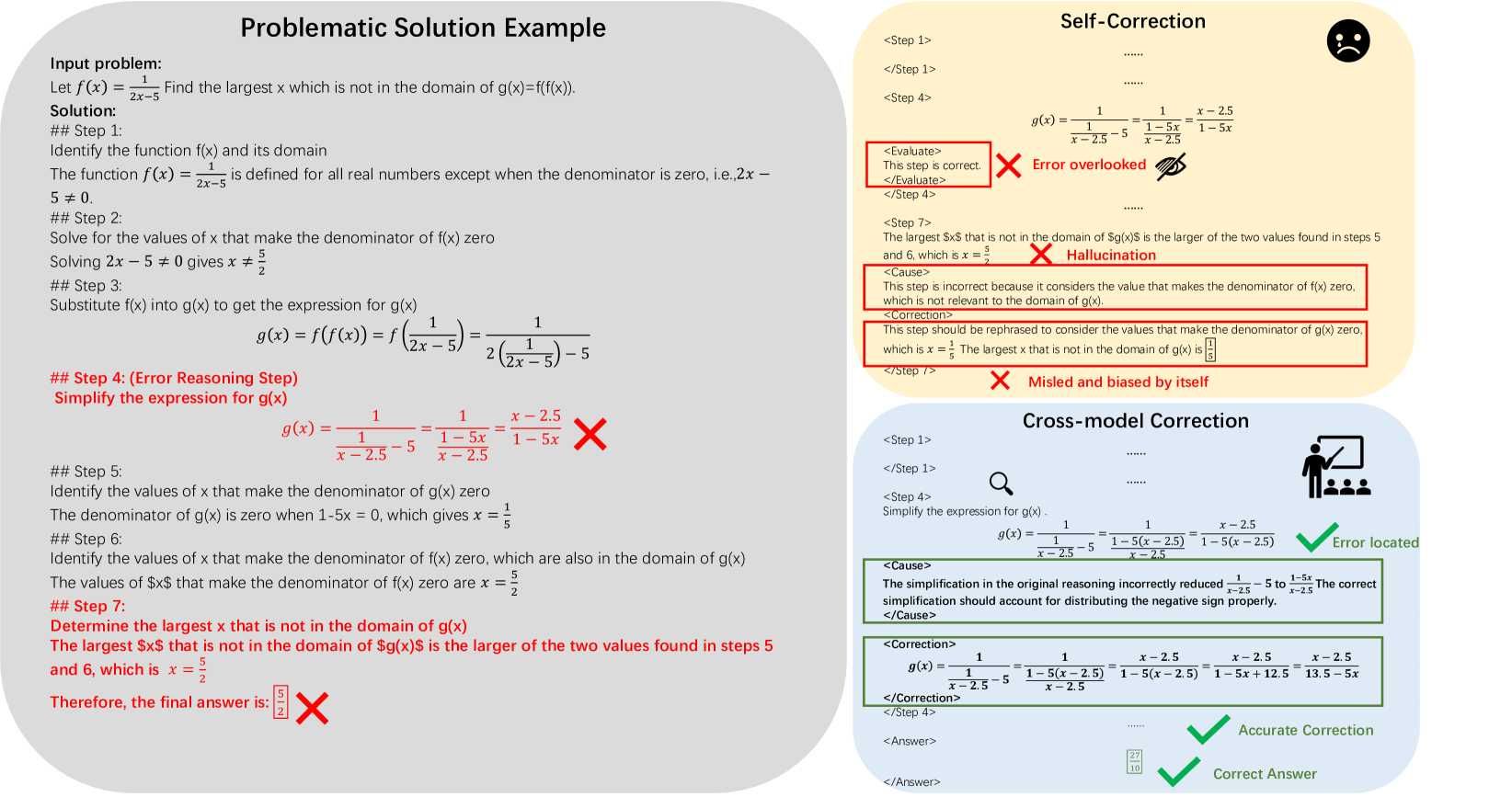
The image presents a side-by-side comparison of a "Problematic Solution Example" and a "Self-Correction" process, likely related to mathematical problem-solving. The left side details a flawed attempt to find the domain of a function, while the right side demonstrates a step-by-step correction process, including error detection and cross-model correction. The diagram uses numbered steps, equations, and annotations to highlight errors and improvements.
### Components/Axes
The image is divided into three main sections:
1. **Input Problem:** A mathematical problem statement.
2. **Problematic Solution Example:** A numbered list of steps representing an incorrect solution.
3. **Self-Correction:** A series of steps demonstrating the correction process, divided into "Step 1", "Step 2", etc., and further subdivided into "Evaluate", "Cause", and "Correction". There is also a "Cross-model Correction" section.
The diagram uses red "X" marks to indicate errors and green checkmarks to indicate corrections. Annotations like "Error overlooked", "Hallucination", "Misled and biased by itself", and "Error located" are used to explain the nature of the errors.
### Detailed Analysis or Content Details
**Input Problem:**
The problem statement is: "Let f(x) = 1/(2x-5). Find the largest x which is not in the domain of g(x)=f(f(x))".
**Problematic Solution Example:**
* **Step 1:** Identify the function f(x) and its domain. The function f(x) = 1/(2x-5) is defined for all real numbers except when the denominator is zero, i.e., 2x - 5 ≠ 0.
* **Step 2:** Solve for the values of x that make the denominator of f(x) zero. Solving 2x - 5 = 0 gives x = 5/2.
* **Step 3:** Substitute f(x) into g(x) to get the expression for g(x). g(x) = f(f(x)) = f(1/(2x-5)) = 1/(2(1/(2x-5))-5).
* **Step 4 (Error Reasoning Step):** Simplify the expression for g(x). g(x) = 1 / ( (2/(2x-5)) - 5x ) = 1 / ( (2 - 5x(2x-5))/(2x-5) ) = 1 / (2 - 10x^2 + 25x)/(2x-5)
* **Step 5:** Identify the values of x that make the denominator of g(x) zero. The denominator of g(x) is zero when 1 - 5x = 0, which gives x = 1/5.
* **Step 6:** Identify the values of x that make the denominator of f(x) zero, which are also in the domain of g(x). The values of x that make the denominator of f(x) zero are x = 5/2.
* **Step 7:** Identify the largest x that is not in the domain of g(x). The largest x that is not in the domain of g(x) is x = 5/2.
**Self-Correction:**
* **Step 1:** g(x) = 1/(2(1/(2x-5))-5) = 1/(2/(2x-5) - 5) = 1/(2 - 5(2x-5))/(2x-5) = 1/(2 - 10x + 25)/(2x-5) = 1/(27-10x)/(2x-5)
* **Evaluate:** Correct
* **Step 2:** The largest x is not in the domain of g(x) is the larger of the two values found in steps 5 and 6, which is x = 5/2.
* **Cause:** This step is incorrect because it considers the value that makes the denominator of f(x) zero, which is not relevant to the domain of g(x).
* **Correction:** This step should be rephrased to consider the values that make the denominator of g(x) zero, which is the largest x that is not in the domain of g(x).
* **Annotation:** Hallucination
* **Step 3:** Misled and biased by itself.
* **Annotation:** X (red mark)
* **Cross-model Correction:**
* **Step 1:** Simplify the expression for g(x). g(x) = 1/(27-10x)/(2x-5)
* **Step 2:** The simplification in the original reasoning incorrectly reduced 1/(27-10x)/(2x-5) to 1/(1-5x).
* **Cause:** The incorrect reasoning incorrectly inverted the numerator.
* **Correction:** The actual solution for the denominator is (27-10x)/(2x-5).
* **Step 3:** Identify the values of x that make the denominator zero. (27-10x)/(2x-5) = 0 when 27-10x = 0, which gives x = 27/10 = 2.7
* **Step 4:** Evaluate: x = 27/10 = 2.7
* **Annotation:** Correct
### Key Observations
* The initial solution incorrectly identifies x = 5/2 as the largest value not in the domain of g(x).
* The self-correction process highlights a "hallucination" where the solution introduces irrelevant information.
* The cross-model correction identifies an error in simplification, specifically an incorrect inversion of the numerator.
* The final corrected solution identifies x = 27/10 (2.7) as the correct answer.
### Interpretation
The diagram illustrates the importance of careful step-by-step reasoning in mathematical problem-solving. It demonstrates how errors can arise from overlooking key details (like the denominator of g(x) specifically) and how a self-correction process, aided by error detection and cross-validation, can lead to a correct solution. The annotations ("Hallucination", "Misled and biased by itself") suggest that the initial solution was not grounded in a solid understanding of the problem and relied on flawed assumptions. The cross-model correction emphasizes the need to verify each simplification step to avoid propagating errors. The diagram serves as a cautionary tale about the pitfalls of automated problem-solving and the value of human oversight. The diagram is a visual representation of debugging a mathematical solution.