TECHNICAL ASSET FINGERPRINT
6c7db4afcbd8b49ffd90aac2
Click to view fullscreen
Press ESC or click to close
FOUND IN PAPERS
EXPERT: healer-alpha-free VERSION 1
RUNTIME: free/openrouter/healer-alpha
INTEL_VERIFIED
## Diagram: Mathematical Error Analysis and Correction
### Overview
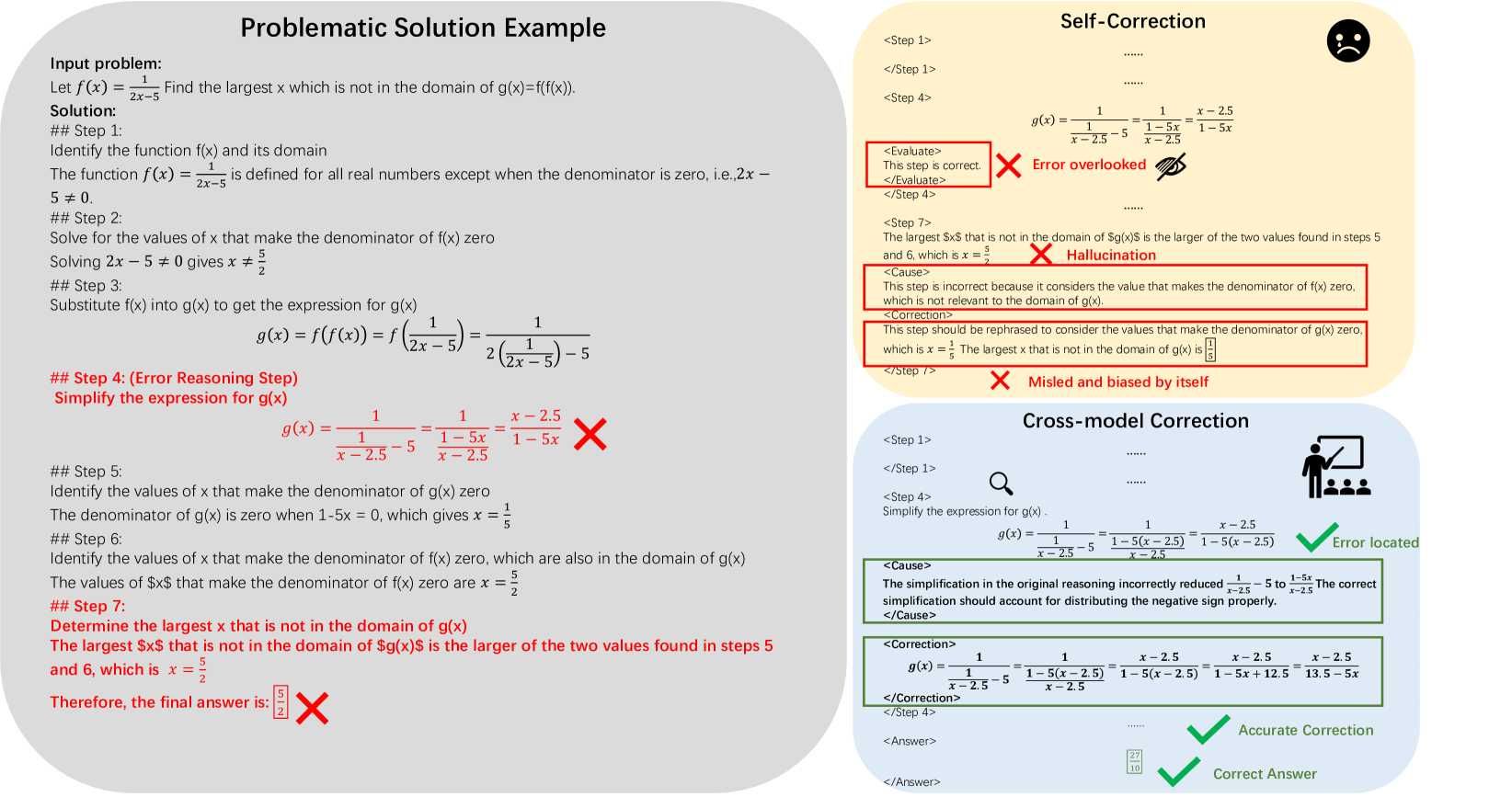
The image is a two-panel educational diagram illustrating a mathematical problem-solving process, highlighting errors in an initial solution and demonstrating two methods of correction: self-correction (which contains further errors) and cross-model correction (which provides an accurate fix). The left panel shows a "Problematic Solution Example," and the right panel is divided into a "Self-Correction" section (top) and a "Cross-model Correction" section (bottom).
### Components/Axes
The diagram is structured into distinct regions:
1. **Left Panel (Gray Background):** Titled "Problematic Solution Example." Contains the original problem statement and a 7-step solution with errors marked.
2. **Right Panel - Top (Yellow Background):** Titled "Self-Correction." Shows an attempt to correct the original solution, which itself contains errors.
3. **Right Panel - Bottom (Blue Background):** Titled "Cross-model Correction." Shows a successful correction of the error.
**Key Visual Elements:**
* **Red "X" marks:** Indicate incorrect steps or answers.
* **Green checkmarks (✓):** Indicate correct steps or answers.
* **Icons:** A sad face (😔) in the Self-Correction section and a teacher/presentation icon in the Cross-model Correction section.
* **Text Boxes:** Contain `<Cause>` and `<Correction>` explanations.
### Detailed Analysis
#### **Left Panel: Problematic Solution Example**
* **Input problem:** "Let \( f(x) = \frac{1}{2x-5} \). Find the largest x which is not in the domain of \( g(x)=f(f(x)) \)."
* **Solution Steps:**
* **Step 1:** Identifies the domain of \( f(x) \): all real numbers except \( x = \frac{5}{2} \).
* **Step 2:** Solves \( 2x - 5 \neq 0 \) to get \( x \neq \frac{5}{2} \).
* **Step 3:** Substitutes to find \( g(x) = f(f(x)) = \frac{1}{2(\frac{1}{2x-5}) - 5} \).
* **Step 4 (Error Reasoning Step):** Attempts to simplify \( g(x) \). The step shows: \( g(x) = \frac{1}{\frac{1}{x-2.5} - 5} = \frac{1}{\frac{1-5x}{x-2.5}} = \frac{x-2.5}{1-5x} \). This step is marked with a large red **X**.
* **Step 5:** Identifies values making the denominator of \( g(x) \) zero: \( 1-5x = 0 \) gives \( x = \frac{1}{5} \).
* **Step 6:** Identifies values making the denominator of \( f(x) \) zero (\( x = \frac{5}{2} \)) as also being outside the domain of \( g(x) \).
* **Step 7:** Determines the largest x not in the domain of \( g(x) \) is the larger of \( \frac{1}{5} \) and \( \frac{5}{2} \), which is \( \frac{5}{2} \). This step is marked with a red **X**.
* **Final Answer:** "Therefore, the final answer is: \( \frac{5}{2} \)" marked with a red **X**.
#### **Right Panel - Top: Self-Correction**
* This section shows a flawed attempt to correct the original error.
* **Step 4:** Repeats the incorrect simplification from the original solution: \( g(x) = \frac{1}{\frac{1}{x-2.5} - 5} = \frac{1}{\frac{1-5x}{x-2.5}} = \frac{x-2.5}{1-5x} \).
* **Annotation:** A red box around `<Evaluate> This step is correct. </Evaluate>` is marked with a red **X** and labeled "Error overlooked."
* **Step 7:** States "The largest x that is not in the domain of g(x) is the larger of the two values found in steps 5 and 6, which is \( x = \frac{5}{2} \)." This is marked with a red **X** and labeled "Hallucination."
* **Cause Box:** `<Cause> This step is incorrect because it considers the value that makes the denominator of f(x) zero, which is not relevant to the domain of g(x). </Cause>`
* **Correction Box:** `<Correction> This step should be rephrased to consider the values that make the denominator of g(x) zero, which is \( x = \frac{1}{5} \). The largest x that is not in the domain of g(x) is \( \frac{1}{5} \). </Correction>`
* **Overall Label:** The entire self-correction attempt is marked with a red **X** and labeled "Misled and biased by itself."
#### **Right Panel - Bottom: Cross-model Correction**
* This section shows the accurate correction.
* **Step 4:** Presents the correct simplification: \( g(x) = \frac{1}{\frac{1}{x-2.5} - 5} = \frac{1}{\frac{1-5(x-2.5)}{x-2.5}} = \frac{x-2.5}{1-5(x-2.5)} \). This is marked with a green checkmark (✓) and labeled "Error located."
* **Cause Box:** `<Cause> The simplification in the original reasoning incorrectly reduced \( \frac{1}{x-2.5} - 5 \) to \( \frac{1-5x}{x-2.5} \). The correct simplification should account for distributing the negative sign properly. </Cause>`
* **Correction Box:** Shows the full, correct simplification chain:
\( g(x) = \frac{1}{\frac{1}{x-2.5} - 5} = \frac{1}{\frac{1-5(x-2.5)}{x-2.5}} = \frac{x-2.5}{1-5(x-2.5)} = \frac{x-2.5}{1-5x+12.5} = \frac{x-2.5}{13.5-5x} \)
* **Final Answer:** The correct final answer is given as \( \frac{27}{10} \) (which is 2.7), marked with a green checkmark (✓) and labeled "Correct Answer."
### Key Observations
1. **Primary Error:** The core mistake in the original solution (Step 4) is an algebraic simplification error. The expression \( \frac{1}{x-2.5} - 5 \) was incorrectly simplified to \( \frac{1-5x}{x-2.5} \). The correct simplification requires distributing the -5 across the denominator: \( \frac{1 - 5(x-2.5)}{x-2.5} \).
2. **Cascading Errors:** This initial algebraic error led to an incorrect denominator for \( g(x) \) (\( 1-5x \) instead of \( 13.5-5x \)), which in turn led to identifying the wrong critical value (\( x = \frac{1}{5} \) instead of \( x = \frac{27}{10} \)).
3. **Flawed Self-Correction:** The "Self-Correction" section failed to identify the algebraic error in Step 4, instead focusing on a logical error in Step 7 regarding which values to consider for the domain. This demonstrates a "misled and biased" correction that addresses a symptom but not the root cause.
4. **Accurate Cross-Model Correction:** The "Cross-model Correction" successfully pinpointed the exact algebraic misstep in Step 4 and provided the complete, correct simplification, leading to the right answer.
### Interpretation
This diagram serves as a meta-educational tool about problem-solving and error analysis. It demonstrates that:
* **Errors can be layered:** A single algebraic mistake can propagate and cause subsequent logical errors.
* **Correction requires root-cause analysis:** Simply fixing the final conclusion (as the self-correction attempted) is insufficient if the underlying computational error is not addressed.
* **Value of external perspective:** The "Cross-model Correction" implies that an external, unbiased review (from another model or a tutor) is often more effective at identifying fundamental errors than self-correction, which can be prone to overlooking its own initial mistakes due to cognitive bias.
* **The correct answer:** For the function \( f(x) = \frac{1}{2x-5} \), the largest x not in the domain of \( g(x) = f(f(x)) \) is \( x = \frac{27}{10} \) (or 2.7), as this value makes the denominator of the correctly simplified \( g(x) \) equal to zero.
DECODING INTELLIGENCE...