## Problematic Solution Example
### Overview
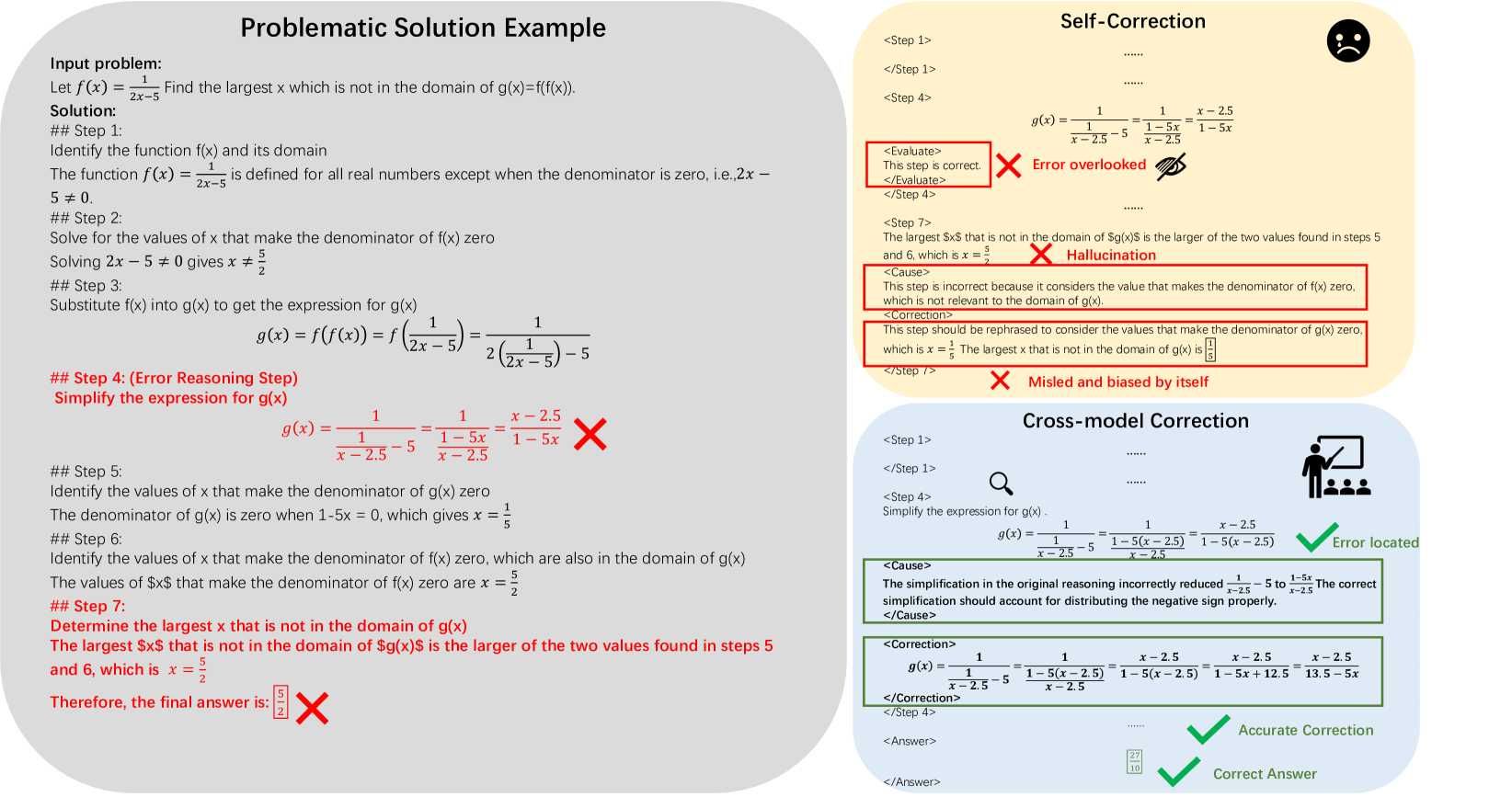
The image displays a mathematical problem and its solution, along with a self-correction section and a cross-model correction section.
### Components/Axes
- **Problem Statement**: The input problem is to find the largest x that is not in the domain of g(x) = f(f(x)).
- **Solution Steps**: The solution involves identifying the function f(x), its domain, solving for the values of x that make the denominator of f(x) zero, substituting f(x) into g(x) to get the expression for g(x), simplifying the expression, identifying the values of x that make the denominator of g(x) zero, and determining the largest x that is not in the domain of g(x).
### Detailed Analysis or ### Content Details
- **Step 1**: Identify the function f(x) and its domain.
- **Step 2**: Solve for the values of x that make the denominator of f(x) zero.
- **Step 3**: Substitute f(x) into g(x) to get the expression for g(x).
- **Step 4**: Simplify the expression for g(x).
- **Step 5**: Identify the values of x that make the denominator of g(x) zero.
- **Step 6**: Identify the values of x that make the denominator of f(x) zero, which are also in the domain of g(x).
- **Step 7**: Determine the largest x that is not in the domain of g(x).
### Key Observations
- The solution involves multiple steps and requires careful attention to detail.
- There are errors in the solution, as indicated by the self-correction and cross-model correction sections.
### Interpretation
The data suggests that the solution to the problem is incorrect. The errors in the solution are due to incorrect simplification and identification of the values of x that make the denominator of g(x) zero. The correct answer is x = 2.