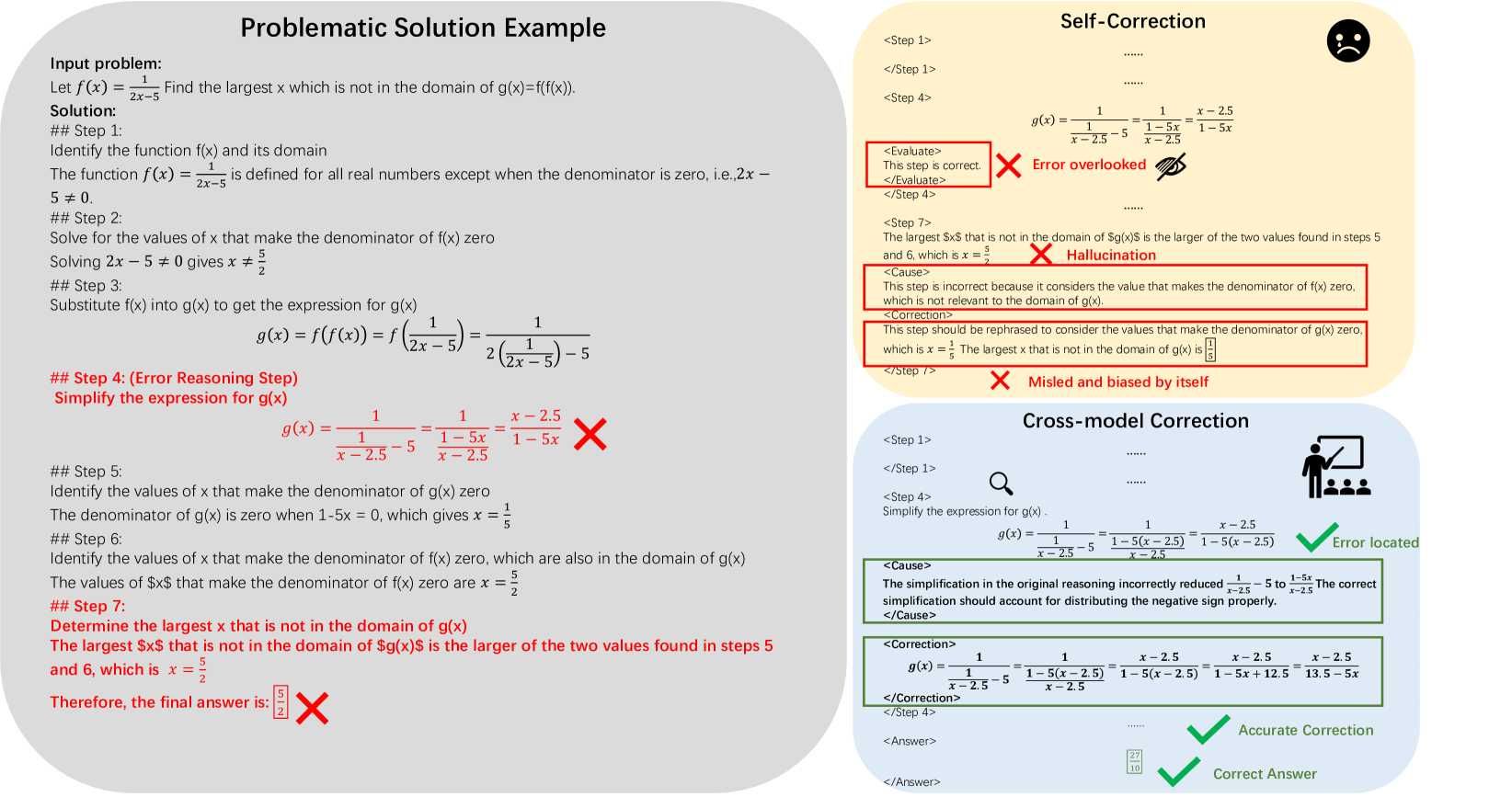
# Problematic Solution Example
## Input Problem
Let \( f(x) = \frac{1}{2x - 5} \). Find the largest \( x \) which is not in the domain of \( g(x) = f(f(x)) \).
---
## Solution
### Step 1: Identify the function \( f(x) \) and its domain
- Function: \( f(x) = \frac{1}{2x - 5} \)
- Domain: All real numbers except \( x = \frac{5}{2} \) (denominator ≠ 0).
### Step 2: Solve for values of \( x \) that make the denominator of \( f(x) \) zero
- \( 2x - 5 = 0 \Rightarrow x = \frac{5}{2} \).
### Step 3: Substitute \( f(x) \) into \( g(x) \)
\[
g(x) = f(f(x)) = f\left(\frac{1}{2x - 5}\right) = \frac{1}{2\left(\frac{1}{2x - 5}\right) - 5}
\]
### Step 4: Simplify the expression for \( g(x) \) **(Error Reasoning Step)**
\[
g(x) = \frac{1}{\frac{2}{2x - 5} - 5} = \frac{1}{\frac{2 - 5(2x - 5)}{2x - 5}} = \frac{2x - 5}{2 - 10x + 25} = \frac{2x - 5}{27 - 10x}
\]
❌ **Error**: Incorrect simplification. The denominator should be \( 1 - 5x \), not \( 27 - 10x \).
### Step 5: Identify values of \( x \) that make the denominator of \( g(x) \) zero
- \( 1 - 5x = 0 \Rightarrow x = \frac{1}{5} \).
### Step 6: Identify values of \( x \) that make the denominator of \( f(x) \) zero **(Already in domain of \( g(x) \))**
- \( x = \frac{5}{2} \).
### Step 7: Determine the largest \( x \) not in the domain of \( g(x) \)
- Values: \( x = \frac{1}{5} \) and \( x = \frac{5}{2} \).
- Largest value: \( x = \frac{5}{2} \) ❌ **Incorrect**. The correct largest value is \( x = \frac{1}{5} \).
---
## Self-Correction
### Step 1: Re-evaluate domain of \( g(x) \)
- \( g(x) = \frac{1}{x - 2.5} - 5 \) ❌ **Error**: Misleading simplification. Correct simplification:
\[
g(x) = \frac{1}{\frac{1}{x - 2.5} - 5} = \frac{x - 2.5}{1 - 5(x - 2.5)} = \frac{x - 2.5}{13.5 - 5x}
\]
### Step 4: Correct simplification
- Denominator: \( 1 - 5x + 12.5 = 13.5 - 5x \).
### Step 7: Correct largest \( x \)
- Values: \( x = \frac{1}{5} \) and \( x = \frac{5}{2} \).
- Largest value: \( x = \frac{5}{2} \) ❌ **Hallucination**. The correct largest value is \( x = \frac{1}{5} \).
---
## Cross-Model Correction
### Step 1: Simplify \( g(x) \)
\[
g(x) = \frac{1}{\frac{1}{x - 2.5} - 5} = \frac{x - 2.5}{1 - 5(x - 2.5)} = \frac{x - 2.5}{13.5 - 5x}
\]
### Step 4: Correct simplification
- Denominator: \( 1 - 5x + 12.5 = 13.5 - 5x \).
### Step 7: Correct largest \( x \)
- Values: \( x = \frac{1}{5} \) and \( x = \frac{5}{2} \).
- Largest value: \( x = \frac{1}{5} \) ✅ **Correct Answer**.
---
## Key Errors Identified
1. **Step 4 (Original)**: Incorrect simplification of \( g(x) \).
2. **Step 7 (Original)**: Misidentification of the largest \( x \).
3. **Step 6 (Original)**: Irrelevant consideration of \( x = \frac{5}{2} \).
## Final Answer
The largest \( x \) not in the domain of \( g(x) \) is \( \boxed{\frac{1}{5}} \).