## Diagram: Agent vs. Automatic Exploration for Artwork Citation
### Overview
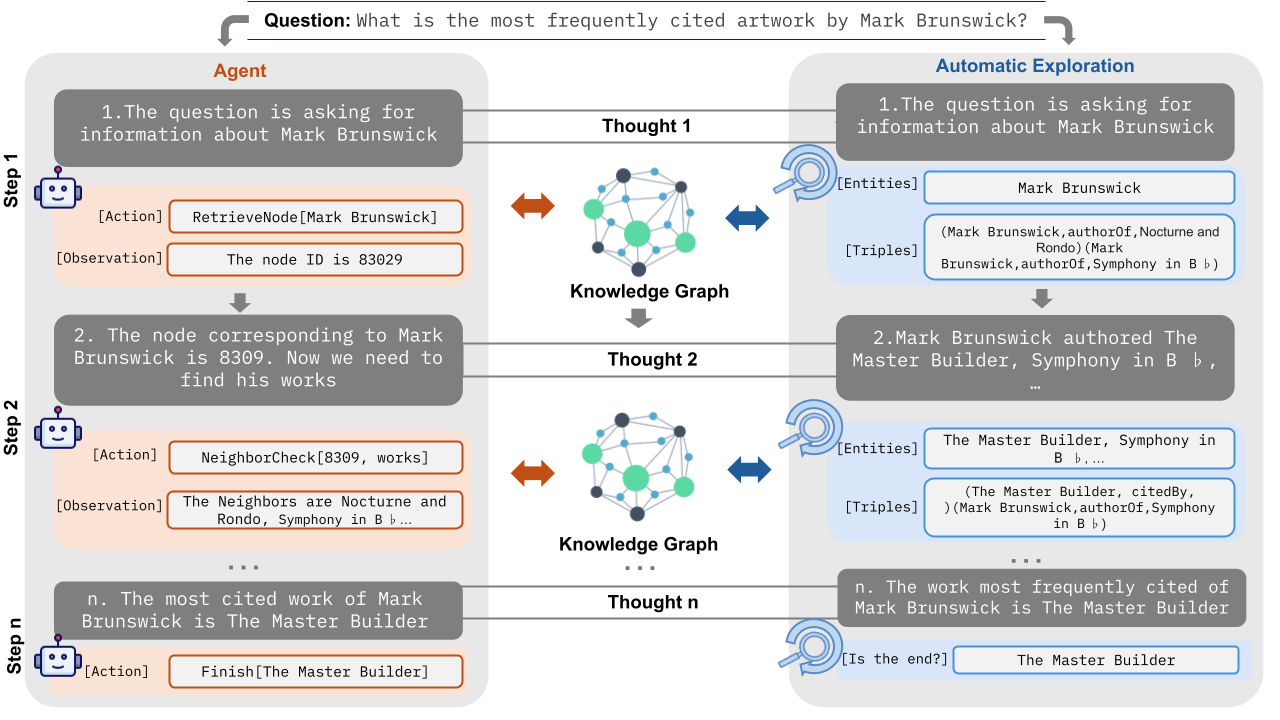
The image presents a diagram comparing two approaches, "Agent" and "Automatic Exploration," to answer the question: "What is the most frequently cited artwork by Mark Brunswick?" The diagram outlines the steps each approach takes, involving knowledge graphs, entity recognition, and triple extraction.
### Components/Axes
* **Title:** Question: What is the most frequently cited artwork by Mark Brunswick?
* **Approaches:**
* Agent (left side)
* Automatic Exploration (right side)
* **Steps:** The diagram shows steps labeled as "Step 1," "Step 2," and "Step n" for both approaches.
* **Knowledge Graph:** A visual representation of a knowledge graph is shown between the Agent and Automatic Exploration columns. It consists of interconnected nodes (green and blue) and edges.
* **Action/Observation (Agent):** Each step in the Agent approach includes an "[Action]" and an "[Observation]".
* **Entities/Triples (Automatic Exploration):** Each step in the Automatic Exploration approach includes "[Entities]" and "[Triples]".
### Detailed Analysis
**Agent Approach:**
* **Step 1:**
* Action: `RetrieveNode[Mark Brunswick]`
* Observation: `The node ID is 83029`
* **Step 2:**
* The node corresponding to Mark Brunswick is 8309. Now we need to find his works.
* Action: `NeighborCheck[8309, works]`
* Observation: `The Neighbors are Nocturne and Rondo, Symphony in Bb...`
* **Step n:**
* n. The most cited work of Mark Brunswick is The Master Builder
* Action: `Finish[The Master Builder]`
**Automatic Exploration Approach:**
* **Step 1:**
* The question is asking for information about Mark Brunswick
* Entities: `Mark Brunswick`
* Triples: `(Mark Brunswick, authorOf, Nocturne and Rondo) (Mark Brunswick, authorOf, Symphony in Bb)`
* **Step 2:**
* 2. Mark Brunswick authored The Master Builder, Symphony in Bb, ...
* Entities: `The Master Builder, Symphony in Bb...`
* Triples: `(The Master Builder, citedBy, ) (Mark Brunswick, authorOf, Symphony in Bb)`
* **Step n:**
* n. The work most frequently cited of Mark Brunswick is The Master Builder
* Is the end?: `The Master Builder`
### Key Observations
* Both approaches aim to answer the same question.
* The Agent approach uses actions and observations to navigate the knowledge graph.
* The Automatic Exploration approach focuses on extracting entities and triples from the knowledge graph.
* Both approaches ultimately arrive at the same answer: "The Master Builder" is the most frequently cited work of Mark Brunswick.
### Interpretation
The diagram illustrates two different methods for querying a knowledge graph to find information. The "Agent" approach simulates a step-by-step reasoning process, while the "Automatic Exploration" approach relies on extracting structured data (entities and triples) to infer the answer. The fact that both approaches converge on the same answer suggests the robustness of the knowledge graph and the validity of both querying methods. The diagram highlights the different strategies employed in AI for knowledge retrieval and reasoning.