## Line Chart: Brain Alignment vs. Pythia Model Size
### Overview
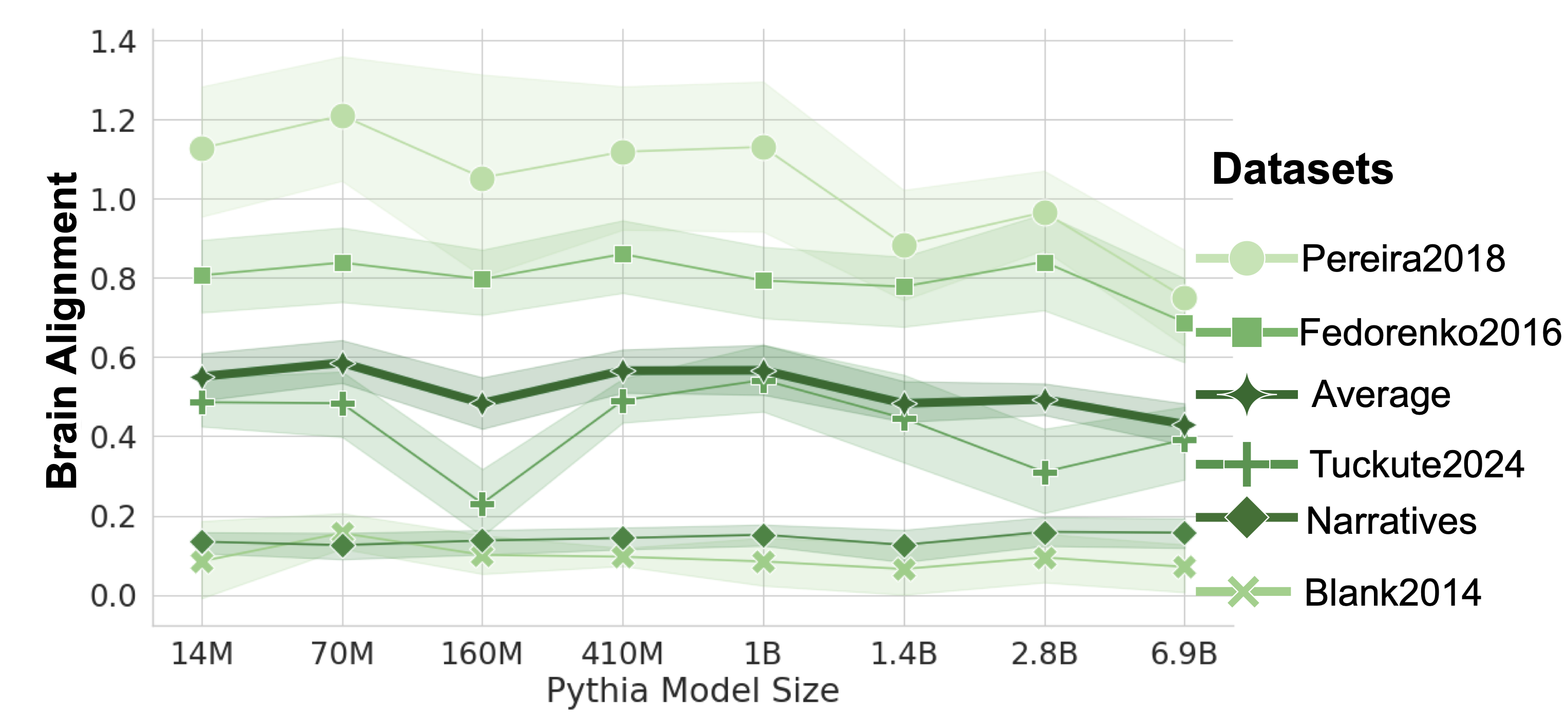
This line chart depicts the relationship between Brain Alignment scores and Pythia Model Size across several datasets. The chart displays six different datasets as lines, showing how Brain Alignment changes as the Pythia Model Size increases. A shaded region encompasses the lines, representing the average Brain Alignment.
### Components/Axes
* **X-axis:** Pythia Model Size, with markers at 14M, 70M, 160M, 410M, 1B, 1.4B, 2.8B, and 6.9B.
* **Y-axis:** Brain Alignment, ranging from 0.0 to 1.4.
* **Legend (top-right):** Lists the datasets and their corresponding line colors:
* Pereira2018 (light green)
* Fedorenko2016 (dark green)
* Average (dark grey)
* Tuckute2024 (light grey)
* Narratives (dark brown)
* Blank2014 (light purple)
### Detailed Analysis
Let's analyze each line's trend and extract approximate data points.
* **Pereira2018 (light green):** The line starts at approximately 1.25 at 14M, decreases to around 0.95 at 70M, rises to approximately 1.1 at 160M, remains relatively stable around 1.1-1.05 until 2.8B, and then decreases to approximately 0.9 at 6.9B.
* **Fedorenko2016 (dark green):** The line begins at approximately 0.85 at 14M, decreases to around 0.75 at 70M, remains relatively stable around 0.75-0.8 until 1.4B, then decreases to approximately 0.6 at 6.9B.
* **Average (dark grey):** The line starts at approximately 0.5 at 14M, increases to around 0.6 at 70M, remains relatively stable around 0.6-0.7 until 1.4B, then decreases to approximately 0.5 at 6.9B.
* **Tuckute2024 (light grey):** The line begins at approximately 0.55 at 14M, decreases to around 0.5 at 70M, remains relatively stable around 0.5-0.6 until 1.4B, then decreases to approximately 0.3 at 6.9B.
* **Narratives (dark brown):** The line starts at approximately 0.2 at 14M, increases to around 0.3 at 70M, remains relatively stable around 0.3-0.4 until 1.4B, then decreases to approximately 0.1 at 6.9B.
* **Blank2014 (light purple):** The line begins at approximately 0.1 at 14M, increases to around 0.2 at 70M, remains relatively stable around 0.2-0.3 until 1.4B, then decreases to approximately 0.05 at 6.9B.
### Key Observations
* The Pereira2018 dataset consistently exhibits the highest Brain Alignment scores across all model sizes.
* The Blank2014 and Narratives datasets consistently exhibit the lowest Brain Alignment scores.
* Generally, Brain Alignment tends to decrease as the Pythia Model Size increases beyond 1.4B for most datasets.
* The average Brain Alignment remains relatively stable between 14M and 1.4B, then decreases at 6.9B.
### Interpretation
The chart suggests that increasing the Pythia Model Size does not necessarily lead to higher Brain Alignment, and may even decrease it for some datasets. The varying responses across datasets indicate that the relationship between model size and Brain Alignment is dataset-dependent. The consistently high alignment of Pereira2018 suggests this dataset is particularly well-suited to the Pythia model architecture, or that the model captures its features effectively. Conversely, the low alignment of Blank2014 and Narratives suggests these datasets are less aligned with the model's learned representations. The decrease in alignment at larger model sizes (6.9B) could indicate overfitting or a diminishing return on investment in model capacity. The average line provides a general trend, but the individual dataset lines reveal more nuanced behavior. This data could be used to inform model selection and training strategies, potentially suggesting that smaller models may be preferable for certain datasets, or that regularization techniques are needed to prevent overfitting in larger models.