## Pie Chart: Distribution of Factors in a Technical Context
### Overview
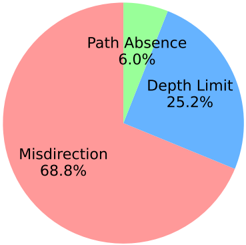
The image is a pie chart illustrating the distribution of three factors: "Misdirection," "Depth Limit," and "Path Absence." Each segment is color-coded and labeled with its corresponding percentage. The chart emphasizes the dominance of "Misdirection" as the largest contributor, followed by "Depth Limit," with "Path Absence" being the smallest segment.
### Components/Axes
- **Legend**: Located on the right side of the chart, the legend maps colors to labels:
- **Pink**: Misdirection (68.8%)
- **Blue**: Depth Limit (25.2%)
- **Green**: Path Absence (6.0%)
- **Segments**: Three distinct wedges represent the factors, with sizes proportional to their percentages.
### Detailed Analysis
1. **Misdirection (68.8%)**:
- Color: Pink
- Position: Largest segment, occupying the majority of the chart.
- Spatial Grounding: Dominates the left and upper portions of the pie.
2. **Depth Limit (25.2%)**:
- Color: Blue
- Position: Second-largest segment, located in the lower-right quadrant.
3. **Path Absence (6.0%)**:
- Color: Green
- Position: Smallest segment, situated in the upper-right quadrant.
### Key Observations
- **Dominance of Misdirection**: "Misdirection" accounts for nearly 69% of the total, making it the primary factor.
- **Secondary Contribution of Depth Limit**: "Depth Limit" contributes a quarter of the total, indicating a significant but secondary role.
- **Minor Role of Path Absence**: "Path Absence" is negligible at 6%, suggesting it is the least impactful factor.
### Interpretation
The data suggests that "Misdirection" is the most critical factor in the analyzed context, overshadowing other variables by a wide margin. The "Depth Limit" plays a moderate role, while "Path Absence" has minimal influence. This distribution could imply that addressing "Misdirection" should be prioritized in technical or operational strategies. The stark contrast between the largest and smallest segments highlights potential inefficiencies or areas for improvement in resource allocation or system design.