\n
## Heatmap: Attention Matrix
### Overview
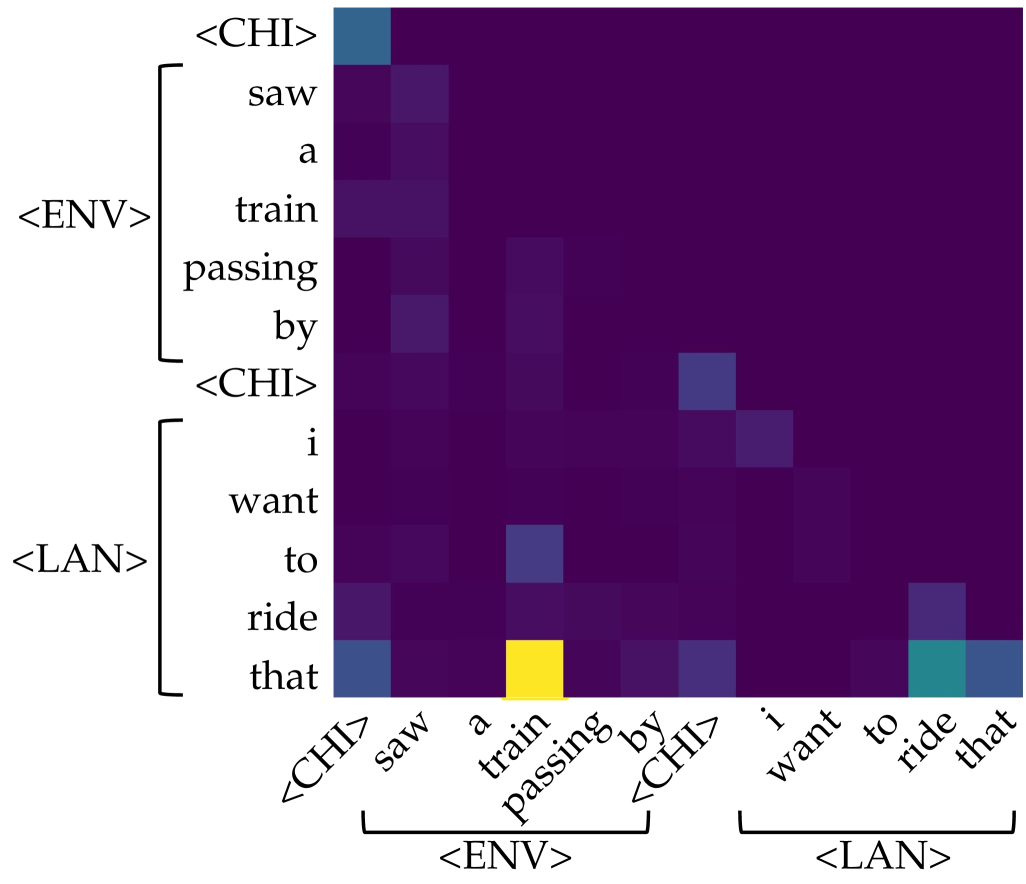
The image presents a heatmap visualizing an attention matrix. The matrix appears to represent the relationships between words in a sequence, likely from a dialogue or narrative. The words are categorized into three groups: `<CHI>` (Child), `<ENV>` (Environment), and `<LAN>` (Language). The heatmap's color intensity indicates the strength of the attention or relationship between the corresponding words.
### Components/Axes
* **X-axis:** Lists the words: `<CHI>`, "saw", "a", "train", "passing", "by", `<CHI>`, "i", "want", "to", "ride", "that".
* **Y-axis:** Lists the words: `<CHI>`, "saw", "a", "train", "passing", "by", `<CHI>`, "i", "want", "to", "ride", "that".
* **Color Scale:** Ranges from dark purple (low attention) to bright yellow (high attention).
* **Categorical Labels:** `<CHI>`, `<ENV>`, and `<LAN>` are used to group words. `<CHI>` represents the child's utterances, `<ENV>` represents the environmental context, and `<LAN>` represents the language used.
### Detailed Analysis
The heatmap shows varying degrees of attention between words. Here's a breakdown of notable observations:
* **`<CHI>` - `<CHI>`:** There is a strong attention between the two instances of `<CHI>` in the top-left and center-left of the matrix (bright yellow). This suggests a strong self-reference or focus on the child's perspective.
* **"saw" - "train":** Moderate attention (light blue) between "saw" and "train", indicating a relationship where the child observed the train.
* **"train" - "passing":** Moderate attention (light blue) between "train" and "passing", indicating a relationship where the train was in motion.
* **"passing" - "by":** Moderate attention (light blue) between "passing" and "by", indicating a relationship where the train was moving past.
* **"i" - "want":** Strong attention (bright yellow) between "i" and "want", indicating the child's desire.
* **"want" - "to":** Moderate attention (light blue) between "want" and "to", indicating a grammatical relationship.
* **"to" - "ride":** Strong attention (bright yellow) between "to" and "ride", indicating the action the child wants to perform.
* **"ride" - "that":** Moderate attention (light blue) between "ride" and "that", indicating the object of the child's desire.
* **`<CHI>` - "i":** Moderate attention (light blue) between the first `<CHI>` and "i", suggesting the child is the speaker.
* **`<CHI>` - "want":** Low attention (dark purple) between the first `<CHI>` and "want", suggesting a weaker direct connection.
* **"saw" - "i":** Very low attention (dark purple) between "saw" and "i".
* **"a" - "train":** Very low attention (dark purple) between "a" and "train".
* **"by" - "i":** Very low attention (dark purple) between "by" and "i".
### Key Observations
* The strongest attention relationships are within the child's utterances ("i want to ride") and between the two instances of `<CHI>`.
* The environmental context ("train passing by") shows moderate attention between its constituent words.
* There's a clear separation in attention patterns between the `<CHI>`, `<ENV>`, and `<LAN>` categories.
* The attention matrix is roughly symmetric, suggesting bidirectional relationships between words.
### Interpretation
This attention matrix likely represents the focus of a child's attention during a conversation or observation. The strong attention within the child's desires ("i want to ride") suggests a high level of internal focus on their goals. The moderate attention within the environmental context indicates the child is processing the scene. The relatively low attention between the child's utterances and the environment suggests the child is primarily focused on their own desires rather than detailed observation of the train. The use of `<CHI>`, `<ENV>`, and `<LAN>` categories suggests a linguistic analysis of the child's language and how they relate to their environment. This could be used to understand how children process information and form intentions. The heatmap provides a visual representation of these relationships, allowing for a quick assessment of the child's attentional focus.