\n
## Diagram: Build Status Interconnection
### Overview
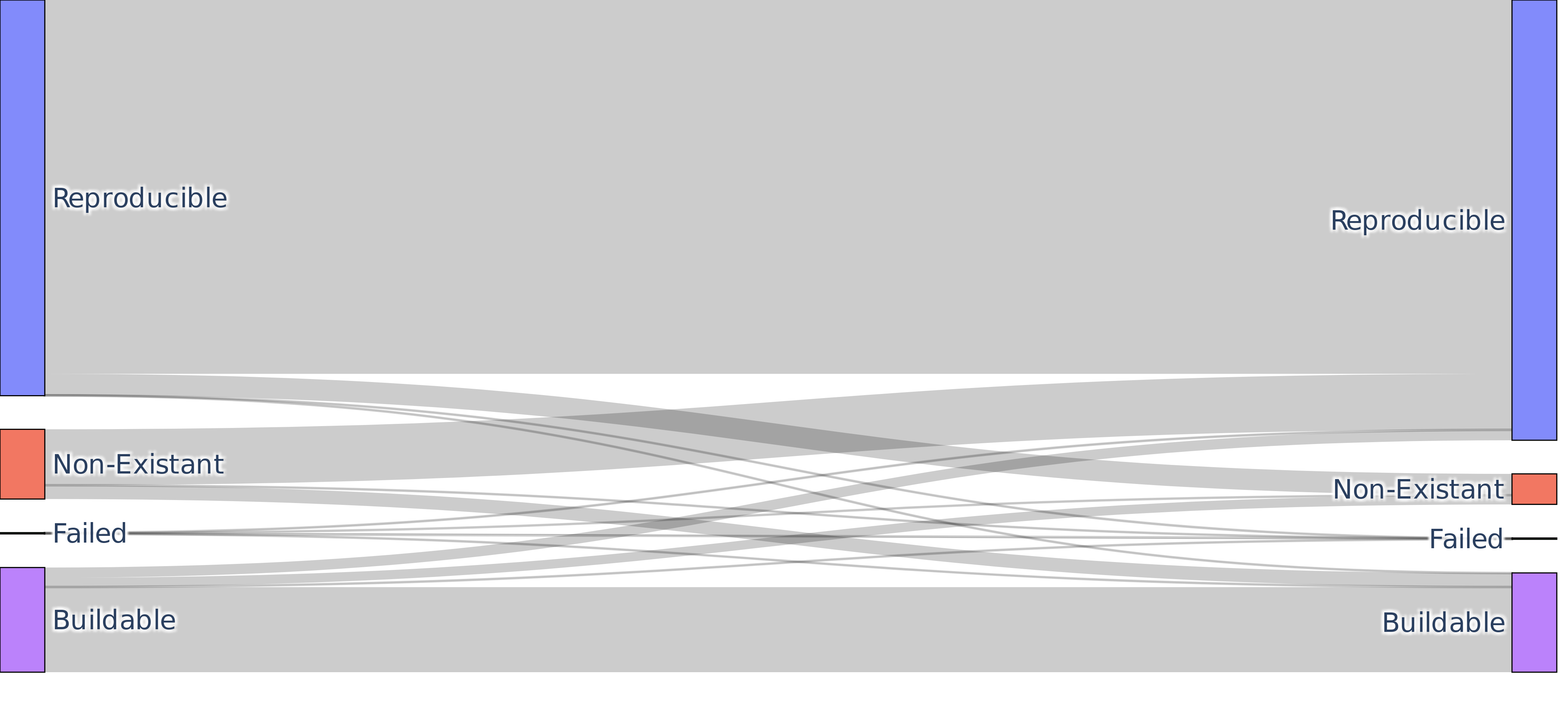
The image depicts a diagram illustrating the interconnection between build statuses. It appears to represent a system where builds can transition between different states: Reproducible, Non-Existent, Failed, and Buildable. The diagram uses lines to show connections between these states, with the thickness of the lines potentially indicating the frequency or strength of the relationship. The diagram is symmetrical, with the states mirrored on either side.
### Components/Axes
The diagram consists of four labeled states positioned vertically on both the left and right sides of the image:
* **Reproducible** (Blue label, top position)
* **Non-Existent** (Red label, middle-top position)
* **Failed** (Orange label, middle-bottom position)
* **Buildable** (Green label, bottom position)
The connections between these states are represented by gray lines of varying thickness. There are no explicit axes or scales.
### Detailed Analysis or Content Details
The diagram shows a complex network of connections between the build states. Each state on the left is connected to each state on the right via multiple lines.
* **Reproducible** (Left) is connected to **Reproducible** (Right) by approximately 6 lines.
* **Non-Existent** (Left) is connected to **Non-Existent** (Right) by approximately 6 lines.
* **Failed** (Left) is connected to **Failed** (Right) by approximately 6 lines.
* **Buildable** (Left) is connected to **Buildable** (Right) by approximately 6 lines.
* **Reproducible** (Left) is connected to **Non-Existent** (Right) by approximately 4 lines.
* **Reproducible** (Left) is connected to **Failed** (Right) by approximately 4 lines.
* **Reproducible** (Left) is connected to **Buildable** (Right) by approximately 4 lines.
* **Non-Existent** (Left) is connected to **Reproducible** (Right) by approximately 4 lines.
* **Non-Existent** (Left) is connected to **Failed** (Right) by approximately 4 lines.
* **Non-Existent** (Left) is connected to **Buildable** (Right) by approximately 4 lines.
* **Failed** (Left) is connected to **Reproducible** (Right) by approximately 4 lines.
* **Failed** (Left) is connected to **Non-Existent** (Right) by approximately 4 lines.
* **Failed** (Left) is connected to **Buildable** (Right) by approximately 4 lines.
* **Buildable** (Left) is connected to **Reproducible** (Right) by approximately 4 lines.
* **Buildable** (Left) is connected to **Non-Existent** (Right) by approximately 4 lines.
* **Buildable** (Left) is connected to **Failed** (Right) by approximately 4 lines.
The lines are not uniform in thickness, suggesting varying degrees of connection or probability. The lines appear to be randomly distributed, with no clear pattern in their thickness.
### Key Observations
The diagram highlights that all build states are interconnected. The self-connections (e.g., Reproducible to Reproducible) appear stronger (more lines) than the connections to other states. The diagram does not provide any quantitative data about the frequency or probability of transitions between states, only a visual representation of their interconnectedness.
### Interpretation
This diagram likely represents a state transition model for software builds. The states represent the outcome of a build process, and the lines represent possible transitions between these states. The thicker lines suggest that certain transitions are more common or likely than others.
The strong self-connections indicate that a build is likely to remain in its current state. The connections between different states suggest that a build can transition from any state to any other state, although the probability of these transitions may vary.
The diagram could be used to analyze build failures and identify potential areas for improvement in the build process. For example, if there are many transitions from "Buildable" to "Failed", it might indicate a problem with the build environment or the build scripts.
The symmetry of the diagram suggests that the transitions are not directional; a build can move between states in either direction. This could indicate that the build process is not deterministic, or that there are external factors that can influence the build outcome.