## Diagram: CatBoost Ensemble Model
### Overview
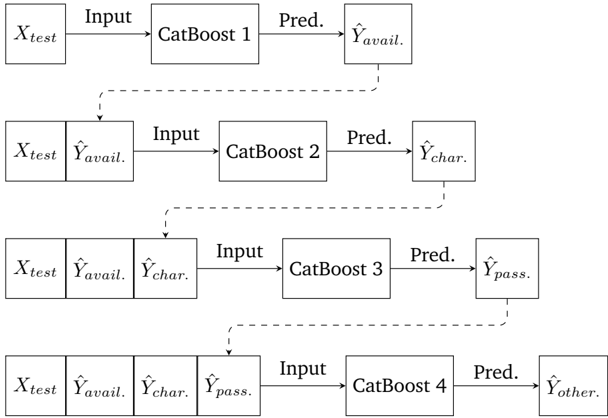
The image is a diagram illustrating a CatBoost ensemble model with four sequential CatBoost models. Each model takes an input, makes a prediction, and the prediction is then fed into the next CatBoost model along with the original input.
### Components/Axes
* **Boxes:** Represent data or models.
* **Arrows:** Indicate the flow of data. Solid arrows represent direct input, while dashed arrows represent feedback or inclusion of previous predictions.
* **Labels:**
* `Xtest`: Represents the test input data.
* `Yavail.`: Represents the prediction from CatBoost 1.
* `Ychar.`: Represents the prediction from CatBoost 2.
* `Ypass.`: Represents the prediction from CatBoost 3.
* `Yother.`: Represents the prediction from CatBoost 4.
* `CatBoost 1`, `CatBoost 2`, `CatBoost 3`, `CatBoost 4`: Represent the individual CatBoost models in the ensemble.
* `Input`: Indicates the input to each CatBoost model.
* `Pred.`: Indicates the prediction output from each CatBoost model.
### Detailed Analysis
The diagram shows a sequential process:
1. **First Stage:** `Xtest` is input into `CatBoost 1`, which predicts `Yavail.`.
2. **Second Stage:** `Xtest` and `Yavail.` are input into `CatBoost 2`, which predicts `Ychar.`.
3. **Third Stage:** `Xtest`, `Yavail.`, and `Ychar.` are input into `CatBoost 3`, which predicts `Ypass.`.
4. **Fourth Stage:** `Xtest`, `Yavail.`, `Ychar.`, and `Ypass.` are input into `CatBoost 4`, which predicts `Yother.`.
Each stage takes the original input `Xtest` and the prediction from the previous stage as input.
### Key Observations
* The model is structured as a sequential ensemble, where each CatBoost model refines the prediction based on the previous model's output.
* The input to each subsequent CatBoost model includes the original input `Xtest` and all previous predictions.
### Interpretation
The diagram illustrates a cascading or stacking approach to ensemble modeling using CatBoost. The model aims to improve prediction accuracy by iteratively refining the predictions through multiple CatBoost models. Each model learns from the errors of the previous model, potentially leading to a more robust and accurate final prediction (`Yother.`). The architecture suggests a hierarchical feature learning process, where each CatBoost model extracts and combines features from the original input and the outputs of preceding models.