## Block Diagram: Feature Processing Pipeline
### Overview
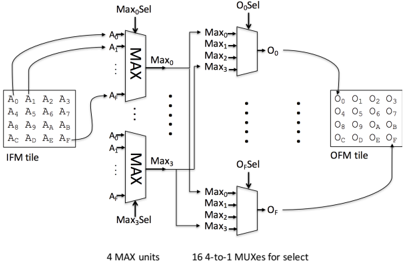
The diagram illustrates a multi-stage processing pipeline for feature extraction, likely from a neural network or signal processing system. Input features (IFM tile) are processed through MAX units, selection logic (MUXes), and output feature mapping (OFM tile).
### Components/Axes
- **Input**: IFM tile (8 input channels: A₀ to A₇).
- **Processing Units**:
- **4 MAX units**: Each takes 8 inputs (A₀–A₇) and outputs 4 max values (Max₀–Max₃).
- **16 4-to-1 MUXes**: Select outputs from MAX units based on control signals (Max_sel, O_sel).
- **Output**: OFM tile (8 output channels: O₀ to O₇).
- **Control Signals**:
- Max_sel: Selects between MAX unit outputs.
- O_sel: Selects final output values for OFM tile.
### Detailed Analysis
1. **IFM Tile**:
- 8 input channels (A₀–A₇) are fed into 4 MAX units.
- Each MAX unit processes 2 input channels (e.g., A₀ and A₁ for Max₀).
2. **MAX Units**:
- 4 units, each outputting 4 max values (Max₀–Max₃).
- Outputs are routed to 16 4-to-1 MUXes.
3. **MUXes**:
- 16 MUXes, each with 4 inputs (Max₀–Max₃) and 1 output.
- Controlled by Max_sel and O_sel signals.
4. **OFM Tile**:
- 8 output channels (O₀–O₇) receive selected values from MUXes.
- O_sel determines which MAX outputs are routed to OFM.
### Key Observations
- **Dimensionality Reduction**: 8 input channels → 4 MAX outputs → 16 MUX outputs → 8 OFM outputs.
- **Selection Logic**: MUXes dynamically route MAX outputs based on control signals, enabling adaptive feature selection.
- **Symmetry**: Input and output tiles have identical channel counts (8), suggesting balanced processing.
### Interpretation
This pipeline likely implements a **max-pooling layer** followed by **adaptive feature selection** in a neural network. The MAX units reduce spatial/temporal resolution while preserving dominant features. The 16 MUXes allow fine-grained control over which features propagate to the output, enabling tasks like attention mechanisms or dynamic feature gating. The symmetry between input and output channels suggests the system maintains feature dimensionality after processing, critical for tasks requiring consistent input-output relationships (e.g., classification, regression).
**Notable Design Choices**:
- Use of MAX units for non-linear feature extraction.
- MUXes introduce flexibility in feature routing, potentially enabling context-aware processing.
- Balanced input/output dimensions imply compatibility with subsequent layers in a network architecture.