## Diagram: Argument Graph and Conditional Logic Flow
### Overview
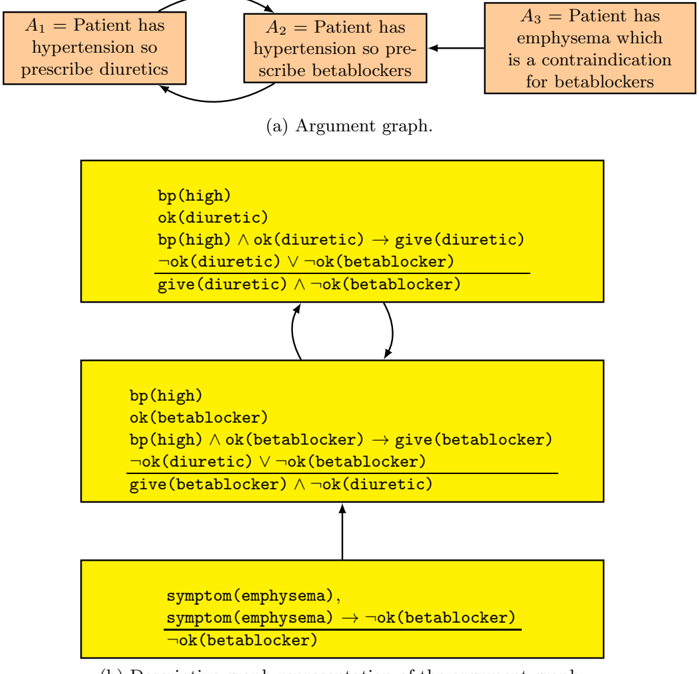
The image combines an argument graph (a) with three code blocks representing conditional logic. The argument graph outlines a clinical decision-making process for hypertension treatment, while the code blocks translate these arguments into logical conditions using Python-like syntax. Arrows indicate causal relationships and decision flows.
### Components/Axes
1. **Argument Graph (a)**:
- **Nodes**:
- `A1`: "Patient has hypertension so prescribe diuretics"
- `A2`: "Patient has hypertension so pre-scribe beta blockers"
- `A3`: "Patient has emphysema which is a contraindication for beta blockers"
- **Edges**:
- `A1 → A2`: Direct causal link
- `A2 → A3`: Conditional relationship (A3 is a contraindication for A2's action)
2. **Code Blocks**:
- **Block 1**:
```python
bp(high)
ok(diuretic) → give(diuretic)
¬ok(diuretic) ∨ ¬ok(beta blocker)
```
- **Block 2**:
```python
bp(high) ∧ ok(beta blocker) → give(beta blocker)
¬ok(diuretic) ∨ ¬ok(beta blocker)
```
- **Block 3**:
```python
symptom(emphysema) → ¬ok(beta blocker)
¬ok(beta blocker)
```
### Detailed Analysis
- **Argument Graph**:
- The graph establishes a hierarchy: A1 (diuretics) → A2 (beta blockers) → A3 (emphysema contraindication).
- A3 acts as a terminal node, overriding A2's recommendation.
- **Code Blocks**:
- **Block 1**: Implements A1's logic. If `ok(diuretic)` is true, prescribe diuretics. Otherwise, check for beta blocker compatibility.
- **Block 2**: Implements A2's logic. If both `bp(high)` and `ok(beta blocker)` are true, prescribe beta blockers. Otherwise, fall back to diuretics.
- **Block 3**: Implements A3's logic. If `symptom(emphysema)` is true, explicitly block beta blockers.
### Key Observations
1. **Logical Contradictions**:
- Block 1 and Block 2 share overlapping conditions (`¬ok(diuretic) ∨ ¬ok(beta blocker)`), suggesting mutual exclusivity.
- Block 3 introduces a hard constraint (`¬ok(beta blocker)`) that overrides previous recommendations.
2. **Flow Direction**:
- The argument graph's top-down flow (`A1 → A2 → A3`) mirrors the code blocks' sequential evaluation.
- Emphysema (A3) acts as a circuit breaker in the decision tree.
3. **Syntax Patterns**:
- All blocks use `bp(high)` as a base condition.
- `ok(X)` functions appear to represent treatment eligibility checks.
- `give(X)` functions represent treatment prescriptions.
### Interpretation
This diagram models a clinical decision support system for hypertension management with safety constraints:
1. **Primary Pathway**:
- Start with diuretics (A1) unless contraindicated.
- If diuretics are unsuitable, proceed to beta blockers (A2) if no emphysema.
2. **Safety Mechanism**:
- Emphysema (A3) creates an absolute contraindication for beta blockers, overriding all prior recommendations.
- The code enforces this through explicit negation (`¬ok(beta blocker)`).
3. **Logical Structure**:
- The use of `∧` (and) and `∨` (or) operators creates a prioritized decision tree.
- The repeated `¬ok(beta blocker)` condition in Blocks 1-3 suggests a system-wide safety check.
4. **Clinical Implications**:
- The system prevents beta blocker prescription in emphysema patients, aligning with real-world medical guidelines.
- The fallback to diuretics in Block 2 ensures treatment continuity when beta blockers are contraindicated.
### Technical Notes
- The code uses Python-like syntax but appears to be pseudocode for a rule engine.
- The argument graph and code blocks are spatially aligned, with the graph providing the "why" and the code providing the "how".
- No numerical data or statistical trends are present; the focus is on logical relationships.