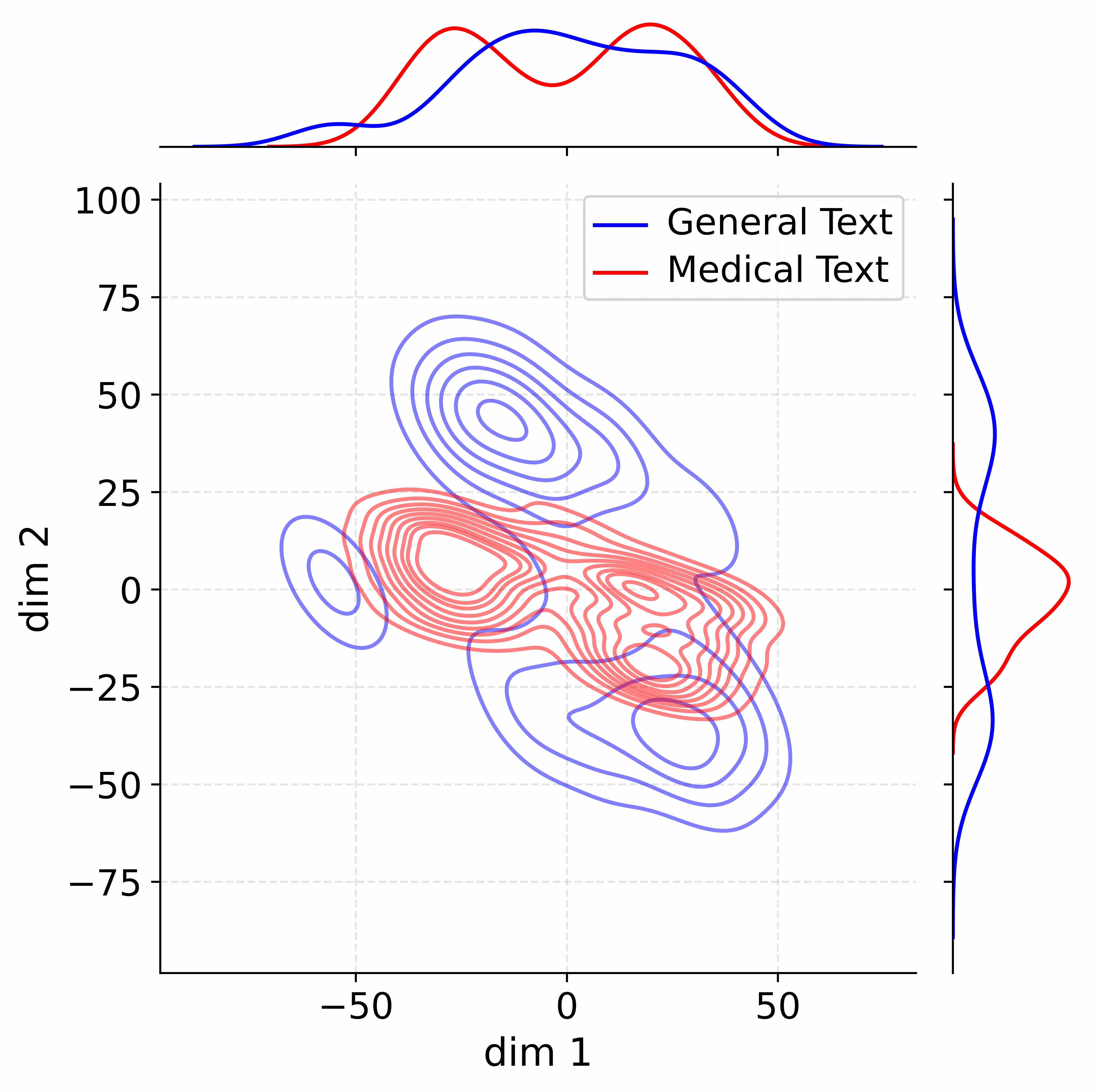
## Joint Contour Plot with Marginal Distributions: General Text vs. Medical Text
### Overview
The image is a joint plot displaying the two-dimensional distribution of two datasets, labeled "General Text" and "Medical Text," across two dimensions ("dim 1" and "dim 2"). The plot consists of a central contour plot showing the density of data points for each category, accompanied by marginal distribution plots (density curves) on the top and right sides. The visualization compares the spread, clustering, and overlap of the two text categories in this reduced-dimensional space.
### Components/Axes
* **Main Plot (Center):**
* **X-axis:** Labeled "dim 1". Ticks are visible at approximately -50, 0, and 50. The axis spans roughly from -75 to 75.
* **Y-axis:** Labeled "dim 2". Ticks are visible at -75, -50, -25, 0, 25, 50, 75, and 100. The axis spans roughly from -80 to 100.
* **Data Series:**
* **General Text:** Represented by blue contour lines.
* **Medical Text:** Represented by red contour lines.
* **Legend:** Located in the top-right quadrant of the main plot area. It contains two entries: a blue line labeled "General Text" and a red line labeled "Medical Text".
* **Marginal Plots:**
* **Top Marginal (above main plot):** Shows the density distribution along "dim 1". Contains a blue curve (General Text) and a red curve (Medical Text).
* **Right Marginal (to the right of main plot):** Shows the density distribution along "dim 2". Contains a blue curve (General Text) and a red curve (Medical Text).
### Detailed Analysis
**1. Main Contour Plot (dim 1 vs. dim 2):**
* **General Text (Blue):** Exhibits a multi-modal distribution with at least three distinct clusters.
* A primary, dense cluster is centered approximately at (dim1 ≈ -10, dim2 ≈ 50). This cluster has tightly packed concentric contours, indicating high density.
* A secondary cluster is located around (dim1 ≈ 25, dim2 ≈ -30).
* A smaller, less dense cluster appears near (dim1 ≈ -60, dim2 ≈ 0).
* The overall spread is wide, covering a large area from dim1 ≈ -70 to 50 and dim2 ≈ -60 to 70.
* **Medical Text (Red):** Shows a more concentrated, bi-modal distribution.
* The largest and densest cluster is centered near (dim1 ≈ -20, dim2 ≈ 0). The contours are very tightly packed, suggesting extremely high data density in this core region.
* A second, smaller cluster is visible around (dim1 ≈ 20, dim2 ≈ -10).
* The distribution is more compact than the General Text, primarily confined to dim1 between -40 and 40, and dim2 between -25 and 25.
* **Overlap:** There is significant spatial overlap between the two distributions, particularly in the region around dim1 ≈ 0, dim2 ≈ 0. The red (Medical) contours are largely contained within the broader spatial extent of the blue (General) contours.
**2. Top Marginal Distribution (dim 1):**
* **General Text (Blue):** The distribution is broad and relatively flat-topped, spanning from approximately -70 to 60 on dim1. It appears to have multiple subtle peaks.
* **Medical Text (Red):** The distribution is narrower and more peaked. It shows a clear bimodal shape with peaks near dim1 ≈ -20 and dim1 ≈ 20, and a dip near dim1 ≈ 0. Its range is roughly -40 to 40.
**3. Right Marginal Distribution (dim 2):**
* **General Text (Blue):** The distribution is very broad, spanning from approximately -75 to 90 on dim2. It has a complex shape with a major peak around dim2 ≈ 50 and a secondary shoulder or peak near dim2 ≈ -30.
* **Medical Text (Red):** The distribution is much narrower and sharply peaked around dim2 ≈ 0. Its range is approximately -25 to 25.
### Key Observations
1. **Dispersion vs. Concentration:** General Text data is significantly more dispersed across both dimensions compared to Medical Text, which is highly concentrated in a specific region of the space.
2. **Cluster Structure:** General Text forms multiple, separated clusters, suggesting heterogeneity within the dataset. Medical Text forms fewer, tighter clusters, indicating greater homogeneity or specialization.
3. **Central Overlap:** Despite their differences, both distributions share a common region of high density near the origin (0,0), implying some underlying similarity or shared features between a subset of general and medical texts.
4. **Dimensional Range:** The range of values for General Text on dim2 (up to ~90) is notably larger than for Medical Text (up to ~25).
### Interpretation
This plot likely visualizes the embedding or feature representations of text documents from two domains after dimensionality reduction (e.g., via PCA, t-SNE, or UMAP). The "dim 1" and "dim 2" axes represent the two most significant latent features capturing the variance in the data.
* **What the data suggests:** The visualization demonstrates that "Medical Text" occupies a more specialized, constrained region within the broader semantic or feature space defined by "General Text." The multi-modal nature of the General Text distribution reflects the diversity of topics, styles, and contexts inherent in general language. In contrast, the tighter clustering of Medical Text suggests it uses a more consistent, domain-specific vocabulary and structure, leading to more similar representations.
* **Relationship between elements:** The marginal distributions confirm the patterns seen in the joint plot. The broad, multi-peaked marginals for General Text correspond to its dispersed, multi-cluster 2D shape. The narrow, peaked marginals for Medical Text correspond to its concentrated 2D clusters. The overlap region indicates that not all medical text is distinct; some documents may use more general language or cover topics that bridge the two domains.
* **Notable implications:** This pattern is typical when comparing domain-specific corpora to general corpora. The analysis could be used to validate that a text classification model is learning domain-discriminative features, or to identify outlier documents (e.g., a medical text that falls far outside the red cluster might be misclassified or contain unusual language). The distinct clusters within each category (especially General Text) might warrant further investigation to see if they correspond to specific sub-topics or genres.