## Line Chart: Energy Consumption Trends (DNNs vs Human)
### Overview
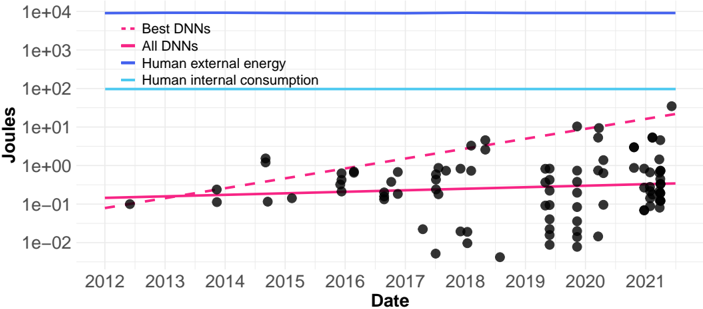
The chart visualizes energy consumption trends (in Joules) over time (2012–2021) for two categories: Deep Neural Networks (DNNs) and human energy use. It includes two human-related metrics ("external energy" and "internal consumption") and two DNN-related metrics ("Best DNNs" and "All DNNs"). The y-axis uses a logarithmic scale (1e-02 to 1e+04 Joules), while the x-axis spans 2012 to 2021.
### Components/Axes
- **X-axis (Date)**: 2012 to 2021, labeled annually.
- **Y-axis (Joules)**: Logarithmic scale from 1e-02 to 1e+04.
- **Legend**: Located at the top-right, with four entries:
- **Best DNNs**: Dashed red line.
- **All DNNs**: Solid pink line.
- **Human external energy**: Solid blue line.
- **Human internal consumption**: Solid cyan line.
- **Data Points**: Black dots scattered across the chart, primarily clustered near the "All DNNs" and "Best DNNs" lines.
### Detailed Analysis
1. **Best DNNs (Dashed Red Line)**:
- Starts near 1e+01 Joules in 2012.
- Rises steadily to ~1e+03 Joules by 2021.
- Slope: ~10x increase over the decade.
2. **All DNNs (Solid Pink Line)**:
- Begins at ~1e-01 Joules in 2012.
- Grows to ~1e+02 Joules by 2021.
- Slope: ~1000x increase over the decade.
3. **Human External Energy (Solid Blue Line)**:
- Flat line at ~1e+04 Joules throughout 2012–2021.
4. **Human Internal Consumption (Solid Cyan Line)**:
- Flat line at ~1e+02 Joules throughout 2012–2021.
5. **Data Points**:
- Black dots align closely with the "All DNNs" and "Best DNNs" lines.
- Outliers: A few points deviate slightly (e.g., 2017, 2020), but most follow the trend.
### Key Observations
- **Exponential Growth**: Both DNN categories show exponential growth, with "Best DNNs" outpacing "All DNNs" by ~10x.
- **Human Stability**: Human energy metrics remain constant, suggesting no significant change in consumption patterns.
- **Scaling Disparity**: By 2021, "Best DNNs" approach human external energy levels (~1e+03 vs. 1e+04), while "All DNNs" surpass human internal consumption (~1e+02 vs. 1e+02).
- **Outliers**: Minor deviations in data points (e.g., 2017, 2020) may reflect measurement noise or transient events.
### Interpretation
The chart highlights the rapid energy consumption growth of DNNs, particularly high-performing models ("Best DNNs"), which are closing the gap with human energy use. By 2021, DNNs collectively exceed human internal consumption, signaling their increasing computational footprint. The stability of human energy metrics contrasts sharply with DNN trends, emphasizing technological advancements' role in driving energy demand. Outliers warrant further investigation to determine if they represent anomalies or intentional design choices in specific models. This trend raises concerns about sustainability and the environmental impact of AI infrastructure.