## Diagram: Westlife Album Factuality Verification & Training Sample Creation
### Overview
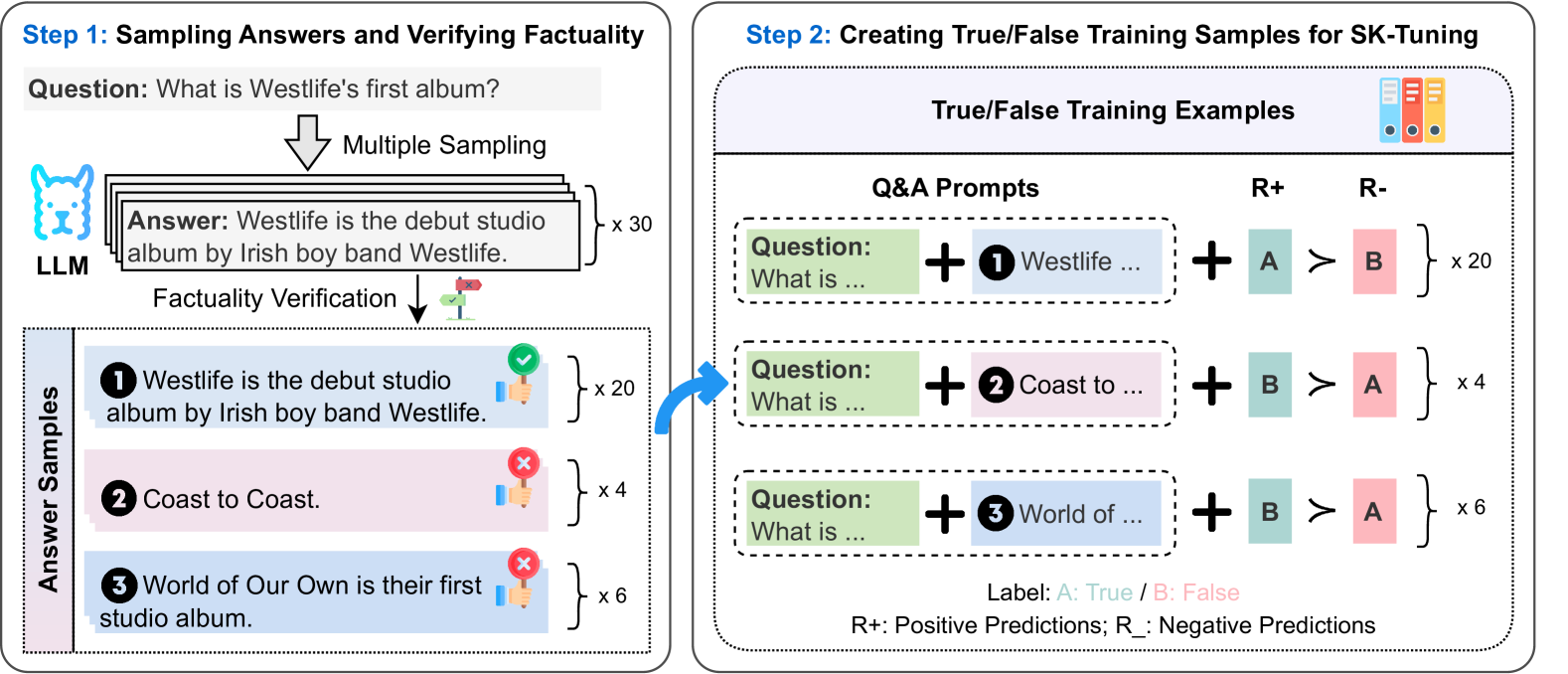
This diagram illustrates a two-step process: Step 1 focuses on sampling answers to a question using a Large Language Model (LLM) and verifying their factual accuracy. Step 2 details the creation of True/False training samples for SK-Tuning, utilizing the results from Step 1. The diagram visually represents the flow of information and the evaluation process.
### Components/Axes
The diagram is divided into two main sections, labeled "Step 1: Sampling Answers and Verifying Factuality" and "Step 2: Creating True/False Training Samples for SK-Tuning".
**Step 1 Components:**
* **LLM:** Represented by a cartoon robot head.
* **Question:** "What is Westlife's first album?"
* **Multiple Sampling:** A box indicating the LLM generates multiple answers.
* **Answer Samples:** A list of three answers:
1. "Westlife is the debut studio album by Irish boy band Westlife."
2. "Coast to Coast."
3. "World of Our Own is their first studio album."
* **Factual Verification:** A process indicated by a downward arrow and a checkmark/cross symbol.
* **Quantities:** Each answer sample is associated with a quantity: x20, x4, x6.
**Step 2 Components:**
* **True/False Training Examples:** A header for this section.
* **Q&A Prompts:** A table with three rows, each representing a prompt.
* **R+ / R-:** Labels indicating Positive and Negative Predictions.
* **Comparison Operator:** ">" (greater than) is used in the comparison.
* **Quantities:** Each prompt is associated with a quantity: x20, x4, x6.
* **Label:** A key indicating A: True / B: False.
### Detailed Analysis or Content Details
**Step 1 Analysis:**
The LLM is prompted with the question "What is Westlife's first album?". It generates three answers:
1. "Westlife is the debut studio album by Irish boy band Westlife." – Verified as True (indicated by a green checkmark) and repeated 20 times.
2. "Coast to Coast." – Verified as False (indicated by a red cross) and repeated 4 times.
3. "World of Our Own is their first studio album." – Verified as False (indicated by a red cross) and repeated 6 times.
**Step 2 Analysis:**
The verified answers are used to create True/False training examples. Each example consists of a question and a comparison between two answers (A and B).
1. **Prompt 1:** Question: "What is..." + "Westlife..." + "A > B" – Repeated 20 times.
2. **Prompt 2:** Question: "What is..." + "Coast to..." + "B > A" – Repeated 4 times.
3. **Prompt 3:** Question: "What is..." + "World of..." + "B > A" – Repeated 6 times.
The label indicates that 'A' represents the True answer and 'B' represents the False answer. R+ denotes positive predictions, and R- denotes negative predictions.
### Key Observations
* The LLM generates multiple answers, demonstrating the need for verification.
* The factual verification process identifies both correct and incorrect answers.
* The quantities (x20, x4, x6) suggest a weighted sampling or prioritization of certain answers for training.
* The comparison operator (">") is used to create a binary True/False classification task.
* The diagram clearly shows the transformation of LLM outputs into a structured training dataset.
### Interpretation
The diagram illustrates a method for improving the factual accuracy of a Large Language Model through a two-step process of answer sampling, verification, and training data creation. The LLM initially generates multiple responses to a question. These responses are then evaluated for factual correctness. The verified answers are subsequently used to construct training examples for a SK-Tuning process, likely aimed at refining the model's ability to distinguish between true and false statements. The weighting (x20, x4, x6) suggests that the training data is not uniformly distributed, potentially prioritizing more frequent or important examples. The use of a comparison operator (">") implies that the model is being trained to rank the correctness of different answers. This process is a form of reinforcement learning, where the model learns from its mistakes and improves its performance over time. The diagram highlights the importance of both generating diverse answers and rigorously verifying their accuracy in building reliable and trustworthy AI systems.