\n
## Diagram: System Architecture - HE Instruction Flow
### Overview
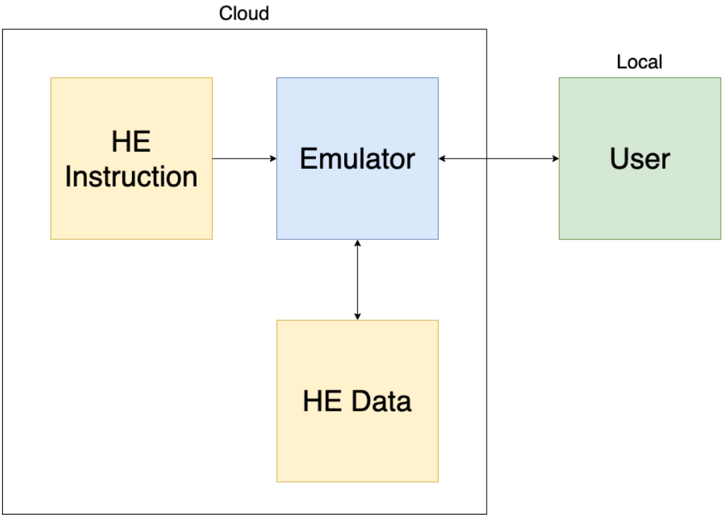
The image depicts a system architecture diagram illustrating the flow of HE (Histopathology Embedding) instructions and data between a "User" (local) and components residing in the "Cloud". The diagram shows a central "Emulator" component facilitating communication between the User and two cloud-based elements: "HE Instruction" and "HE Data".
### Components/Axes
The diagram consists of four rectangular components:
* **User:** Located on the right side, labeled "User" and designated as "Local".
* **HE Instruction:** Located in the top-left corner of the "Cloud" area, labeled "HE Instruction".
* **Emulator:** Positioned centrally within the "Cloud" area, labeled "Emulator".
* **HE Data:** Located in the bottom-center of the "Cloud" area, labeled "HE Data".
The diagram also includes directional arrows indicating the flow of information:
* An arrow originates from "HE Instruction" and points to "Emulator".
* An arrow originates from "Emulator" and points to "User".
* A bidirectional arrow connects "Emulator" and "HE Data".
* The entire diagram is enclosed within a rectangular border labeled "Cloud" in the top-right corner.
### Detailed Analysis or Content Details
The diagram illustrates a data flow:
1. "HE Instruction" sends information to the "Emulator".
2. The "Emulator" processes the instruction and communicates with the "User".
3. The "Emulator" also exchanges data with "HE Data".
There are no numerical values or scales present in the diagram. The diagram is purely conceptual, representing the relationships and flow of information between the components.
### Key Observations
The "Emulator" acts as a central hub, mediating communication between the "User", "HE Instruction", and "HE Data". The bidirectional arrow between the "Emulator" and "HE Data" suggests a continuous or iterative exchange of information. The "User" is explicitly identified as being "Local", implying a distinction from the cloud-based components.
### Interpretation
This diagram likely represents a system for processing histopathology embedding instructions. The "User" initiates a request or provides input, which is then processed by the "Emulator" based on "HE Instruction". The "Emulator" retrieves or updates "HE Data" as part of this process. The cloud-based architecture suggests scalability and accessibility. The separation of "HE Instruction" and "HE Data" implies a modular design, where instructions and data are managed independently. The diagram highlights a client-server model, where the "User" acts as the client and the "Emulator", "HE Instruction", and "HE Data" collectively form the server-side components. The system appears designed to handle histopathology embedding tasks remotely, leveraging cloud resources for processing and data storage.