\n
## Screenshot: SemanticCite User Interface
### Overview
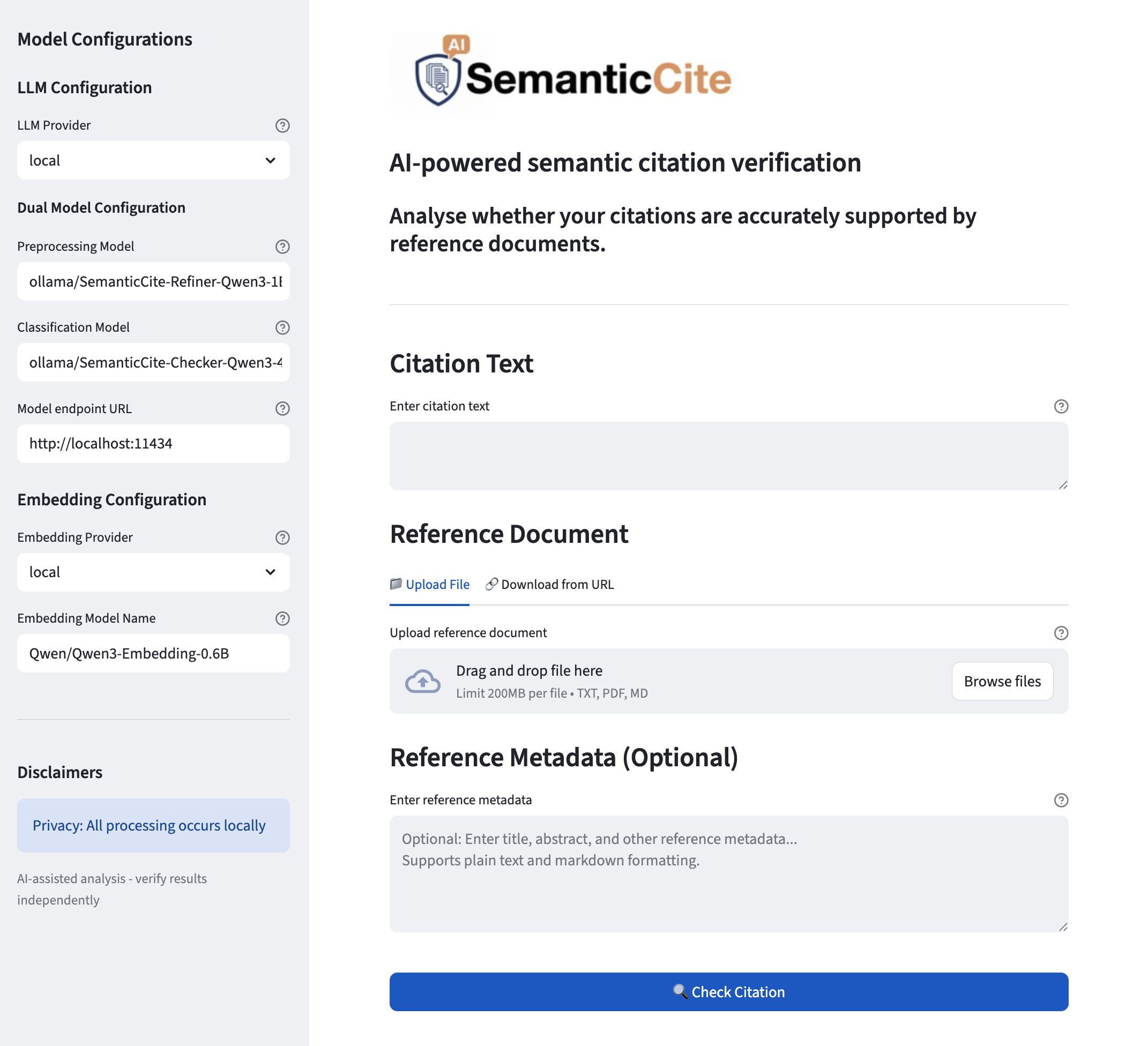
The image is a screenshot of the user interface for a tool called "SemanticCite," which provides AI-powered semantic citation verification. The interface allows users to input citation text and a reference document to check the accuracy of the citation. The UI is divided into sections for Model Configurations, Citation Text input, Reference Document upload, Reference Metadata (optional), and a "Check Citation" button.
### Components/Axes
The screenshot contains the following UI elements:
* **Header:** Displays the SemanticCite logo and a brief description of the tool's function.
* **Model Configurations:** A section with settings for the underlying AI models.
* LLM Provider: Dropdown menu, currently set to "local".
* Preprocessing Model: Label "ollama/SemanticCite-Refiner-Qwen3-1l" with a question mark icon.
* Classification Model: Label "ollama/SemanticCite-Checker-Qwen3-4" with a question mark icon.
* Model endpoint URL: Displays "http://localhost:11434".
* **Embedding Configuration:** A section with settings for the embedding model.
* Embedding Provider: Dropdown menu, currently set to "local".
* Embedding Model Name: Label "Qwen/Qwen3-Embedding.0.6B" with a question mark icon.
* **Disclaimers:** A section with two lines of text regarding privacy and AI-assisted analysis.
* **Citation Text:** A text input field with a placeholder "Enter citation text" and a question mark icon.
* **Reference Document:** A section for uploading a reference document.
* Upload options: "Upload File" and "Download from URL".
* Drag and drop area: "Drag and drop file here. Limit 200MB per file - TXT, PDF, MD".
* "Browse files" button.
* **Reference Metadata (Optional):** A text input field with a placeholder "Enter reference metadata" and a question mark icon. It states that plain text and markdown formatting are supported.
* **"Check Citation" Button:** A prominent button at the bottom of the interface.
### Detailed Analysis or Content Details
The following text is directly transcribed from the screenshot:
* **SemanticCite** (Logo)
* **Al-powered semantic citation verification**
* **Analyse whether your citations are accurately supported by reference documents.**
* **Model Configurations**
* **LLM Configuration**
* **LLM Provider** (Dropdown: local)
* **Dual Model Configuration**
* **Preprocessing Model** ollama/SemanticCite-Refiner-Qwen3-1l
* **Classification Model** ollama/SemanticCite-Checker-Qwen3-4
* **Model endpoint URL** http://localhost:11434
* **Embedding Configuration**
* **Embedding Provider** (Dropdown: local)
* **Embedding Model Name** Qwen/Qwen3-Embedding.0.6B
* **Disclaimers**
* **Privacy and processing occurs locally**
* **Al-assisted analysis - verify results independently**
* **Citation Text** Enter citation text
* **Reference Document**
* **Upload File** ⤓ **Download from URL**
* **Drag and drop file here. Limit 200MB per file - TXT, PDF, MD**
* **Browse files**
* **Reference Metadata (Optional)** Enter reference metadata
* **Optional: Enter title, abstract, and other reference metadata... Supports plain text and markdown formatting.**
* **Check Citation**
### Key Observations
The interface is clean and straightforward. The use of question mark icons next to configuration options suggests that more information is available upon clicking. The emphasis on local processing ("local" selected in dropdowns and disclaimer about privacy) indicates a focus on user data security. The file size limit of 200MB is specified.
### Interpretation
The SemanticCite tool aims to automate the process of verifying the accuracy of citations. By allowing users to input both the citation and the reference document, the AI can analyze whether the citation accurately reflects the content of the source material. The tool leverages Large Language Models (LLMs) and embedding models (Qwen3) for semantic analysis. The configuration options allow users to customize the AI models used for the verification process, potentially enabling experimentation with different models to optimize performance. The emphasis on local processing suggests a commitment to user privacy and data security. The optional metadata field allows for more context to be provided, potentially improving the accuracy of the verification process. The tool is likely intended for researchers, students, and anyone who needs to ensure the accuracy of their citations.