## System Diagram: LLM-based Agent Interaction with Environment
### Overview
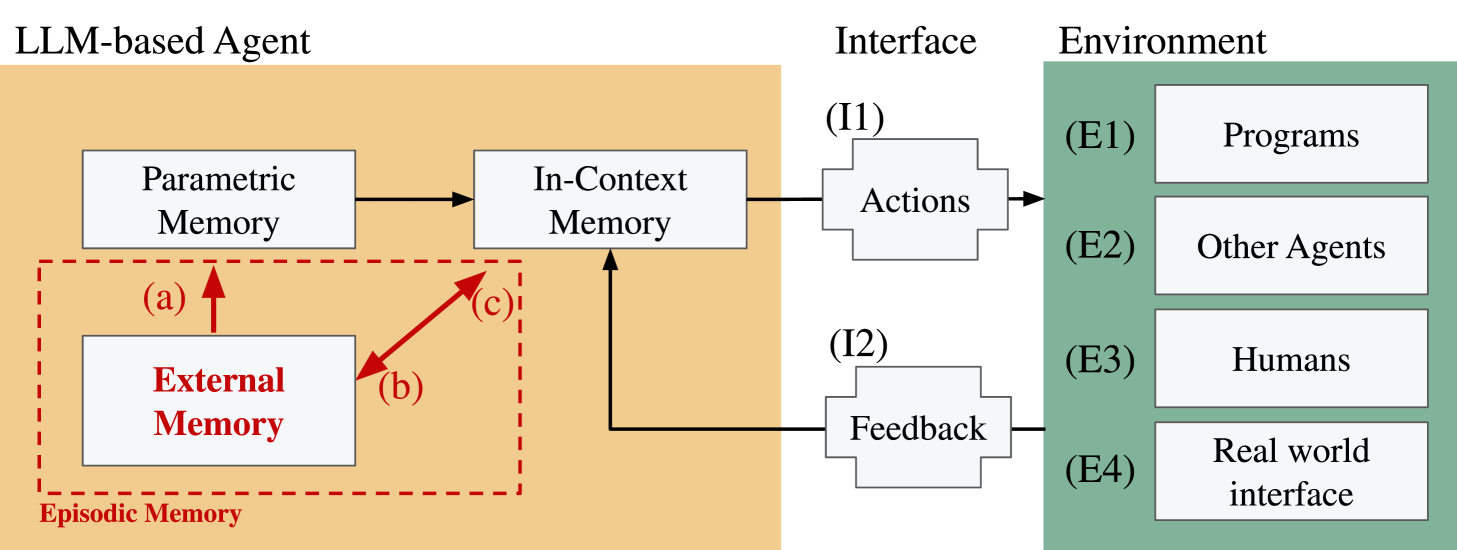
The image is a system diagram illustrating the interaction of an LLM-based agent with its environment through an interface. The diagram highlights the flow of information and actions between the agent's memory components, the interface, and various elements within the environment.
### Components/Axes
* **LLM-based Agent:** The left-most section, colored light orange, representing the agent itself. It contains the following components:
* Parametric Memory: A white rectangular box at the top.
* In-Context Memory: A white rectangular box to the right of Parametric Memory.
* Episodic Memory: A red dashed rectangular box containing:
* External Memory: A white rectangular box within the Episodic Memory.
* Arrow (a): A red arrow pointing upwards from External Memory to Parametric Memory.
* Arrow (b): A red arrow pointing from External Memory to In-Context Memory.
* Arrow (c): A red arrow pointing from In-Context Memory to External Memory.
* **Interface:** The middle section, colored light gray, representing the interface between the agent and the environment. It contains the following components:
* (I1) Actions: A white, stylized rectangular box.
* (I2) Feedback: A white, stylized rectangular box below Actions.
* **Environment:** The right-most section, colored light green, representing the environment the agent interacts with. It contains the following components:
* (E1) Programs: A white rectangular box.
* (E2) Other Agents: A white rectangular box below Programs.
* (E3) Humans: A white rectangular box below Other Agents.
* (E4) Real world interface: A white rectangular box below Humans.
### Detailed Analysis or ### Content Details
* **LLM-based Agent:**
* Parametric Memory feeds into In-Context Memory via a black arrow.
* External Memory within the Episodic Memory interacts with both Parametric Memory (arrow a) and In-Context Memory (arrows b and c).
* **Interface:**
* In-Context Memory feeds into Actions (I1) via a black arrow.
* Feedback (I2) feeds into External Memory via a black arrow.
* Actions (I1) feeds into the Environment.
* **Environment:**
* The environment consists of Programs (E1), Other Agents (E2), Humans (E3), and a Real world interface (E4).
### Key Observations
* The diagram illustrates a closed-loop system where the agent interacts with the environment and receives feedback.
* The Episodic Memory, specifically the External Memory, plays a central role in connecting the agent's internal memory components.
* The interface mediates the interaction between the agent and the environment through actions and feedback.
### Interpretation
The diagram represents a conceptual model of an LLM-based agent interacting with its environment. The agent uses its Parametric and In-Context memories to generate actions, which are then executed in the environment. The agent receives feedback from the environment, which is stored in its External Memory within the Episodic Memory. This feedback can then be used to update the agent's Parametric and In-Context memories, allowing it to learn and adapt to the environment. The red arrows (a, b, c) highlight the dynamic interaction between the agent's memory components, suggesting a continuous process of learning and adaptation. The separation of the agent, interface, and environment allows for modularity and flexibility in the system design.