\n
## Diagram: LLM-based Agent Architecture
### Overview
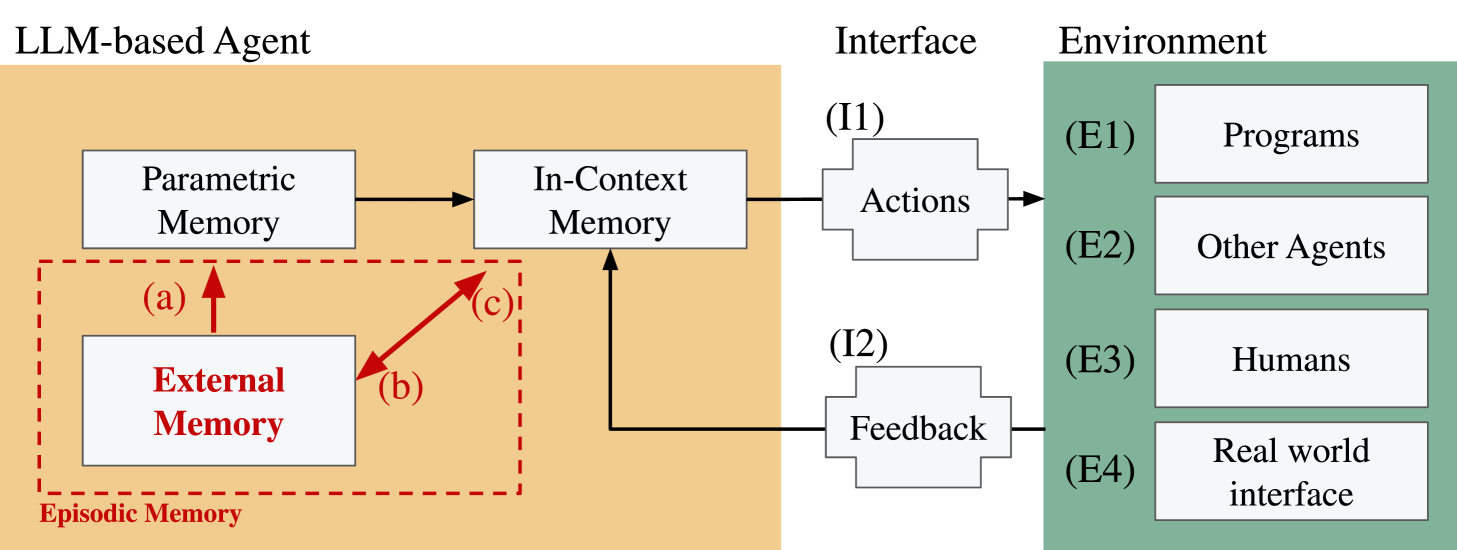
This diagram illustrates the architecture of a Large Language Model (LLM)-based agent, showing its interaction with an environment through an interface. The agent is divided into components representing different types of memory, and the environment contains various entities. Data flow is indicated by arrows labeled (a), (b), and (c).
### Components/Axes
The diagram is segmented into three main sections: "LLM-based Agent" (peach color), "Interface" (yellow color), and "Environment" (green color).
**LLM-based Agent:**
* **Parametric Memory:** Located at the top-left of the agent section.
* **In-Context Memory:** Centrally located within the agent section.
* **External Memory:** Located at the bottom-left of the agent section.
* **Episodic Memory:** Represented by a dashed box encompassing the "External Memory".
**Interface:**
* **Actions (I1):** A rectangular box on the left side of the interface.
* **Feedback (I2):** A rectangular box on the right side of the interface.
**Environment:**
* **Programs (E1):** A rectangular box at the top of the environment.
* **Other Agents (E2):** A rectangular box below "Programs".
* **Humans (E3):** A rectangular box below "Other Agents".
* **Real world interface (E4):** A rectangular box at the bottom of the environment.
**Arrows:**
* **(a):** Arrow from "External Memory" to "Parametric Memory".
* **(b):** Arrow from "External Memory" to "In-Context Memory".
* **(c):** Arrow from "In-Context Memory" to "External Memory".
### Detailed Analysis or Content Details
The diagram depicts a cyclical flow of information within the LLM-based agent and between the agent and the environment.
* **Memory Interaction:** "External Memory" feeds information to both "Parametric Memory" (arrow a) and "In-Context Memory" (arrow b). "In-Context Memory" also provides information back to "External Memory" (arrow c), creating a feedback loop.
* **Agent-Environment Interaction:** "Actions" (I1) from the interface are sent to the "Environment", while "Feedback" (I2) from the environment is sent back to the agent.
* **Environment Components:** The environment consists of "Programs", "Other Agents", "Humans", and a "Real world interface".
### Key Observations
The diagram emphasizes the importance of different memory types in an LLM-based agent. The cyclical flow between "External Memory" and "In-Context Memory" suggests a continuous learning and adaptation process. The interface acts as a bridge between the agent and the external world, enabling interaction with various entities.
### Interpretation
This diagram illustrates a conceptual model for an LLM-based agent. The agent's architecture is designed to leverage different types of memory to enhance its capabilities. "Parametric Memory" likely represents the LLM's learned weights, while "In-Context Memory" refers to the information provided in the current prompt. "External Memory" serves as a long-term storage for knowledge and experiences. The interaction with the environment through the interface allows the agent to perform actions and receive feedback, enabling it to learn and improve over time. The inclusion of "Humans" and a "Real world interface" in the environment highlights the agent's potential for real-world applications. The diagram suggests a complex system where information flows continuously between different components, enabling the agent to adapt and respond to its environment.