## Diagram: LLM-based Agent Architecture
### Overview
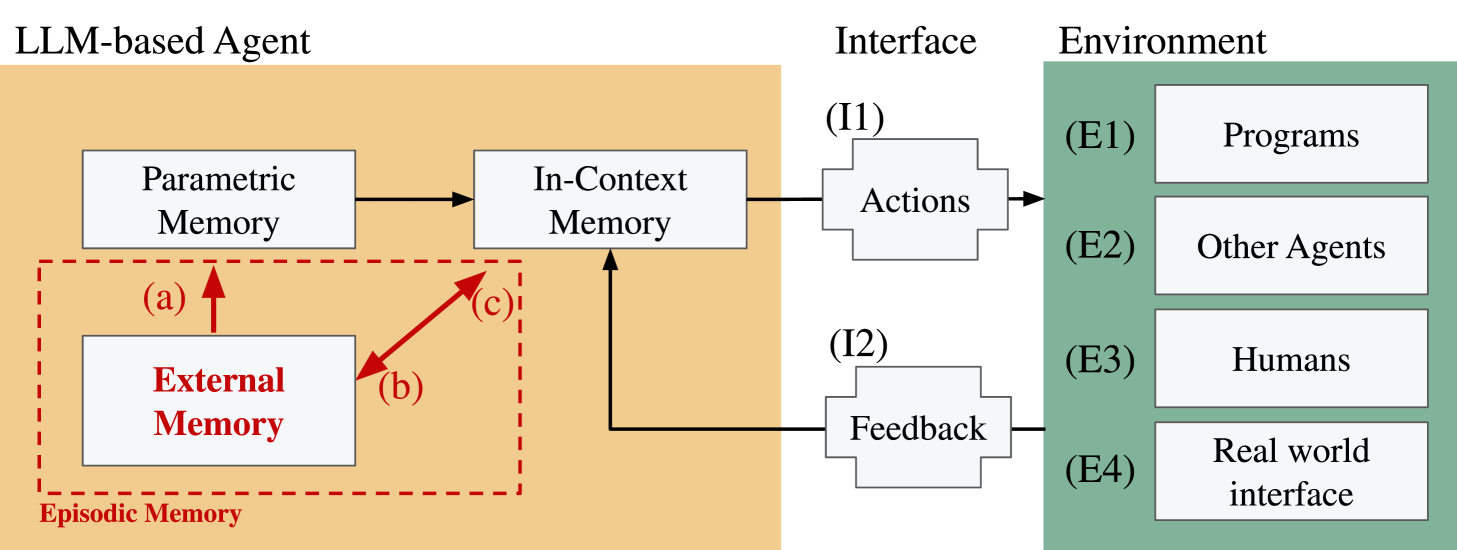
The diagram illustrates the architecture of an LLM-based agent system, divided into three primary components: **LLM-based Agent**, **Interface**, and **Environment**. Arrows indicate directional interactions between components, with labeled connections (a, b, c, I1, I2, E1-E4). The system emphasizes memory management, contextual processing, and environmental interaction.
---
### Components/Axes
1. **LLM-based Agent** (orange section):
- **Parametric Memory**: Stores static knowledge (e.g., model parameters).
- **In-Context Memory**: Temporary storage for active tasks.
- **External Memory**: Labeled as part of **Episodic Memory** (dashed red box), with bidirectional interactions:
- (a) ↑: Input to Parametric Memory.
- (b) ←: Output from In-Context Memory.
- (c) ↗: Feedback loop to In-Context Memory.
- **In-Context Memory** → **Actions** (Interface section).
2. **Interface** (gray section):
- (I1) **Actions**: Outputs from In-Context Memory.
- (I2) **Feedback**: Input from Environment to In-Context Memory.
3. **Environment** (green section):
- (E1) **Programs**: Software components.
- (E2) **Other Agents**: External AI systems.
- (E3) **Humans**: User interactions.
- (E4) **Real world interface**: Physical world integration.
---
### Detailed Analysis
- **Memory Flow**:
- External Memory (Episodic) feeds into Parametric Memory (a), which combines with In-Context Memory (b) to generate Actions.
- Feedback (I2) from the Environment (E1-E4) loops back to In-Context Memory (c), enabling adaptive learning.
- **Environmental Interaction**:
- Actions (I1) influence Programs, Other Agents, Humans, and the Real world interface (E1-E4).
- Feedback (I2) aggregates inputs from all environmental elements to refine the agent’s decisions.
---
### Key Observations
1. **Modular Design**: Clear separation of memory types (Parametric vs. Episodic) and environmental components.
2. **Feedback Loop**: Critical for iterative improvement, connecting all environmental elements (E1-E4) to In-Context Memory.
3. **Bidirectional Memory**: External Memory (Episodic) interacts with both Parametric and In-Context Memory, suggesting dynamic knowledge integration.
---
### Interpretation
This architecture demonstrates a hybrid system where:
- **Static knowledge** (Parametric Memory) is combined with **dynamic context** (In-Context Memory) to drive actions.
- **Episodic Memory** (External Memory) acts as a long-term repository, influencing both static and contextual decisions.
- The **feedback loop** (I2) ensures the agent adapts to environmental changes, including interactions with humans, other agents, and real-world systems.
- The separation of **Interface** and **Environment** highlights modularity, allowing scalability (e.g., adding new environmental components without redesigning the core agent).
The diagram emphasizes a closed-loop system where memory, action, and environmental feedback are interdependent, critical for robust LLM-based agents in complex, real-world scenarios.