\n
## Grid: Binary Representation
### Overview
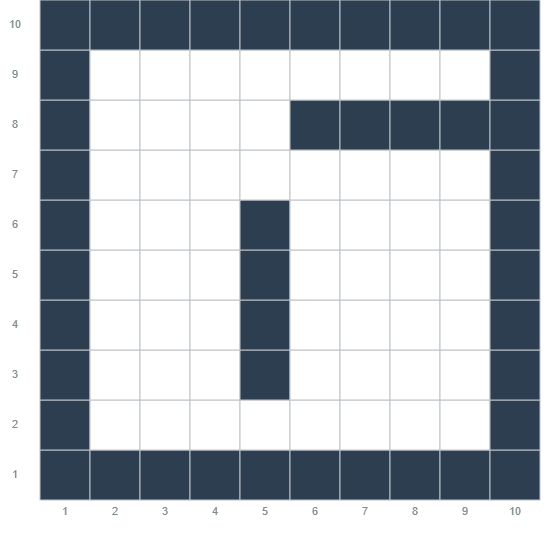
The image depicts a 10x10 grid filled with colored squares. The grid appears to represent a binary pattern, with some squares colored dark blue and others left white. There are no explicit labels or legends. The grid forms a shape resembling the letter "E".
### Components/Axes
* **X-axis:** Ranges from 1 to 10, with integer values.
* **Y-axis:** Ranges from 1 to 10, with integer values.
* **Color Scheme:** Two colors are used: dark blue (representing a value) and white (representing the absence of a value).
### Detailed Analysis or Content Details
The dark blue squares are located at the following coordinates:
* (1, 1) to (1, 10) - Horizontal line along the bottom.
* (1, 1) to (10, 1) - Vertical line along the left.
* (1, 10) to (10, 10) - Horizontal line along the top.
* (10, 1) to (10, 10) - Vertical line along the right.
* (6, 6) to (6, 8) - Vertical line.
* (5, 6) to (7, 6) - Horizontal line.
* (5, 3) to (5, 5) - Vertical line.
* (8, 8) to (10, 8) - Horizontal line.
The white squares represent the background and the absence of the value.
### Key Observations
The arrangement of the dark blue squares forms a clear "E" shape within the grid. The grid is symmetrical along the horizontal axis. The pattern is discrete, with sharp transitions between the dark blue and white squares.
### Interpretation
The image likely represents a visual encoding of the letter "E" using a binary grid. The dark blue squares could represent "on" or "1" states, while the white squares represent "off" or "0" states. This could be a simplified representation of a pixelated image or a basic form of data visualization. The grid structure suggests a digital or computational context. The "E" shape could be a symbolic representation or a part of a larger code or message. The image is a simple, yet effective, way to convey information using a limited set of visual elements. It is a visual representation of a binary pattern, and the shape formed is the letter "E".