## Grid Diagram: 10x10 Cell Pattern
### Overview
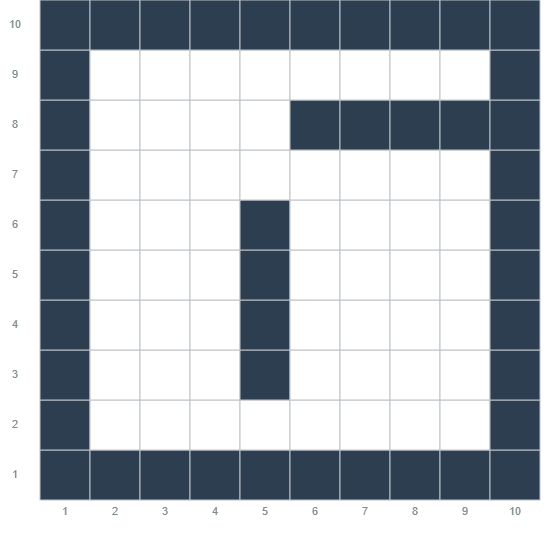
The image depicts a 10x10 grid with specific cells filled in black. The filled cells form a border around the grid and include internal vertical and horizontal lines. No explicit labels, legends, or textual annotations are present beyond the row and column numbers.
### Components/Axes
- **Rows**: Labeled 1 to 10 (vertical axis, left side).
- **Columns**: Labeled 1 to 10 (horizontal axis, bottom).
- **Filled Cells**: Black squares indicate a binary state (e.g., "occupied" vs. "empty").
- **No Legend**: No explicit key or color coding is provided.
### Detailed Analysis
- **Border**: All cells in rows 1 and 10, and columns 1 and 10 are filled.
- **Internal Vertical Line**: Column 5 has filled cells from rows 3 to 8.
- **Internal Horizontal Line**: Row 8 has filled cells from columns 6 to 9.
- **Additional Filled Cells**:
- Row 3: Columns 1, 5, 6, 10.
- Row 4: Columns 1, 5, 6, 10.
- Row 5: Columns 1, 5, 6, 10.
- Row 6: Columns 1, 5, 6, 10.
- Row 7: Columns 1, 5, 6, 10.
- Row 8: Columns 1, 5, 6, 7, 8, 9, 10.
- Row 9: Columns 1, 10.
### Key Observations
1. **Symmetry**: The filled cells create a symmetrical border around the grid.
2. **Internal Structure**: A vertical line in column 5 and a horizontal line in row 8 intersect at cell (8,5), forming a cross.
3. **Asymmetry**: The horizontal line in row 8 extends further (columns 6–9) compared to other rows.
### Interpretation
The grid likely represents a structured layout, such as a maze, a circuit diagram, or a spatial pattern. The filled cells may indicate:
- **Boundaries**: The outer border could signify a perimeter or enclosure.
- **Pathways**: The internal lines (column 5 and row 8) might represent routes or connections.
- **Data Representation**: Without a legend, the filled cells could symbolize a binary condition (e.g., "active" vs. "inactive").
The absence of a legend limits definitive interpretation, but the pattern suggests a deliberate design for navigation, segmentation, or data encoding. The intersection at (8,5) may serve as a focal point or junction.