\n
## Chart: Model Performance vs. Number of Tokens
### Overview
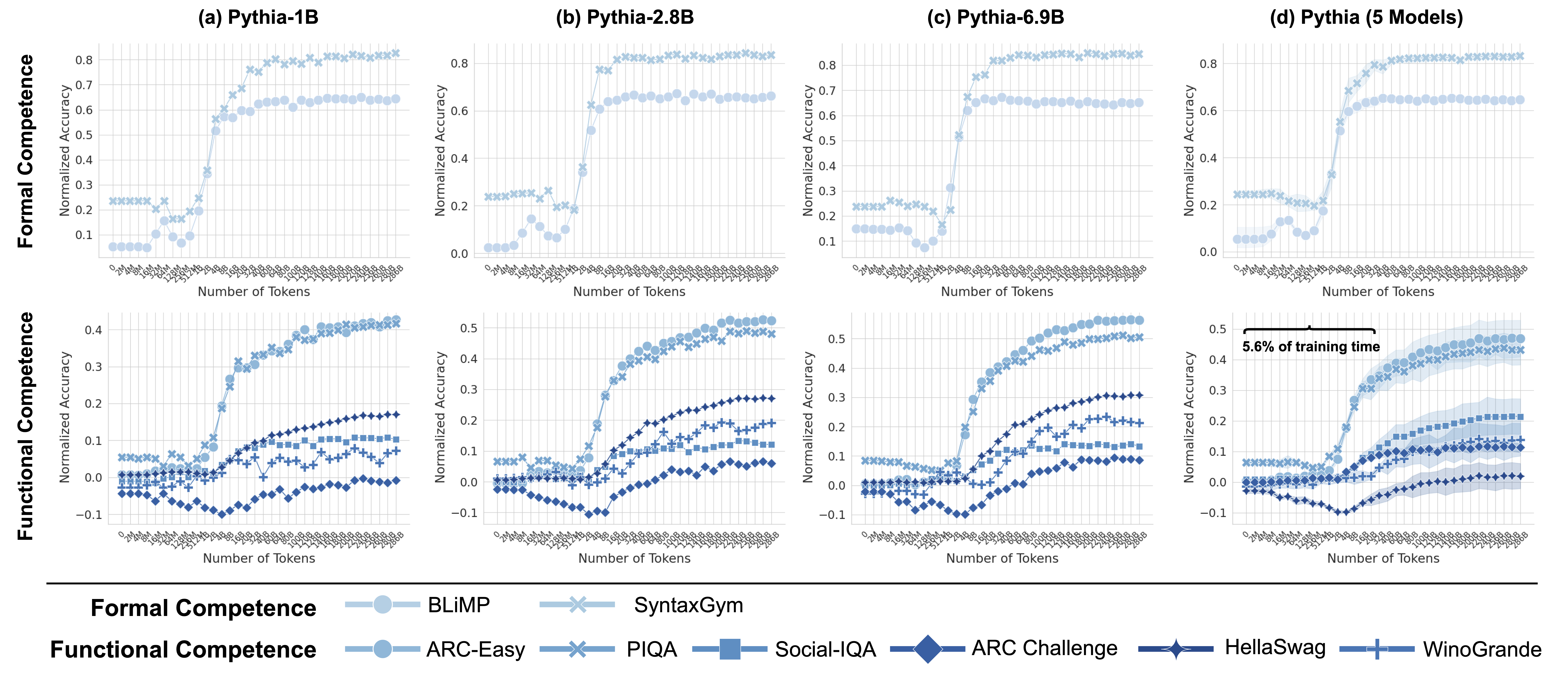
The image presents a series of four charts comparing the performance of different Pythia models (1B, 2.8B, 6.9B, and an ensemble of 5 models) on two types of competence tests: Formal and Functional. Performance is measured as Normalized Accuracy against the Number of Tokens processed. Each chart displays multiple data series representing different benchmark datasets.
### Components/Axes
* **X-axis:** Number of Tokens (Scale: 0 to approximately 2000, with no specific markings)
* **Y-axis (Top Charts - Formal Competence):** Normalized Accuracy (Scale: 0 to 0.8, with markings at 0, 0.2, 0.4, 0.6, and 0.8)
* **Y-axis (Bottom Charts - Functional Competence):** Normalized Accuracy (Scale: -0.1 to 0.4, with markings at -0.1, 0, 0.1, 0.2, 0.3, and 0.4)
* **Legend:** Located at the bottom-center of the image.
* **Formal Competence:** BLIMP (Light Blue), SyntaxGym (Light Green)
* **Functional Competence:** ARC-Easy (Dark Green), PIQA (Orange), Social-IQA (Dark Blue), ARC Challenge (Purple), HellaSwag (Teal), and Winogrande (Red)
* **Sub-Titles:** Each chart is labeled (a) Pythia-1B, (b) Pythia-2.8B, (c) Pythia-6.9B, (d) Pythia (5 Models)
* **Annotation:** Chart (d) includes the annotation "5.6% of training time"
### Detailed Analysis or Content Details
**Chart (a) Pythia-1B:**
* **Formal Competence:**
* BLIMP: Line slopes upward, starting around 0.05 and reaching approximately 0.25.
* SyntaxGym: Line is relatively flat, fluctuating around 0.1.
* **Functional Competence:**
* ARC-Easy: Line starts near 0 and increases to approximately 0.15.
* PIQA: Line starts near 0 and increases to approximately 0.2.
* Social-IQA: Line starts near 0 and increases to approximately 0.1.
* ARC Challenge: Line is relatively flat, fluctuating around 0.
* HellaSwag: Line starts near 0 and increases to approximately 0.1.
* Winogrande: Line is relatively flat, fluctuating around 0.
**Chart (b) Pythia-2.8B:**
* **Formal Competence:**
* BLIMP: Line slopes upward, starting around 0.1 and reaching approximately 0.4.
* SyntaxGym: Line is relatively flat, fluctuating around 0.15.
* **Functional Competence:**
* ARC-Easy: Line starts near 0 and increases to approximately 0.3.
* PIQA: Line starts near 0 and increases to approximately 0.35.
* Social-IQA: Line starts near 0 and increases to approximately 0.2.
* ARC Challenge: Line is relatively flat, fluctuating around 0.
* HellaSwag: Line starts near 0 and increases to approximately 0.2.
* Winogrande: Line is relatively flat, fluctuating around 0.
**Chart (c) Pythia-6.9B:**
* **Formal Competence:**
* BLIMP: Line slopes upward, starting around 0.15 and reaching approximately 0.6.
* SyntaxGym: Line is relatively flat, fluctuating around 0.2.
* **Functional Competence:**
* ARC-Easy: Line starts near 0 and increases to approximately 0.4.
* PIQA: Line starts near 0 and increases to approximately 0.45.
* Social-IQA: Line starts near 0 and increases to approximately 0.3.
* ARC Challenge: Line is relatively flat, fluctuating around 0.
* HellaSwag: Line starts near 0 and increases to approximately 0.3.
* Winogrande: Line is relatively flat, fluctuating around 0.
**Chart (d) Pythia (5 Models):**
* **Formal Competence:**
* BLIMP: Line slopes upward, starting around 0.2 and reaching approximately 0.7.
* SyntaxGym: Line is relatively flat, fluctuating around 0.25.
* **Functional Competence:**
* ARC-Easy: Line starts near 0 and increases to approximately 0.3.
* PIQA: Line starts near 0 and increases to approximately 0.35.
* Social-IQA: Line starts near 0 and increases to approximately 0.25.
* ARC Challenge: Line is relatively flat, fluctuating around 0.
* HellaSwag: Line starts near 0 and increases to approximately 0.25.
* Winogrande: Line is relatively flat, fluctuating around 0.
### Key Observations
* Generally, performance on both Formal and Functional Competence tasks increases with model size (1B to 6.9B to 5 Models).
* BLIMP consistently shows the highest performance among the Formal Competence benchmarks.
* PIQA consistently shows the highest performance among the Functional Competence benchmarks.
* ARC Challenge and Winogrande consistently show the lowest performance across all models.
* The 5-model ensemble shows the highest overall performance, particularly on Formal Competence.
* The shaded areas around the lines represent the variance in performance.
### Interpretation
The charts demonstrate a clear positive correlation between model size and performance on both Formal and Functional competence benchmarks. Larger models (Pythia-6.9B and the 5-model ensemble) consistently outperform smaller models (Pythia-1B and Pythia-2.8B). This suggests that increasing model capacity leads to improved ability to process and understand language.
The divergence in performance between Formal and Functional Competence tasks indicates that the models may be better at tasks requiring strict grammatical understanding (Formal) than those requiring real-world reasoning and common sense (Functional). The consistently low performance on ARC Challenge and Winogrande suggests these tasks are particularly challenging for the models, potentially due to their reliance on complex reasoning or nuanced understanding of context.
The annotation "5.6% of training time" on chart (d) suggests that the 5-model ensemble achieves its superior performance at a computational cost, requiring significantly more training time than the individual models. This highlights the trade-off between performance and efficiency in model development. The shaded areas around the lines indicate the variability in performance, which could be due to factors such as data sampling or model initialization.