## Category Diagram: Commutative Diagram of Mappings
### Overview
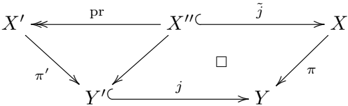
The image presents a commutative diagram illustrating mappings between sets or objects labeled X', X'', X, Y', and Y. The diagram uses arrows to represent these mappings, with labels indicating the specific transformations or projections. A small square in the center suggests a commutative property within the diagram.
### Components/Axes
* **Nodes:** The diagram consists of five nodes representing sets or objects: X', X'', X, Y', and Y.
* **Arrows:** Arrows indicate mappings between the nodes. Each arrow is labeled with a function or projection name.
* **Labels:** The arrows are labeled with the following mappings:
* `pr`: Mapping from X'' to X' (double-headed arrow indicating a projection or retraction).
* `j̃`: Mapping from X'' to X.
* `π'`: Mapping from X' to Y'.
* `j`: Mapping from Y'' to Y.
* `π`: Mapping from X to Y.
* **Commutativity Indicator:** A small square symbol is located in the center of the diagram, indicating that the diagram is commutative.
### Detailed Analysis or Content Details
* **X'' to X'**: A double-headed arrow labeled "pr" maps X'' to X'. This suggests a projection or retraction operation.
* **X'' to X**: An arrow labeled "j̃" maps X'' to X.
* **X' to Y'**: An arrow labeled "π'" maps X' to Y'.
* **Y'' to Y**: An arrow labeled "j" maps Y'' to Y.
* **X to Y**: An arrow labeled "π" maps X to Y.
* **X'' to Y''**: An arrow maps X'' to Y''.
* **Triangle 1 (X', X'', Y')**: The path from X'' to X' to Y' is equivalent to the path from X'' to Y''.
* **Triangle 2 (X, X'', Y)**: The path from X'' to X to Y is equivalent to the path from X'' to Y'' to Y.
* **Commutativity**: The square in the center implies that the composition of mappings around any closed loop in the diagram results in the same transformation.
### Key Observations
* The diagram illustrates relationships between different sets or objects through mappings.
* The double-headed arrow "pr" suggests a specific type of mapping, possibly a projection or retraction.
* The square symbol indicates that the diagram is commutative, meaning that different paths between the same nodes result in the same transformation.
### Interpretation
The diagram represents a commutative diagram, a common tool in category theory and related fields. It visually demonstrates how different mappings between objects relate to each other. The commutativity property ensures that the order in which mappings are applied does not affect the final result, as long as the overall path is equivalent. The specific mappings (pr, j̃, π', j, π) likely represent functions or transformations relevant to the context in which this diagram is used. The diagram suggests that there are two equivalent ways to map from X'' to Y: directly, or through X' and Y'. Similarly, there are two equivalent ways to map from X'' to Y: directly, or through X and Y.