## Diagram Type: Mathematical Commutative Diagram
### Overview
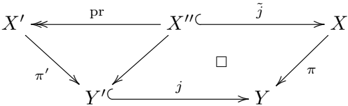
This image is a mathematical commutative diagram, likely from the field of category theory or algebraic geometry. It illustrates the relationships between five mathematical objects (X', X'', X, Y', Y) through various morphisms (arrows). The diagram is composed of a triangle on the left and a square on the right, which is indicated to be a pullback square.
### Components
**Objects (Nodes):**
* **X'** (Top left)
* **X''** (Top center)
* **X** (Top right)
* **Y'** (Bottom left)
* **Y** (Bottom right)
**Morphisms (Arrows):**
1. **pr: X'' → X'**
* Source: X''
* Target: X'
* Label: **pr**
* Type: Projection (implied by the label 'pr')
2. **j̃: X'' ↪ X**
* Source: X''
* Target: X
* Label: **j̃** (j with a tilde)
* Type: Inclusion (indicated by the hooked tail of the arrow)
3. **π': X' → Y'**
* Source: X'
* Target: Y'
* Label: **π'**
4. **(Unlabeled): X'' → Y'**
* Source: X''
* Target: Y'
* Label: None
5. **j: Y' ↪ Y**
* Source: Y'
* Target: Y
* Label: **j**
* Type: Inclusion (indicated by the hooked tail of the arrow)
6. **π: X → Y**
* Source: X
* Target: Y
* Label: **π**
**Other Symbols:**
* **□** (Square symbol): Located in the center of the right-hand square (formed by X'', X, Y', Y). This symbol indicates that the square is a **pullback square** (also known as a Cartesian square).
### Detailed Analysis of Structure and Commutativity
The diagram is structured into two main parts that are implied to be commutative:
1. **Left Triangle:**
* Vertices: X', X'', Y'
* Morphisms: pr: X'' → X', π': X' → Y', and the unlabeled arrow X'' → Y'.
* Commutativity: The diagram implies that the composition of the projection and π' is equal to the unlabeled arrow. Mathematically, this is expressed as: **π' ∘ pr = (unlabeled arrow X'' → Y')**.
2. **Right Pullback Square:**
* Vertices: X'', X, Y', Y
* Morphisms: j̃: X'' ↪ X, π: X → Y, j: Y' ↪ Y, and the unlabeled arrow X'' → Y'.
* Pullback Property: The square symbol (□) signifies that X'' is the pullback of the morphisms π: X → Y and j: Y' ↪ Y. This means that X'' is the limit of the diagram formed by X, Y, and Y', and for any other object Z with morphisms to X and Y' that commute with π and j, there exists a unique morphism from Z to X'' that makes the entire diagram commute.
* Commutativity: As a consequence of being a pullback square, the diagram commutes. Mathematically, this means: **π ∘ j̃ = j ∘ (unlabeled arrow X'' → Y')**.
### Interpretation
The diagram defines the object **X''** in two ways simultaneously:
1. As the domain of a projection **pr** to **X'**.
2. As the pullback of the maps **π: X → Y** and the inclusion **j: Y' ↪ Y**.
The commutativity of the left triangle further relates the projection **pr** and the map **π'** to the structure of the pullback. Specifically, the composition **π' ∘ pr** is the canonical map from the pullback **X''** to **Y'**.
This type of diagram is common in geometric contexts, for example, where:
* Y' is a subspace of Y (inclusion j).
* X is a space fibered over Y (map π).
* X'' is the restriction of the fiber space X to the subspace Y' (the pullback).
* X' is another space related to Y' (map π').
* X'' is also related to X' via a projection pr, and the maps from X'' to Y' via X' and directly are the same.