## Diagram: Comparison of Bits, P-bits, and Qubits
### Overview
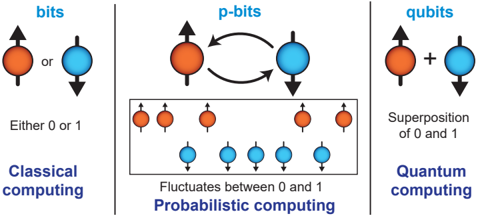
The image presents a comparative diagram illustrating the concepts of bits, p-bits, and qubits, representing classical, probabilistic, and quantum computing, respectively. Each type of bit is visually represented with a diagram of a sphere with an arrow.
### Components/Axes
* **Title:** The diagram is divided into three sections, each labeled with a different type of bit: "bits", "p-bits", and "qubits". The labels are in blue.
* **Bits (Classical Computing):**
* Represents classical computing.
* Shows two possible states: a red sphere with an upward arrow and a blue sphere with a downward arrow.
* Text: "or" is placed between the two states.
* Text: "Either 0 or 1" is below the states.
* Text: "Classical computing" is below the "Either 0 or 1" text.
* **P-bits (Probabilistic Computing):**
* Represents probabilistic computing.
* Shows a red sphere with an upward arrow and a blue sphere with a downward arrow, connected by a curved double-headed arrow, indicating fluctuation between the two states.
* Below the p-bits is a rectangle containing multiple red spheres with upward arrows and blue spheres with downward arrows. The red spheres are clustered at the top of the rectangle, and the blue spheres are clustered at the bottom.
* Text: "Fluctuates between 0 and 1" is below the rectangle.
* Text: "Probabilistic computing" is below the "Fluctuates between 0 and 1" text.
* **Qubits (Quantum Computing):**
* Represents quantum computing.
* Shows a red sphere with an upward arrow and a blue sphere with a downward arrow, connected by a "+" sign, indicating superposition.
* Text: "Superposition of 0 and 1" is below the states.
* Text: "Quantum computing" is below the "Superposition of 0 and 1" text.
### Detailed Analysis or ### Content Details
* **Bits:** A bit can be either 0 or 1. The diagram shows a red sphere with an upward arrow representing one state and a blue sphere with a downward arrow representing the other state.
* **P-bits:** A p-bit fluctuates between 0 and 1. The diagram shows a red sphere with an upward arrow and a blue sphere with a downward arrow, connected by a curved double-headed arrow. The rectangle below shows a collection of p-bits, with a tendency for red spheres (0) to be at the top and blue spheres (1) to be at the bottom.
* **Qubits:** A qubit can be in a superposition of 0 and 1. The diagram shows a red sphere with an upward arrow and a blue sphere with a downward arrow, connected by a "+" sign.
### Key Observations
* The diagram visually distinguishes between classical, probabilistic, and quantum computing by illustrating the states and behaviors of bits, p-bits, and qubits.
* The use of color (red and blue) consistently represents the two possible states (0 and 1) across all three types of bits.
* The arrows indicate the direction of spin or state.
### Interpretation
The diagram effectively illustrates the fundamental differences between classical, probabilistic, and quantum computing. Classical bits have definite states (0 or 1), p-bits fluctuate between these states, and qubits can exist in a superposition of both states simultaneously. The visual representation of these concepts helps to understand the underlying principles of each computing paradigm. The clustering of red and blue spheres in the p-bits section suggests a probabilistic distribution, where the bit is more likely to be in one state than the other at any given time. The "+" sign in the qubits section emphasizes the superposition principle, a key feature of quantum computing.