\n
## Diagram: Comparison of Classical, Probabilistic, and Quantum Computing
### Overview
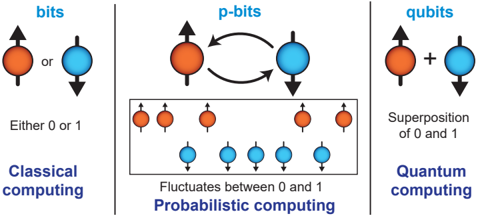
The image is a diagram illustrating the fundamental differences between classical computing (bits), probabilistic computing (p-bits), and quantum computing (qubits). It visually represents how information is stored and manipulated in each paradigm. The diagram uses circular nodes to represent the states of each type of information unit, with arrows indicating possible states or transitions.
### Components/Axes
The diagram is divided into three vertical sections, each representing a different computing paradigm:
* **Left:** Classical Computing - labeled "bits" in blue font.
* **Center:** Probabilistic Computing - labeled "p-bits" in blue font.
* **Right:** Quantum Computing - labeled "qubits" in blue font.
Each section also contains descriptive text:
* Classical Computing: "Either 0 or 1"
* Probabilistic Computing: "Fluctuates between 0 and 1"
* Quantum Computing: "Superposition of 0 and 1"
The bottom of each section shows multiple representations of the information unit.
### Detailed Analysis or Content Details
**Classical Computing (Bits):**
* A single circular node is shown.
* The node can be either orange (representing one state) or blue (representing another state).
* An arrow points upwards from the orange node and downwards from the blue node.
* The text "Either 0 or 1" is positioned below the node.
**Probabilistic Computing (P-bits):**
* Two circular nodes are shown: one orange and one blue.
* A curved, bidirectional arrow connects the orange and blue nodes, indicating fluctuation between states.
* Below the two nodes, a grid of nodes is shown. There are four orange nodes in the top row and six blue nodes in the bottom row.
* The text "Fluctuates between 0 and 1" is positioned below the nodes.
**Quantum Computing (Qubits):**
* Two circular nodes are shown: one orange and one blue.
* A "+" symbol is positioned between the orange and blue nodes.
* An arrow points upwards from the orange node and downwards from the blue node.
* The text "Superposition of 0 and 1" is positioned below the nodes.
### Key Observations
* Classical bits have a definite state (0 or 1).
* Probabilistic bits fluctuate between states, representing probabilities.
* Quantum bits exist in a superposition of states, meaning they can be both 0 and 1 simultaneously.
* The diagram visually emphasizes the increasing complexity and flexibility of information representation as one moves from classical to probabilistic to quantum computing.
### Interpretation
The diagram effectively illustrates the core concept differentiating these three computing paradigms: the representation of information. Classical computing relies on definite states, while probabilistic computing introduces the notion of uncertainty and probability. Quantum computing takes this further by allowing for superposition, where a qubit can exist in multiple states simultaneously. This capability is what gives quantum computers their potential for solving certain problems much faster than classical computers. The diagram is a conceptual illustration rather than a quantitative one; it doesn't provide numerical data but rather conveys the fundamental principles of each computing approach. The use of color (orange and blue) consistently represents the two possible states (0 and 1) across all three paradigms, aiding in understanding the transition and evolution of information representation. The "+" symbol in the quantum computing section is a visual cue for the concept of superposition, indicating the combination of both states.