## Diagram: Comparison of Computing Bit Types
### Overview
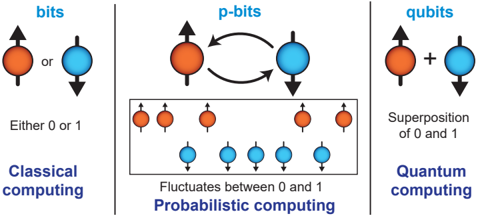
The image is a technical diagram comparing the fundamental information units (bits) used in three different computing paradigms: Classical, Probabilistic, and Quantum. It uses a three-column layout to visually and textually contrast how each system represents and manipulates data.
### Components/Axes
The diagram is divided into three vertical panels, each dedicated to a computing type.
1. **Left Panel (Classical Computing):**
* **Header:** "bits" (in blue text).
* **Visual Elements:** Two distinct circles. A red circle with a black upward-pointing arrow. A blue circle with a black downward-pointing arrow. The word "or" is placed between them.
* **Descriptive Text:** "Either 0 or 1" and "Classical computing" (in blue text).
2. **Middle Panel (Probabilistic Computing):**
* **Header:** "p-bits" (in blue text).
* **Visual Elements (Top):** A red circle with an upward arrow and a blue circle with a downward arrow, connected by two curved, opposing black arrows, indicating a dynamic relationship or fluctuation.
* **Visual Elements (Bottom):** A rectangular box containing a row of eight smaller circles. The first four are red with upward arrows. The next four are blue with downward arrows. This represents a snapshot of multiple p-bits in different states.
* **Descriptive Text:** "Fluctuates between 0 and 1" and "Probabilistic computing" (in blue text).
3. **Right Panel (Quantum Computing):**
* **Header:** "qubits" (in blue text).
* **Visual Elements:** A red circle with an upward arrow and a blue circle with a downward arrow, connected by a black plus sign ("+").
* **Descriptive Text:** "Superposition of 0 and 1" and "Quantum computing" (in blue text).
### Detailed Analysis
The diagram establishes a clear visual language:
* **Red Circle + Up Arrow:** Represents the state "1".
* **Blue Circle + Down Arrow:** Represents the state "0".
* **Spatial Grounding:** The legend (color/arrow meaning) is consistent across all three panels. The placement of elements is symmetrical, with each panel having a header at the top, a primary visual in the center, and descriptive text at the bottom.
**Component Isolation & Flow:**
* **Classical (Left):** Shows a strict, exclusive choice. The bit is in one definite state (1 OR 0) at any given time.
* **Probabilistic (Middle):** Shows a dynamic system. The top visual indicates a single p-bit can flip between states. The bottom box shows an ensemble of p-bits, each independently in a state of 0 or 1 at a given moment, illustrating the probabilistic nature across multiple units.
* **Quantum (Right):** Shows a combined state. The plus sign indicates that the qubit exists in a superposition, embodying both the 0 and 1 states simultaneously, not as a fluctuation but as a combined quantum state.
### Key Observations
1. **Progression of Complexity:** The diagram illustrates a conceptual progression from a deterministic system (Classical) to a stochastic one (Probabilistic) to a quantum mechanical one (Quantum).
2. **Visual Metaphors:** The use of arrows (up/down) is a consistent metaphor for binary states. The curved arrows in the p-bit section effectively convey instability or switching, while the plus sign in the qubit section conveys combination or superposition.
3. **Textual Language:** All primary descriptive text is in English. The headers ("bits", "p-bits", "qubits") are also in English. No other languages are present in the image.
### Interpretation
This diagram serves as an educational tool to explain the core difference in how information is physically represented in emerging computing technologies versus classical ones.
* **What it demonstrates:** It visually argues that the power of probabilistic and quantum computing stems from moving beyond the rigid, binary "either/or" logic of classical bits. Probabilistic bits (p-bits) introduce randomness and parallel exploration of states, while quantum bits (qubits) leverage the principle of superposition to process information in a fundamentally different, non-binary way.
* **Relationships:** The three panels are directly comparable. The central theme is the state of the fundamental unit. The diagram suggests that p-bits and qubits are not merely faster versions of classical bits but represent different paradigms for information processing.
* **Underlying Message:** The implication is that these alternative bit representations enable solving certain classes of problems (like optimization, simulation, or cryptography) that are intractable for classical computers. The diagram simplifies complex quantum mechanical and stochastic concepts into an accessible visual analogy, highlighting the shift from certainty to probability to superposition.