## Diagram: Comparison of Classical, Probabilistic, and Quantum Computing Models
### Overview
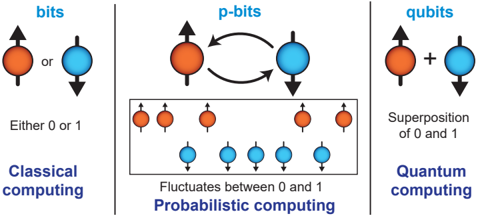
The image visually contrasts three computational paradigms: classical computing (bits), probabilistic computing (p-bits), and quantum computing (qubits). Each section uses color-coded circles (red for 0, blue for 1) and annotations to illustrate fundamental differences in state representation and behavior.
### Components/Axes
1. **Left Section (Classical Computing)**:
- **Label**: "bits"
- **Visual Elements**: Two circles (red and blue) with arrows pointing to them.
- **Text**: "Either 0 or 1" (binary determinism).
- **Computing Type**: "Classical computing" (bold blue text).
2. **Middle Section (Probabilistic Computing)**:
- **Label**: "p-bits"
- **Visual Elements**: Red and blue circles connected by bidirectional arrows, forming a loop.
- **Text**: "Fluctuates between 0 and 1" (probabilistic state transitions).
- **Computing Type**: "Probabilistic computing" (bold blue text).
3. **Right Section (Quantum Computing)**:
- **Label**: "qubits"
- **Visual Elements**: Overlapping red and blue circles with a "+" symbol between them.
- **Text**: "Superposition of 0 and 1" (quantum state coexistence).
- **Computing Type**: "Quantum computing" (bold blue text).
### Detailed Analysis
- **Classical Computing (Bits)**:
- Represents binary states (0 or 1) as mutually exclusive, static values.
- Arrows indicate fixed, unidirectional assignment of states.
- **Probabilistic Computing (P-bits)**:
- Depicts states as dynamic, with bidirectional arrows showing transitions between 0 and 1.
- The looped arrows suggest probabilistic fluctuations rather than deterministic outcomes.
- **Quantum Computing (Qubits)**:
- Illustrates superposition via overlapping circles and a "+" symbol, implying simultaneous existence of 0 and 1.
- No directional arrows, emphasizing non-classical state behavior.
### Key Observations
1. **State Representation**:
- Classical bits are rigidly binary.
- P-bits introduce probabilistic transitions but remain binary.
- Qubits transcend binary constraints through superposition.
2. **Visual Hierarchy**:
- Arrows in p-bits emphasize motion, while qubits use static overlap to denote superposition.
- Color coding (red=0, blue=1) is consistent across all sections for clarity.
3. **Abstraction Level**:
- Classical: Fundamental digital logic.
- Probabilistic: Introduces uncertainty in state determination.
- Quantum: Represents probabilistic amplitudes and entanglement.
### Interpretation
The diagram underscores the evolution of computational models:
- **Classical bits** form the basis of traditional computing, operating on strict binary logic.
- **P-bits** extend this by incorporating probabilistic behavior, useful in stochastic systems or Monte Carlo simulations.
- **Qubits** represent a paradigm shift, leveraging quantum mechanics to enable parallel processing and exponential computational power for specific problems (e.g., factoring, optimization).
The absence of numerical data focuses on conceptual distinctions rather than quantitative metrics. The use of overlapping circles for qubits visually reinforces the non-intuitive nature of quantum states, contrasting with the linear progression from classical to probabilistic models.