## Document Analysis: Reasons to Ban Bottled Water
### Overview
The image presents a text-based argument against bottled water, highlighting its environmental impact. It includes statistics, comparisons to tap water, and a photograph illustrating plastic bottle waste.
### Components/Axes
* **Title:** Reasons to Ban Bottled Water
* **Sections:**
* Introduction: General arguments against bottled water.
* Environmental Impact: Specific details about the negative environmental consequences.
* Plastic Pollution: Details about plastic pollution.
* Energy & Carbon Footprint: Details about energy and carbon footprint.
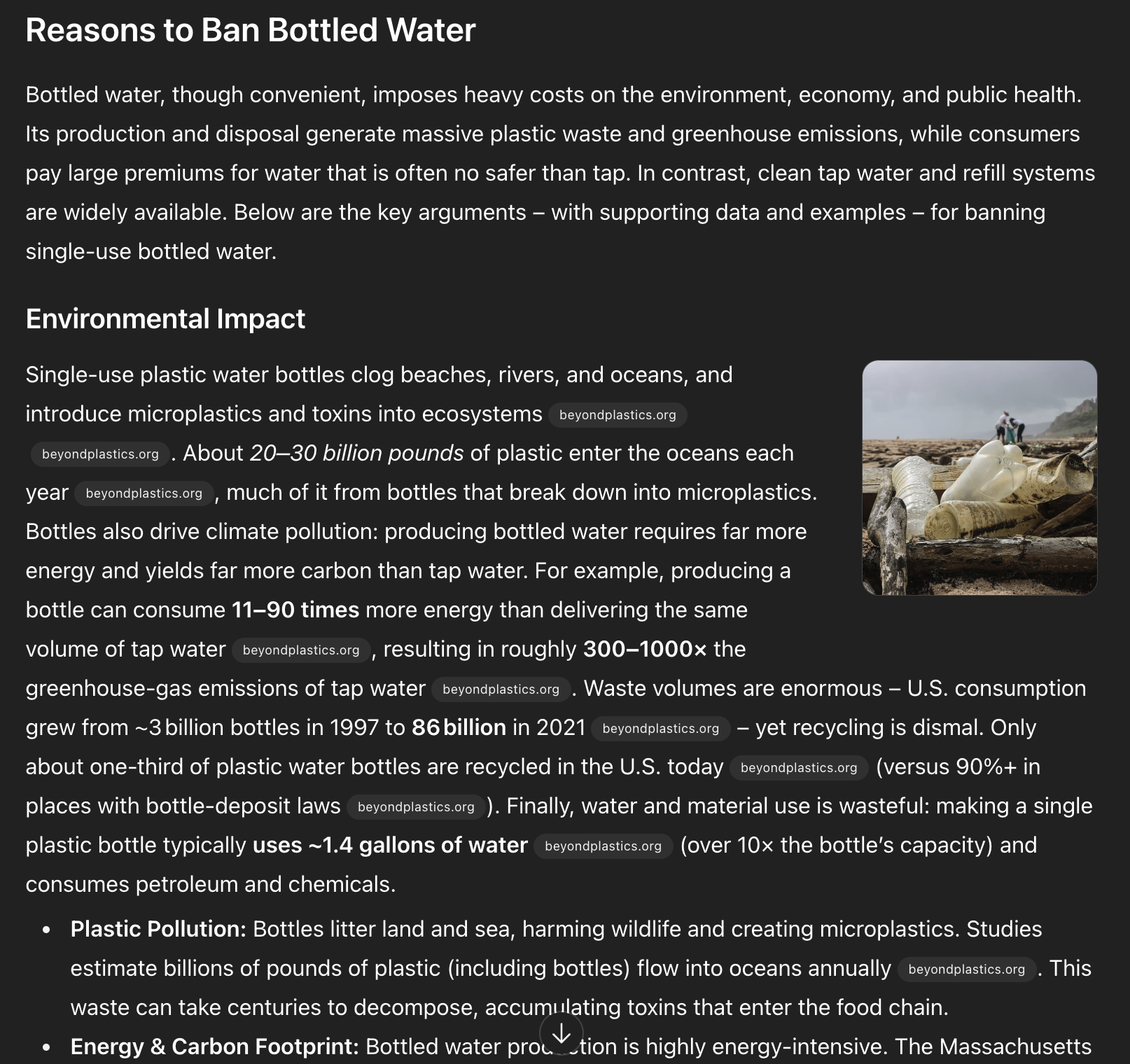
* **Image:** A photograph showing discarded plastic bottles on a beach.
### Detailed Analysis or Content Details
* **Introduction:**
* Bottled water is described as convenient but imposing heavy costs on the environment, economy, and public health.
* Its production and disposal generate massive plastic waste and greenhouse emissions.
* Consumers pay large premiums for water that is often no safer than tap water.
* Clean tap water and refill systems are widely available.
* **Environmental Impact:**
* Single-use plastic water bottles clog beaches, rivers, and oceans.
* They introduce microplastics and toxins into ecosystems.
* Approximately 20-30 billion pounds of plastic enter the oceans each year.
* Bottles break down into microplastics.
* Producing a bottle can consume 11-90 times more energy than delivering the same volume of tap water.
* This results in roughly 300-1000x the greenhouse-gas emissions of tap water.
* U.S. consumption grew from ~3 billion bottles in 1997 to 86 billion in 2021.
* Recycling rates are low, with only about one-third of plastic water bottles recycled in the U.S. today (versus 90%+ in places with bottle-deposit laws).
* Making a single plastic bottle typically uses ~1.4 gallons of water (over 10x the bottle's capacity).
* **Plastic Pollution:**
* Bottles litter land and sea, harming wildlife and creating microplastics.
* Billions of pounds of plastic (including bottles) flow into oceans annually.
* This waste can take centuries to decompose, accumulating toxins that enter the food chain.
* **Energy & Carbon Footprint:**
* Bottled water production is highly energy-intensive.
* **Image:**
* The photograph shows a pile of discarded plastic water bottles on a beach.
* In the background, two people are visible on the beach.
### Key Observations
* The text emphasizes the significant environmental impact of bottled water, particularly in terms of plastic waste and energy consumption.
* The statistics provided highlight the scale of the problem, with billions of pounds of plastic entering the oceans annually and a substantial increase in bottled water consumption over the years.
* The comparison to tap water underscores the unnecessary nature of bottled water, given the availability of safer and more sustainable alternatives.
### Interpretation
The document presents a compelling case against bottled water, arguing that its environmental costs far outweigh its convenience. The statistics and comparisons provided effectively illustrate the scale of the problem and the need for more sustainable alternatives. The photograph serves as a visual reminder of the environmental consequences of single-use plastic water bottles. The document advocates for banning single-use bottled water, suggesting that clean tap water and refill systems are viable and environmentally responsible solutions.