\n
## Text Document: Reasons to Ban Bottled Water
### Overview
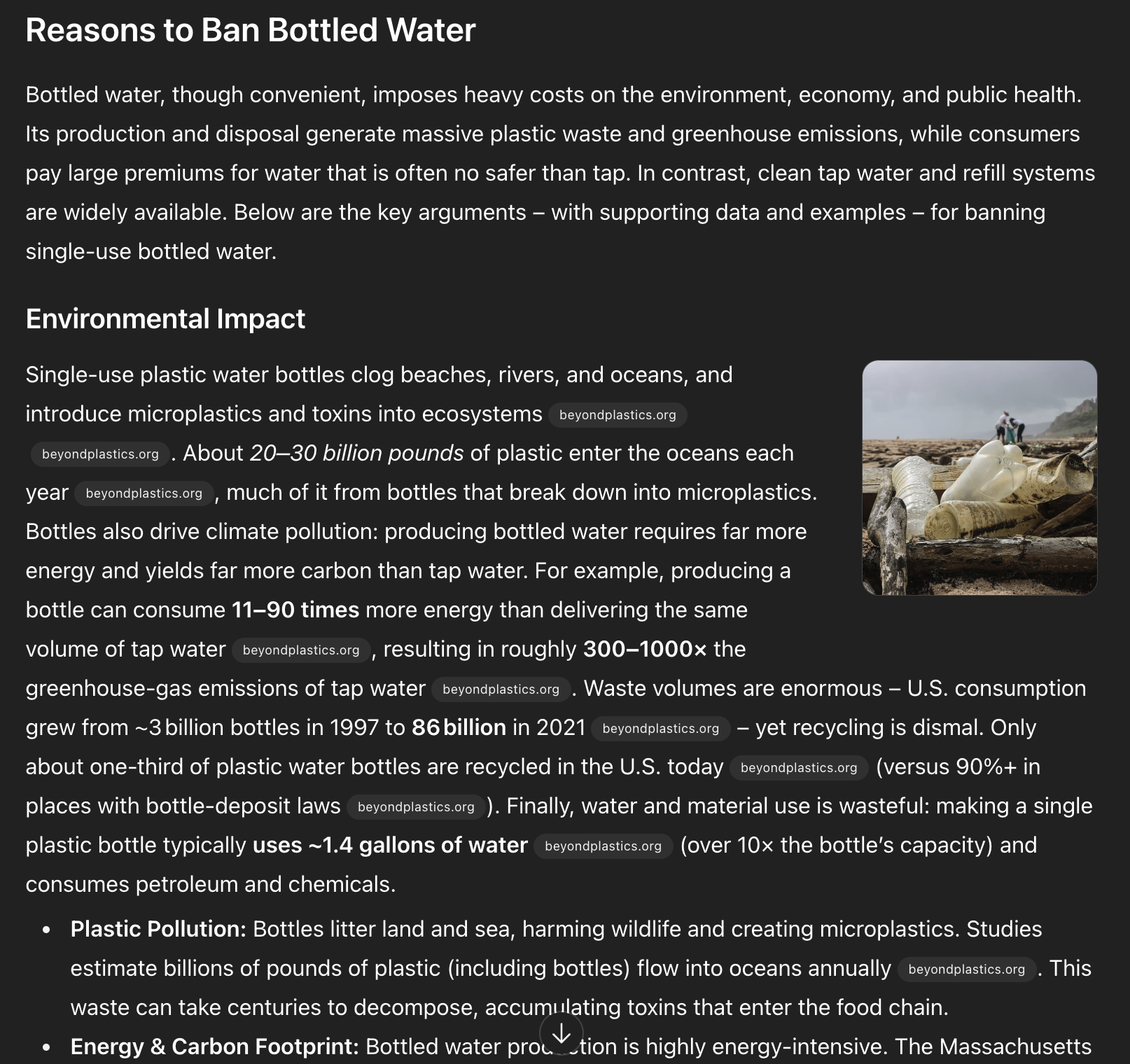
The image presents a text document outlining the reasons to ban bottled water. It details the environmental impact, energy & carbon footprint, and health concerns associated with bottled water consumption, contrasting it with the benefits of tap water and refill systems. The document cites data and examples to support its arguments. A plastic bottle image is present on the right side of the document.
### Components/Axes
The document is structured with a heading, introductory paragraph, section headings ("Environmental Impact", "Energy & Carbon Footprint"), and bullet points. The website "beyondplastics.org" is frequently cited as a source.
### Detailed Analysis or Content Details
The document contains the following key points:
* **Bottled water's impact:** Bottled water production and disposal generate massive plastic waste and greenhouse gas emissions. Consumers pay a premium for water that is often no safer than tap water.
* **Environmental Impact:**
* Single-use plastic bottles clog ecosystems and introduce microplastics and toxins.
* Approximately 20-30 billion pounds of plastic enter the oceans each year.
* Producing a bottle can consume 11-90 times more energy than delivering the same volume of tap water, resulting in 300-1000x the greenhouse-gas emissions.
* U.S. consumption grew from ~3 billion bottles in 1997 to 86 billion in 2021.
* Only about one-third of plastic water bottles are recycled in the U.S. (versus 90%+ in places with bottle-deposit laws).
* Making a single plastic bottle typically uses ~1.4 gallons of water (over 10x the bottle's capacity).
* **Plastic Pollution:** Bottles litter land and sea, harming wildlife and creating microplastics. Billions of pounds of plastic flow into oceans annually. This waste takes centuries to decompose, accumulating toxins.
* **Energy & Carbon Footprint:** Bottled water production is highly energy-intensive. The Massachusetts Department of Environmental Protection estimates that the energy required to produce and transport bottled water is equivalent to 300,000 barrels of oil annually.
* **Health Concerns:** Bottled water is not necessarily safer than tap water. It can leach chemicals into the water, and the plastic itself can pose health risks.
* **Alternatives:** Clean tap water and refill systems are widely available.
### Key Observations
The document strongly advocates for reducing or eliminating bottled water consumption. It emphasizes the significant environmental and energy costs associated with bottled water, while highlighting the availability of safe and sustainable alternatives. The frequent citation of "beyondplastics.org" suggests a reliance on data from this organization. The large increase in bottled water consumption from 1997 to 2021 is a notable statistic.
### Interpretation
The document presents a clear argument against bottled water, framing it as an unsustainable and environmentally damaging practice. The data presented suggests that the benefits of convenience offered by bottled water are outweighed by its negative consequences. The document appeals to both environmental and economic concerns, positioning tap water and refill systems as more responsible choices. The document's tone is persuasive and aims to inform readers about the hidden costs of bottled water consumption. The inclusion of specific data points (e.g., energy consumption ratios, plastic waste figures) lends credibility to the arguments presented. The document is a piece of advocacy, aiming to influence consumer behavior and promote more sustainable practices. The image of the plastic bottle serves as a visual reminder of the problem being discussed.