## Screenshot: Article Excerpt on Banning Bottled Water
### Overview
This image is a screenshot of a digital article or web page titled "Reasons to Ban Bottled Water." The content argues against single-use bottled water, focusing on its environmental, economic, and public health costs. The layout features a main text column on the left and a supporting photograph on the right. The text is structured with a main title, an introductory paragraph, a section heading ("Environmental Impact"), detailed body text with inline citations, and the beginning of a bulleted list.
### Components/Axes
* **Main Title:** "Reasons to Ban Bottled Water"
* **Introductory Paragraph:** A summary statement outlining the article's thesis.
* **Section Heading:** "Environmental Impact"
* **Body Text:** Prose detailing environmental arguments with embedded data and citations.
* **Citations:** Repeated inline references to "beyondplastics.org" in small, grey-background badges.
* **Embedded Image:** A photograph positioned to the right of the "Environmental Impact" section text.
* **Bulleted List:** Begins with two items: "Plastic Pollution:" and "Energy & Carbon Footprint:".
### Content Details
**Text Transcription:**
**Title:** Reasons to Ban Bottled Water
**Introductory Paragraph:**
Bottled water, though convenient, imposes heavy costs on the environment, economy, and public health. Its production and disposal generate massive plastic waste and greenhouse emissions, while consumers pay large premiums for water that is often no safer than tap. In contrast, clean tap water and refill systems are widely available. Below are the key arguments – with supporting data and examples – for banning single-use bottled water.
**Section: Environmental Impact**
Single-use plastic water bottles clog beaches, rivers, and oceans, and introduce microplastics and toxins into ecosystems [beyondplastics.org]. About **20–30 billion pounds** of plastic enter the oceans each year [beyondplastics.org], much of it from bottles that break down into microplastics. Bottles also drive climate pollution: producing bottled water requires far more energy and yields far more carbon than tap water. For example, producing a bottle can consume **11–90 times** more energy than delivering the same volume of tap water [beyondplastics.org], resulting in roughly **300–1000×** the greenhouse-gas emissions of tap water [beyondplastics.org]. Waste volumes are enormous – U.S. consumption grew from ~3 billion bottles in 1997 to **86 billion** in 2021 [beyondplastics.org] – yet recycling is dismal. Only about one-third of plastic water bottles are recycled in the U.S. today [beyondplastics.org] (versus 90%+ in places with bottle-deposit laws [beyondplastics.org]). Finally, water and material use is wasteful: making a single plastic bottle typically **uses ~1.4 gallons of water** [beyondplastics.org] (over 10× the bottle’s capacity) and consumes petroleum and chemicals.
**Bulleted List (Partial):**
* **Plastic Pollution:** Bottles litter land and sea, harming wildlife and creating microplastics. Studies estimate billions of pounds of plastic (including bottles) flow into oceans annually [beyondplastics.org]. This waste can take centuries to decompose, accumulating toxins that enter the food chain.
* **Energy & Carbon Footprint:** Bottled water production is highly energy-intensive. The Massachusetts... (text cuts off).
**Embedded Photograph Description:**
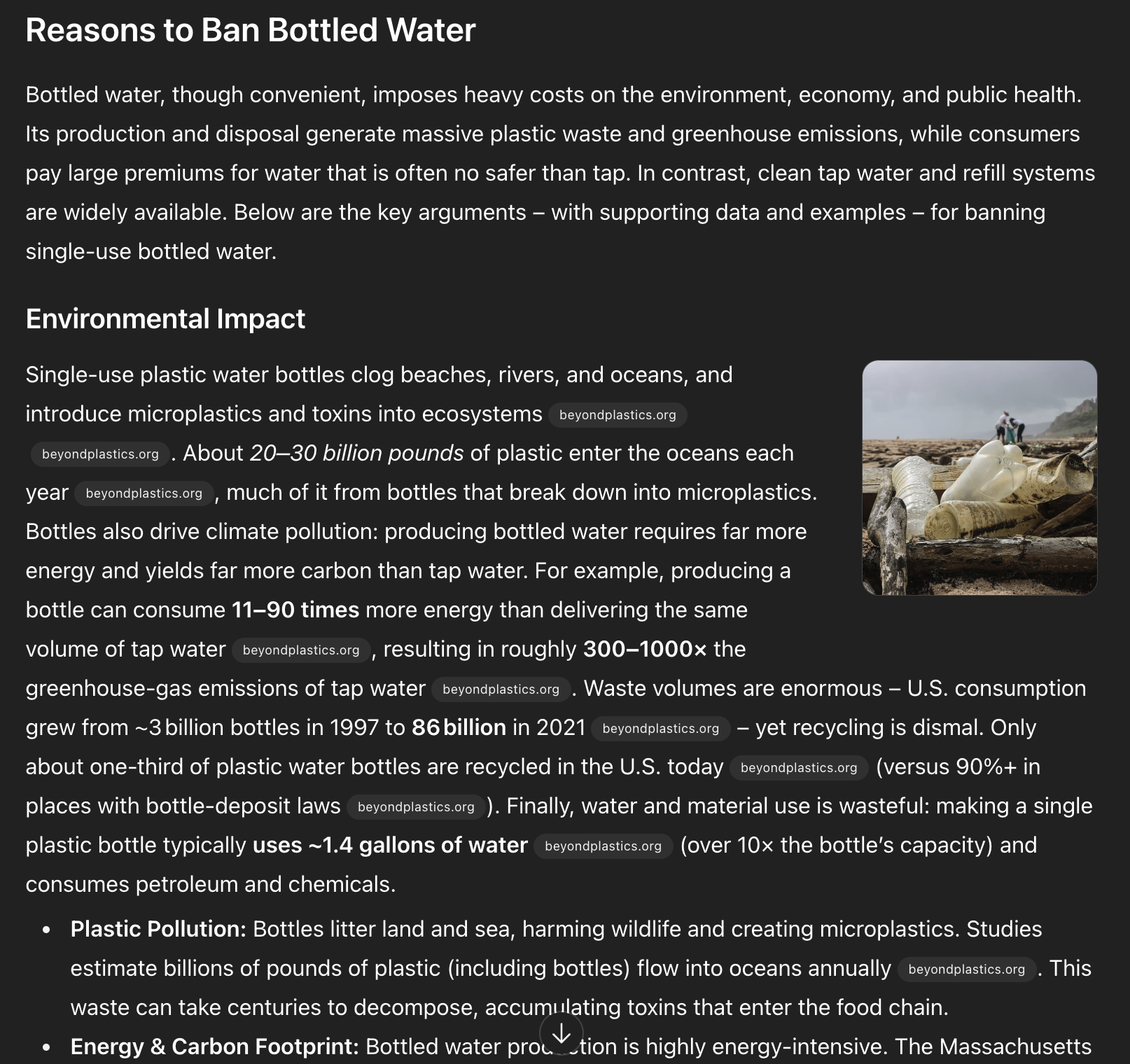
Positioned to the right of the "Environmental Impact" text. The image shows a shoreline littered with numerous large, discarded plastic water bottles and other debris. In the background, two people are visible on the beach, with hills or mountains under a cloudy sky. The photo visually reinforces the text's point about plastic pollution.
### Key Observations
1. **Data-Driven Argument:** The text heavily relies on specific numerical data (e.g., 20-30 billion pounds, 11-90 times more energy, 86 billion bottles) to substantiate its claims.
2. **Source Attribution:** Every major data point and claim is followed by an inline citation to "beyondplastics.org," indicating a single primary source for the information presented in this excerpt.
3. **Visual Reinforcement:** The embedded photograph is not decorative; it directly illustrates the "clog beaches" and "plastic pollution" claims made in the adjacent text.
4. **Comparative Analysis:** The argument is structured around comparisons: bottled water vs. tap water (energy, emissions, cost), U.S. recycling rates vs. regions with deposit laws, and water used to make a bottle vs. the bottle's capacity.
5. **Document Structure:** The content follows a clear persuasive structure: thesis statement -> section heading -> detailed evidence with data -> summarized key points in a list.
### Interpretation
This screenshot captures a segment of a persuasive technical or advocacy document. Its primary purpose is to build a factual case against single-use bottled water by aggregating and presenting environmental impact data. The consistent citation of a single source ("beyondplastics.org") suggests this may be a summary or promotion of a report from that organization.
The elements relate to each other to create a cohesive argument: the title states the position, the introduction frames the issue, the "Environmental Impact" section provides the core evidence using statistics and comparisons, the photograph offers visceral, visual proof, and the bulleted list begins to distill the evidence into memorable, categorical takeaways. The cutoff at the end implies this is only the first section of a longer document that likely covers economic and public health arguments as mentioned in the introduction.
The notable outlier in the data is the wide range given for energy consumption ("11–90 times"), which indicates significant variability depending on the study or context, a nuance the text acknowledges by presenting it as a range rather than a single figure. The overall trend in the data presented is one of massive scale (billions of pounds, billions of bottles) coupled with systemic inefficiency (low recycling rates, high resource input per unit).