\n
## Diagram: Target Acquisition Geometry
### Overview
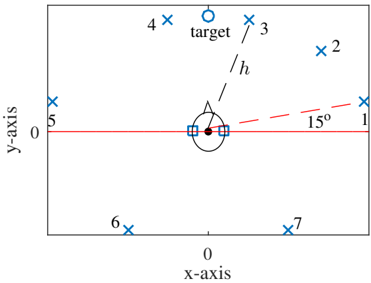
The image depicts a 2D diagram illustrating the geometry of a target acquisition scenario. A central agent (represented by a triangle within a circle) is oriented towards a distant target. Several surrounding points are labeled with numbers 1 through 7, likely representing sensor locations or potential obstacles. A dashed line indicates the angle of view to the target, and a label 'h' denotes a distance. The diagram uses a Cartesian coordinate system with labeled x and y axes.
### Components/Axes
* **X-axis:** Labeled "x-axis". The origin appears to be at approximately x=0.
* **Y-axis:** Labeled "y-axis". The origin appears to be at approximately y=0.
* **Target:** Labeled "target", located in the upper-right quadrant.
* **Sensor/Obstacle Points:** Points 1 through 7 are distributed around the central agent.
* **Angle:** A dashed red line extending from the central agent to the target, labeled with "15°".
* **Distance:** A dashed line labeled "h" extending from the central agent towards the target.
* **Central Agent:** Represented by a triangle inside a circle. The triangle's apex points in the direction of the target. A small square is located at the center of the triangle.
### Detailed Analysis or Content Details
* **Point Locations (Approximate Coordinates):**
* 1: (0.8, 0.7)
* 2: (1.5, 0.5)
* 3: (0.7, 1.2)
* 4: (-0.5, 1.3)
* 5: (-0.8, -0.5)
* 6: (-0.5, -1.2)
* 7: (0.5, -1.3)
* **Angle to Target:** The angle between the positive x-axis and the line of sight to the target is approximately 15 degrees.
* **Distance 'h':** The distance 'h' is not numerically defined, but visually represents the distance from the central agent to the target.
* **Central Agent Orientation:** The central agent is oriented at approximately 15 degrees relative to the positive x-axis.
* **Central Agent Internal Structure:** The central agent contains a small square at its center, potentially representing a sensor or focal point.
### Key Observations
* The points 1-7 are positioned around the central agent, suggesting they might be sensors providing data or obstacles affecting the agent's view.
* The angle of 15 degrees is a key parameter in the geometry of the target acquisition.
* The diagram is a simplified 2D representation of a potentially more complex 3D scenario.
### Interpretation
The diagram illustrates a basic target acquisition problem. The central agent is attempting to locate a target, and the surrounding points may represent factors influencing the acquisition process. The 15-degree angle and distance 'h' are critical parameters for calculating the target's position and determining the agent's optimal strategy. The diagram suggests a scenario where the agent needs to account for the positions of surrounding elements (points 1-7) when aiming at the target. The internal square within the central agent could represent the agent's sensor or the point from which the angle measurement is taken. The diagram is likely used to explain or analyze the geometric relationships involved in target tracking or guidance systems.