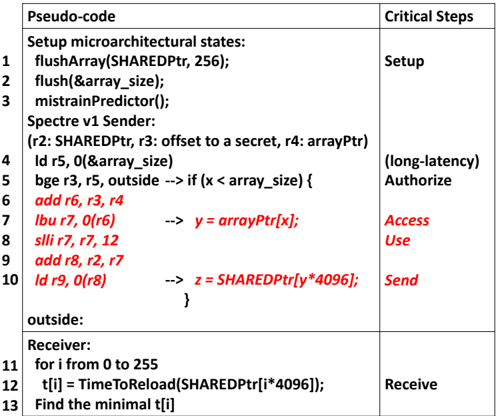
## Pseudo-code
| Pseudo-code | Critical Steps |
|----------------------------------------------------------------------------|----------------------------------------------------------------------------|
| Setup microarchitectural states: | Setup |
| flushArray(SHAREDPtr, 256); | |
| flush(&array_size); | |
| mistrainPredictor(); | |
| Spectre v1 Sender: | |
| (r2: SHAREDPtr, r3: offset to a secret, r4: arrayPtr) | |
| ld r5, 0(&array_size) | (long-latency) Authorize |
| bge r3, r5, outside -- if (x < array_size) { | |
| add r6, r3, r4 | Access Use |
| lbu r7, 0(r6) | |
| slri r7, r7, 12 | |
| add r8, r2, r7 | |
| ld r9, 0(r8) | |
| -- > y = arrayPtr[x]; | |
| -- > z = SHAREDPtr[y*4096]; | |
| } | |
| outside: | |
| Receiver: | |
| for i from 0 to 255 | Receive |
| t[i] = TimeToReload(SHAREDPtr[i*4096]); | |
| Find the minimal t[i] | |
### Interpretation
The pseudo-code provided appears to be a part of a microarchitectural simulation or a software development process. It outlines a series of steps that are likely related to setting up microarchitectural states, using a Spectre v1 Sender, and processing data through a series of operations.
The critical steps include:
1. Setting up microarchitectural states.
2. Flushing an array with a size of 256.
3. Flushing the array size.
4. Initializing a mistrain predictor.
5. Using a Spectre v1 Sender to send data.
6. Performing operations on the array, including loading, storing, and accessing elements.
7. Finding the minimal time to reload the data.
The interpretation of this pseudo-code is that it is a part of a larger system that involves setting up and processing data in a microarchitectural context. The Spectre v1 Sender is likely used to send data to the system, and the operations on the array are used to process and analyze the data.
The pseudo-code does not provide any specific information about the data or the context in which it is being used. It is a high-level description of a process that involves setting up microarchitectural states, using a Spectre v1 Sender, and processing data through a series of operations.