## Diagram: Transformation and Generalization Types
### Overview
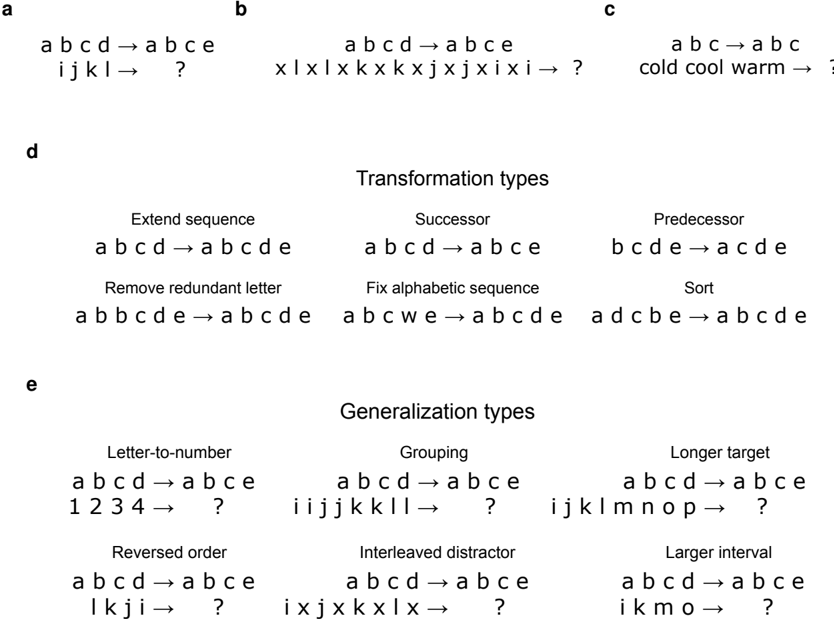
The image presents examples of transformation and generalization types applied to letter sequences. It shows how a sequence like "abcd" can be altered to "abce" using different rules, with question marks indicating a need to determine the next step in a given sequence.
### Components/Axes
The image is divided into five sections, labeled a, b, c, d, and e. Sections d and e are further subdivided into categories of transformation and generalization types, respectively. Each category includes an example of a transformation or generalization rule, followed by a sequence and an arrow indicating the transformation, and a question mark indicating a missing element.
### Detailed Analysis
**Section a:**
* `abcd -> abce`
* `ijkl -> ?`
**Section b:**
* `abcd -> abce`
* `xlxlxkxkxjxjxixi -> ?`
**Section c:**
* `abc -> abc`
* `cold cool warm -> ?`
**Section d: Transformation types**
* **Extend sequence:**
* `abcd -> abcde`
* **Remove redundant letter:**
* `abbcde -> abcde`
* **Successor:**
* `abcd -> abce`
* **Fix alphabetic sequence:**
* `abcwe -> abcde`
* **Predecessor:**
* `bcde -> acde`
* **Sort:**
* `adcbe -> abcde`
**Section e: Generalization types**
* **Letter-to-number:**
* `abcd -> abce`
* `1234 -> ?`
* **Reversed order:**
* `abcd -> abce`
* `lkji -> ?`
* **Grouping:**
* `abcd -> abce`
* `iijjkkll -> ?`
* **Interleaved distractor:**
* `abcd -> abce`
* `ixjxkxlx -> ?`
* **Longer target:**
* `abcd -> abce`
* `ijklmnop -> ?`
* **Larger interval:**
* `abcd -> abce`
* `ikmo -> ?`
### Key Observations
* The initial sequence `abcd -> abce` is a common starting point for many of the transformations and generalizations.
* The question marks indicate that the user is expected to infer the pattern and complete the sequence.
* The transformation types focus on altering the sequence to fit a specific rule, while the generalization types focus on applying a broader pattern.
### Interpretation
The image serves as a visual guide to different types of sequence transformations and generalizations. It highlights how a simple sequence can be manipulated in various ways, requiring pattern recognition and logical deduction to complete the missing elements. The examples provided offer a framework for understanding and applying these transformations and generalizations to other sequences. The image is likely part of a larger educational or cognitive exercise.