\n
## Diagram: Cognitive Transformation Types
### Overview
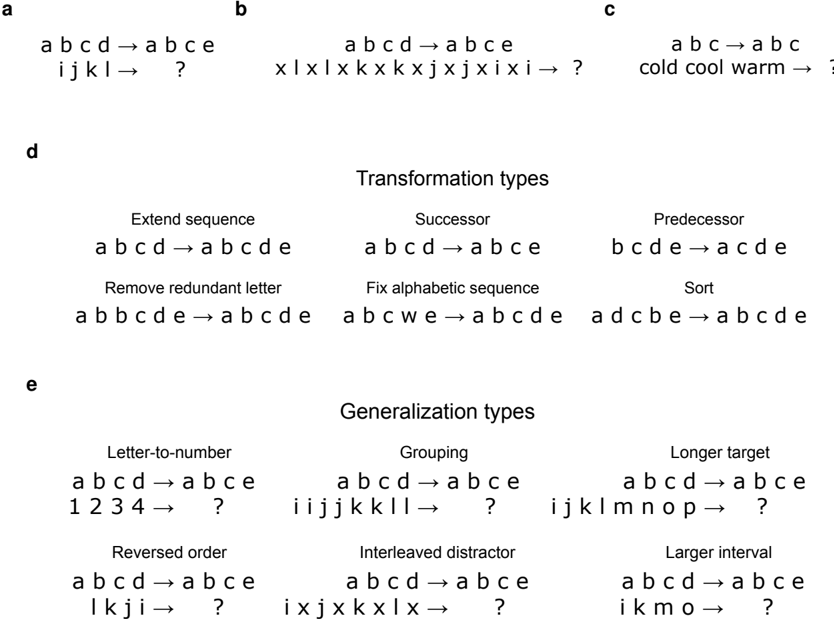
The image presents a diagram illustrating different types of cognitive transformations, categorized into "Transformation types" and "Generalization types". Each type is demonstrated with example sequences and a question mark indicating the expected output. The diagram is organized into sections labeled a through e, with a central header for each category.
### Components/Axes
The diagram consists of several sections:
* **Section a:** Presents a simple sequence transformation.
* **Section b:** Shows a sequence with repeated characters and a transformation.
* **Section c:** Demonstrates a transformation involving words related to temperature.
* **Section d:** Header: "Transformation types". Contains examples of: Extend sequence, Successor, Predecessor, Remove redundant letter, Fix alphabetic sequence, Sort.
* **Section e:** Header: "Generalization types". Contains examples of: Letter-to-number, Grouping, Longer target, Reversed order, Interleaved distractor, Larger interval.
Each example consists of an input sequence followed by an arrow and the expected output, represented by a question mark.
### Detailed Analysis or Content Details
**Section a:**
* `abcd -> abce`
* `ijkl -> ?`
**Section b:**
* `abcd -> abce`
* `xlxlxkxkxjxixixi -> ?`
**Section c:**
* `abc -> abc`
* `cold cool warm -> ?`
**Section d: Transformation types**
* **Extend sequence:** `abcd -> abcde`
* **Successor:** `abcd -> abce`
* **Predecessor:** `bcde -> acde`
* **Remove redundant letter:** `abbcde -> abcde`
* **Fix alphabetic sequence:** `abcwe -> abcde`
* **Sort:** `adcbе -> abcde`
**Section e: Generalization types**
* **Letter-to-number:** `abcd -> abce`
* `1234 -> ?`
* **Grouping:** `abcd -> abce`
* `iijjkkll -> ?`
* **Longer target:** `abcd -> abce`
* `ijklmnop -> ?`
* **Reversed order:** `abcd -> abce`
* `lkji -> ?`
* **Interleaved distractor:** `abcd -> abce`
* `ixjxkxix -> ?`
* **Larger interval:** `abcd -> abce`
* `ikmo -> ?`
### Key Observations
The diagram focuses on identifying patterns and applying transformations to sequences. The "Transformation types" section demonstrates operations that modify a sequence based on specific rules (extending, finding successors, removing redundancy, sorting). The "Generalization types" section presents more abstract patterns, such as mapping letters to numbers or identifying underlying sequences within more complex arrangements. The question marks indicate that the viewer is expected to infer the output based on the demonstrated pattern.
### Interpretation
This diagram appears to be designed to assess or illustrate cognitive abilities related to pattern recognition, abstract reasoning, and sequence completion. The examples progressively increase in complexity, moving from simple letter sequences to more abstract relationships. The use of question marks encourages active problem-solving and the application of learned patterns. The categorization into "Transformation types" and "Generalization types" suggests a distinction between rule-based operations and the identification of underlying principles. The diagram could be used in a psychological assessment, educational material, or as a visual aid for understanding cognitive processes. The examples in section 'c' are unique in that they use words instead of letters, suggesting the transformation is based on semantic relationships (temperature). The diagram is a visual representation of cognitive tasks, and the expected outputs are not explicitly provided, requiring the viewer to actively engage in pattern identification and extrapolation.