## Diagram: Sequence Transformation and Generalization Examples
### Overview
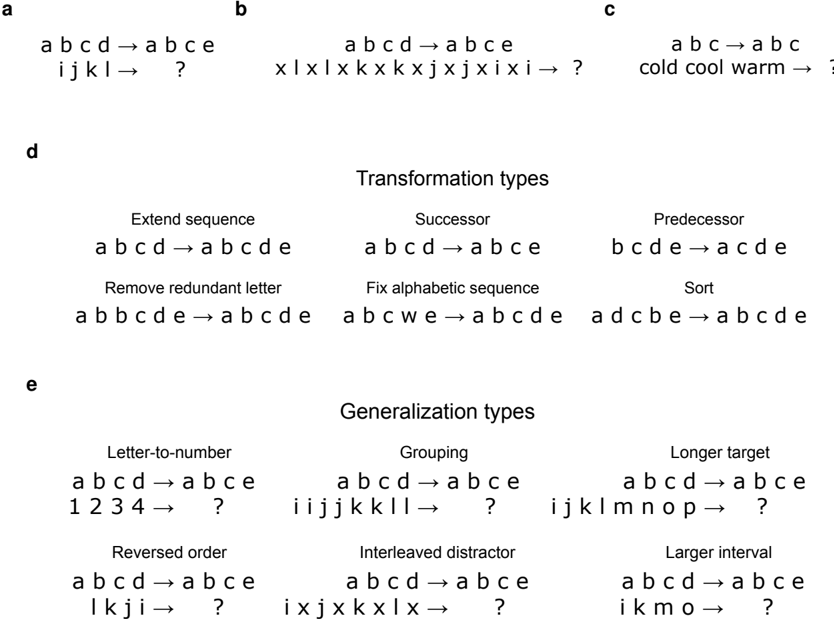
The image is a technical diagram illustrating various types of abstract sequence transformations and generalizations. It is divided into five labeled sections (a, b, c, d, e), each presenting examples of pattern-based reasoning tasks. The diagram uses simple alphabetic and word sequences to demonstrate how an initial sequence is transformed into a target sequence, with some examples posing a question (?) for the viewer to solve.
### Components/Axes
The diagram is organized into five distinct sections, each with a bold lowercase letter label in the top-left corner of its region:
- **Section a**: Top-left region.
- **Section b**: Top-center region.
- **Section c**: Top-right region.
- **Section d**: Middle region, titled "Transformation types".
- **Section e**: Bottom region, titled "Generalization types".
Each section contains one or more examples. Each example consists of:
1. An initial sequence (e.g., `a b c d`).
2. An arrow (`→`) indicating a transformation.
3. A target sequence (e.g., `a b c e`) or a question mark (`?`) indicating the problem to be solved.
### Detailed Analysis
#### Section a
- **Example 1**: `a b c d → a b c e`
- **Transformation**: The fourth element changes from `d` to `e`. This appears to be a "Successor" transformation (changing the last element to its alphabetical successor).
- **Example 2**: `i j k l → ?`
- **Transformation**: Applying the same logic as Example 1, the target would be `i j k m`.
#### Section b
- **Example 1**: `a b c d → a b c e` (Same as Section a, Example 1).
- **Example 2**: `x l x l x k x k x j x j x i x i → ?`
- **Transformation**: This is a complex, interleaved sequence. The pattern appears to be pairs of letters (`x l`, `x k`, `x j`, `x i`) where the second letter in each pair is decreasing alphabetically (`l, k, j, i`). The next pair would logically be `x h`. Therefore, the full target sequence would be `x l x l x k x k x j x j x i x i x h x h`.
#### Section c
- **Example 1**: `a b c → a b c`
- **Transformation**: The sequence remains unchanged. This could represent an "Identity" transformation or a case where no change is required.
- **Example 2**: `cold cool warm → ?`
- **Transformation**: This uses words instead of letters. The pattern is less clear. It may involve semantic relationships (e.g., temperature progression: cold → cool → warm) or a categorical shift. A possible answer could be `hot`, continuing the temperature trend.
#### Section d: Transformation types
This section explicitly names and illustrates six types of sequence transformations.
1. **Extend sequence**: `a b c d → a b c d e` (Adds the next element in sequence).
2. **Successor**: `a b c d → a b c e` (Changes the last element to its successor).
3. **Predecessor**: `b c d e → a c d e` (Changes the first element to its predecessor).
4. **Remove redundant letter**: `a b b c d e → a b c d e` (Removes a duplicate `b`).
5. **Fix alphabetic sequence**: `a b c w e → a b c d e` (Replaces `w` with the correct letter `d` to maintain alphabetical order).
6. **Sort**: `a d c b e → a b c d e` (Rearranges the elements into alphabetical order).
#### Section e: Generalization types
This section names and illustrates six types of generalizations, which apply the core transformation logic to new contexts.
1. **Letter-to-number**: `a b c d → a b c e` / `1 2 3 4 → ?` (Applies the "Successor" rule to numbers. Target: `1 2 3 5`).
2. **Grouping**: `a b c d → a b c e` / `i i j j k k l l → ?` (Applies the rule to grouped pairs. Target: `i i j j k k l l m m`).
3. **Longer target**: `a b c d → a b c e` / `i j k l m n o p → ?` (Applies the rule to a longer sequence. Target: `i j k l m n o q`).
4. **Reversed order**: `a b c d → a b c e` / `l k j i → ?` (Applies the rule to a reversed sequence. Target: `l k j h`).
5. **Interleaved distractor**: `a b c d → a b c e` / `i x j x k x l x → ?` (Applies the rule to a sequence with an interleaved distractor `x`. Target: `i x j x k x l x m x`).
6. **Larger interval**: `a b c d → a b c e` / `i k m o → ?` (Applies the rule to a sequence with a larger step interval. Target: `i k m q`).
### Key Observations
- The diagram progresses from simple, implicit examples (a, b, c) to explicitly categorized types (d, e).
- The core transformation in most examples is the "Successor" rule (changing the last element to the next in sequence), which is then generalized in various ways.
- Section `b` contains the most complex pattern, requiring the solver to identify an interleaved structure and a decreasing subsequence.
- Section `c` introduces a semantic/word-based example, suggesting the rules can apply beyond simple alphabetic sequences.
- The "Generalization types" in Section `e` demonstrate how a single abstract rule (like "Successor") can be tested across different domains (numbers, grouped items, reversed order, etc.).
### Interpretation
This diagram serves as a taxonomy or test bank for abstract reasoning tasks, likely used in cognitive science, artificial intelligence evaluation, or educational psychology. It deconstructs the process of pattern recognition into fundamental transformation operations (like successor, sort, remove redundancy) and then shows how these operations can be generalized to novel situations.
The underlying message is that intelligence involves not just recognizing a pattern in a specific instance, but also extracting the abstract rule governing that pattern and applying it flexibly to new contexts. The progression from `a` to `e` mirrors a learning or testing sequence: first encounter examples, then learn the named categories, and finally see how those categories apply to increasingly complex or varied problems. The presence of the question marks (`?`) frames the entire diagram as a series of problems to be solved, emphasizing its function as a tool for assessment or demonstration of reasoning capabilities.