## Diagram: Text Transformation and Generalization Types
### Overview
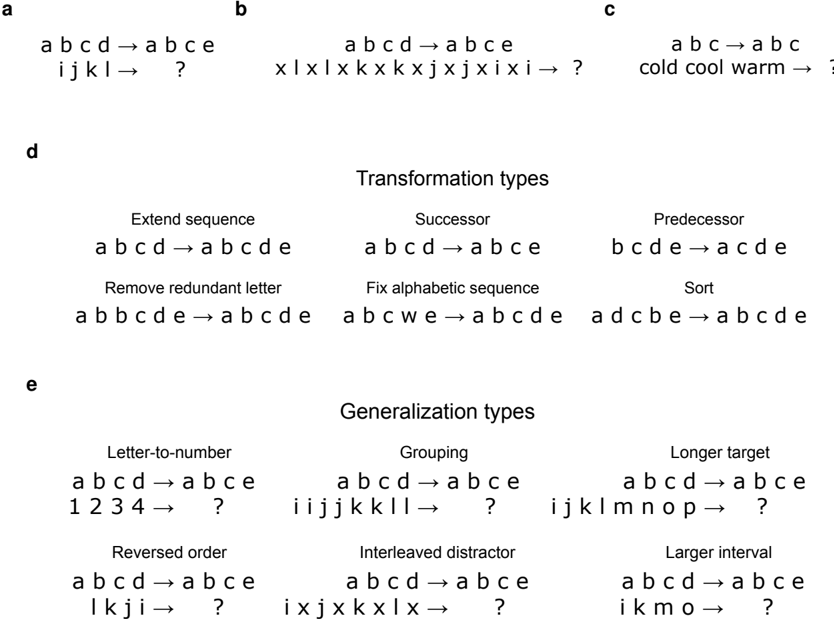
The image presents a structured diagram illustrating text transformation and generalization techniques. It is divided into labeled sections (a-e) with examples of transformations and generalization rules applied to sequences of letters, words, or numbers. The diagram emphasizes pattern recognition, sequence manipulation, and rule-based transformations.
### Components/Axes
- **Sections a-e**: Labeled regions containing specific transformation/generalization examples.
- **Transformation Types** (Section d):
- Extend sequence
- Successor
- Predecessor
- Remove redundant letter
- Fix alphabetic sequence
- Sort
- **Generalization Types** (Section e):
- Letter-to-number
- Grouping
- Longer target
- Reversed order
- Interleaved distractor
- Larger interval
### Detailed Analysis
#### Section a
- **Transformation**: `abcd → abce` (adds a letter)
- **Example**: `ijkl → ?` (pattern: replace last letter with next in alphabet)
#### Section b
- **Transformation**: `abcd → abce` (same as a)
- **Example**: `x l x l x k x k x j x j x i x i → ?` (pattern: alternating letters with incremental suffixes)
#### Section c
- **Transformation**: `abc → abc` (no change)
- **Example**: `cold cool warm → ?` (pattern: temperature progression)
#### Section d (Transformation Types)
1. **Extend sequence**: `abcd → abcde` (adds a letter)
2. **Successor**: `abcd → abce` (replaces last letter with next in alphabet)
3. **Predecessor**: `bcde → acde` (replaces first letter with previous in alphabet)
4. **Remove redundant letter**: `abbcde → abcde` (removes duplicate)
5. **Fix alphabetic sequence**: `abcwe → abcde` (corrects out-of-order letters)
6. **Sort**: `c b e → a b c d e` (alphabetizes letters)
#### Section e (Generalization Types)
1. **Letter-to-number**: `abcd → abce` (mapped to `1234 → ?`)
2. **Grouping**: `abcd → abce` (grouped letters `iijjjkklll → ?`)
3. **Longer target**: `abcd → abce` (extended to `ijklmnop → ?`)
4. **Reversed order**: `abcd → abce` (reversed `lkji → ?`)
5. **Interleaved distractor**: `abcd → abce` (interleaved `ixjxkxlx → ?`)
6. **Larger interval**: `abcd → abce` (spaced letters `ikmo → ?`)
### Key Observations
- **Pattern Consistency**: Most transformations involve incremental changes (e.g., adding/removing letters, fixing sequences).
- **Ambiguity in Examples**: Some examples (e.g., `ijkl → ?`, `lkji → ?`) lack explicit answers, suggesting open-ended rule application.
- **Hierarchical Structure**: Transformations (d) and generalizations (e) are distinct but overlapping categories.
### Interpretation
This diagram likely serves as a framework for natural language processing (NLP) or computational linguistics tasks, such as text normalization, sequence prediction, or rule-based text generation. The transformations focus on syntactic manipulation (e.g., sorting, removing redundancies), while generalizations involve semantic or structural adaptations (e.g., letter-to-number mapping, interleaving). The unresolved examples (`?`) imply that the system must infer rules dynamically, highlighting the importance of pattern recognition in automated text processing. The progression from simple letter sequences to complex word/number mappings suggests scalability for diverse linguistic tasks.