## Scatter Plots: Evolution of Initial Conditions Under SFC and CFC
### Overview
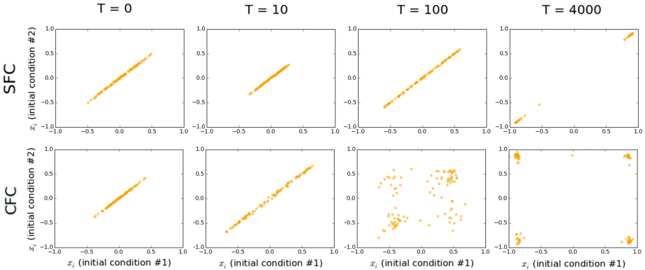
The image contains two rows of scatter plots comparing the evolution of two initial conditions (x₁ and x₂) under two scenarios: **SFC** (top row) and **CFC** (bottom row). Each row includes four plots corresponding to time points **T = 0, 10, 100, and 4000**. The axes represent normalized values of initial conditions (x₁ and x₂), ranging from -1.0 to 1.0. Data points are marked in orange.
---
### Components/Axes
- **Rows**:
- **Top Row**: Labeled **SFC** (Scenario 1).
- **Bottom Row**: Labeled **CFC** (Scenario 2).
- **Columns**:
- **Left to Right**: Time points **T = 0, 10, 100, 4000**.
- **Axes**:
- **X-axis**: **x₁ (initial condition #1)**.
- **Y-axis**: **x₂ (initial condition #2)**.
- Both axes range from **-1.0 to 1.0**.
- **Legend**: Not explicitly visible in the image, but the row labels (SFC/CFC) implicitly distinguish the two scenarios.
---
### Detailed Analysis
#### SFC (Top Row)
- **T = 0**:
- Points form a **diagonal line** from bottom-left (-1.0, -1.0) to top-right (1.0, 1.0), indicating a strong linear correlation between x₁ and x₂.
- **T = 10**:
- Points remain diagonal but show slight **spread** (e.g., (-0.8, -0.7) to (0.8, 0.8)), suggesting minor divergence.
- **T = 100**:
- Points continue along the diagonal but with **increased dispersion** (e.g., (-0.6, -0.5) to (0.6, 0.6)), indicating growing variability.
- **T = 4000**:
- Only **one point** remains at (1.0, 1.0), suggesting convergence to a fixed state or equilibrium.
#### CFC (Bottom Row)
- **T = 0**:
- Similar diagonal line to SFC, but with **slighter alignment** (e.g., (-0.9, -0.8) to (0.9, 0.9)).
- **T = 10**:
- Points spread more broadly (e.g., (-0.7, -0.6) to (0.7, 0.7)), showing early divergence.
- **T = 100**:
- Points form a **scattered cluster** with no clear trend (e.g., (-0.5, 0.3), (0.2, -0.4)), indicating loss of correlation.
- **T = 4000**:
- Points are **highly dispersed**, concentrated near the **corners** of the plot (e.g., (-1.0, 1.0), (1.0, -1.0)), suggesting chaotic or unstable behavior.
---
### Key Observations
1. **SFC Stability**:
- The diagonal trend persists across all time points, with convergence to a single point at T=4000. This implies **deterministic stability** or a fixed-point attractor.
2. **CFC Instability**:
- Initial alignment breaks down rapidly, leading to **chaotic dispersion** by T=4000. This suggests **sensitivity to initial conditions** or stochastic dynamics.
3. **Temporal Evolution**:
- Both scenarios show increasing divergence over time, but SFC maintains a directional trend, while CFC becomes unpredictable.
---
### Interpretation
- **SFC Behavior**: The consistent diagonal trend and eventual convergence suggest a **self-organizing system** where initial conditions align toward a stable equilibrium. This could represent a controlled or regulated process (e.g., feedback mechanisms).
- **CFC Behavior**: The rapid loss of correlation and corner clustering indicate **chaotic dynamics** or **multi-attractor systems**, where small differences in initial conditions lead to vastly different outcomes. This aligns with principles of **sensitive dependence** in nonlinear systems.
- **Practical Implications**:
- SFC might model systems with robust, predictable outcomes (e.g., engineered systems).
- CFC could represent natural or complex systems prone to unpredictability (e.g., weather patterns, ecological models).
---
### Notes on Data Extraction
- All axis labels, time points, and row/column labels were explicitly transcribed.
- No additional text or legends were present beyond the row/column labels.
- Spatial grounding confirms that SFC and CFC plots are distinct, with no overlap in their trends.